Languages
Sunday, October 18, 2026



News and Views from the Global South
Aid

Bangladesh Aims at Middle-Income Status by 2021
The environmental challenges facing Bangladesh, described by the United Nations as one of the world’s “least developed countries” (LDCs), are monumental, including recurrent cyclones, perennial floods, widespread riverbank erosion and a potential sea level rise predicted to put about 27 million people at risk over the next two decades.
Civil Society Summit Calls for International Action on Climate Migration
Civil society leaders from more than 100 countries called for action on climate-induced displacement at a summit in Suva, Fiji last week.
The Protracted Refugee and Migrant Crisis: A Challenge to Multilateralism
It is an incontrovertible fact that more people are on the move owing to globalization. Fifteen percent of the world’s population are on the move worldwide. In other words, of the world population of 7 billion, one billion are on the move. Seven hundred and forty million people are referred to as internal or as domestic migrants within their countries of origin. The number of internally displaced persons reaches about 60 million. On top of this, the world has more than 244 million international migrants who cross borders often into the unknown. Lastly, there are 22.5 million refugees – encompassing the 5.3 million Palestinian refugees – registered by the United Nations High Commissioner for Refugees who have been forced to flee their home societies as a result of violence and armed conflict. The first two decades of the 21st century will go down in history as the era in which the world has witnessed the most complex and massive movement of people since the end of the Second World War.
For Freedom from Poverty, Universal Health Coverage Is a Must
Today is 12 December 2017 is an auspicious day, as it marks Kenya’s independence from colonial rule in 1963. Today is also Universal Health Coverage Day. It is the anniversary of the first unanimous United Nations resolution calling for countries to provide affordable, quality health care to every person, everywhere.
Are Value Chains a Pathway to Nutrition in Sub-Saharan Africa?
Although difficult to ascertain whether it is a trend reversal, two recent FAO reports (2017a, b) show a rise in hunger globally as well as in Africa. The number of undernourished (NoU) in the world suffering from chronic food deprivation began to rise in 2014 –from 775 million people to 777 million in 2015 – and is now estimated to have increased further, to 815 million in 2016. The stagnation of the global average of the proportion of undernourished (PoU) from 2013 to 2015 is the result of two offsetting changes at the regional level: in Sub-Saharan Africa, the share of undernourished people increased, while there was a continued decline in Asia in the same period. However, in 2016, the PoU increased in most regions except Northern Africa, Southern Asia, Eastern Asia, Central America and the Caribbean. The deterioration was most severe in Sub-Saharan Africa and South-Eastern Asia (FAO 2017a,b).
Rohingya Refugees: The Woes of Women (Part Two)
Under pouring rain, hundreds of young and expectant mothers stand in line. With her bare feet and the bottom of her dress covered in mud, Rashida is one of them, clutching her emaciated infant. She lost her husband on the treacherous trek from Myanmar to Bangladesh, and with nowhere to go and her resources exhausted, rain-drenched and standing in this long, muddy line for food and medicine for her child is her only hope.
Rohingya Refugees: The Woes of Women – Part One
Afia* lines up her bucket every morning in the refugee camp for water delivery from humanitarian relief workers. On one particularly sweltering day, she kept four water pitchers in a row with gaps between them, hoping to insert another empty container in the space when the water arrived.
Rohingya Exodus Is a “Major Global Humanitarian Emergency”
In less than four months, over 600,000 Rohingya refugees have fled brutal persecution in Myanmar to seek safety across the border in Bangladesh. They are now crowded into camps across a stretch of 30 kms in Cox's Bazar, a southeastern coastal region of the small South Asian nation.
“Will Civil Society & Democracy in India Rise to the Existential Challenges They Face?”
A cursory glance at international funding of the social sector in India reveals that it has grown at over 25% annually over the past three years.
Rohingya Refugees Face Fresh Ordeal in Crowded Camps
Mariam Akhtar, 23, is desperately searching for her young daughter two weeks after arriving from Myanmar in Cox’s Bazar, a southeastern coastal district in Bangladesh.
Civil Society Week Puts Spotlight on the Pacific
It's a busy week for movers, shakers and policymakers attending a global gathering of civil society activists here in Fiji. For the first time, the International Civil Society Week (ICSW) is holding its sessions in the Pacific. It's a sign of a growing awareness of the problems facing these remote islands – problems they cannot be ignored any longer.
Empowering Women Improves Communities, Ensures Success for Generations
At an event held on October 29 at the International Fund for Agricultural Development (IFAD) Gender Awards 2017, five countries were honored for impressive achievements in gender equality and women’s empowerment despite harsh conditions and numerous daunting situational and societal obstacles. The five countries are Bangladesh, Mozambique, Colombia, Morocco, and Mauritania. The IFAD supported projects in these countries have ambitious goals for a more egalitarian future. To date these projects have successfully provided women with decision-making opportunities, skill training, and increased autonomy through the development of their own livelihoods.
Are Rising Attacks On Human Rights Defenders The ‘New Normal’?
At CIVICUS, a global civil society alliance working to strengthen citizen participation, we receive bad news of attacks on compatriots every day.
UN Makes Record Appeal for Humanitarian Aid in 2018
The UN has made its largest appeal to work towards reaching the more than 135 million people across the world in need of humanitarian assistance and protection.
‘Sparks of Hope’ in a Time of Fear
Out of 300 nominations from across the globe, just four have won an innovation award for their commitment to human rights. Now in its 12th year, the Nelson Mandala-Graça Machel Innovation Awards seeks to celebrate and promote diverse individuals and organizations for their excellence and bravery in creating social change.
“Every Day Is a Nightmare”
Parul Akhtar,* a Rohingya woman in her mid-twenties, may never wish to remember the homeland she and her children left about three weeks ago.
Combating Climate Change? Combat Land Degradation, Says UNCCD Chief
Land restoration is not a “glamorous subject even when you give all the numbers,” admits Monique Barbut, the Executive Secretary of United Nations Convention to Combat Desertification UNCCD). But she also stresses that by 2050, the world population will reach 10 billion. To feed that extra 2.4 billion, current food production would need to be increased by 75 percent.
Financing Will Continue to be Key Issue in Battling Climate Change
“The Bonn climate talks were foundational, paving the way to finalize the rules that underpin the Paris Agreement next year and setting the stage for countries to commit to enhance their national climate plans by 2020. On both counts, the climate talks in Bonn were a success. However, negotiators have plenty of homework to do to get there.
Climate Change is Already Upon us & Will Only Worsen in Short Term
It is fitting that this year’s conference of parties (on climate change, COP 23) is led by Fiji, a nation on the frontlines. Last month I visited other small islands facing the impacts of a warming world: Antigua and Barbuda and Dominica. The hurricane damage was beyond belief. The catastrophic effects of climate change are upon us. Floods, fires, extreme storms and drought are growing in intensity and frequency.
On Gender Day at Climate Meet, Some Progress, Many Hurdles
“Five years ago, when we first started talking about including gender in the negotiations, the parties asked us, ‘Why gender?’ Today, they are asking, ‘How do we include gender?’ That’s the progress we have seen since Doha,” said Kalyani Raj.
The Harsh Plight of 152 Million Child Labourers
While trillions of dollars are being spent on exploring remote galaxies, Planet Earth is still home to harsh realities that could be easily –and much less expensively—resolved. One of them is that worldwide 152 million children are currently victims of child labour.« Previous Page — Next Page »





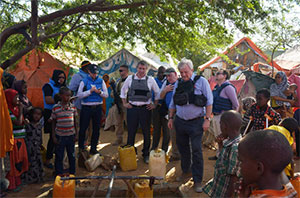 UN Emergency Relief Coordinator Visits Somalia. Credit: UN Photo/Tobin Jones
In recent years, conflicts have broken out across the world with no sign of slowing down or stopping. In times like this, millions of people globally are in dire need of humanitarian aid. Famine, warfare, natural disasters, and economic decline plague a host of nations, including Palestine, Sudan, Chad, Lebanon, and Haiti, to name a few. Humanitarian aid provides millions of people with critical services including healthcare, food, clean drinking water, psychosocial support, housing, and access to education. UN agencies such as the UNDP, UNICEF, the World Food Programme (WFP), UNHCR, UNRWA, and UNEP work with the UN Office for the Coordination of Humanitarian Aid (OCHA) and local organizations to come up with the best possible strategies to support affected communities. At the same time, humanitarian aid and those working on the frontlines are consistently threatened by both actors directly involved in conflict as well as those who are meant to contribute to the international humanitarian regime at large. The near-collapse of United States international aid structures in 2025, including the termination of 83% of USAID’s 6,300 global initiatives, has left millions of people without access to vital humanitarian assistance. 98 million people in 2025, only 65% of people targeted for humanitarian assistance, received the help they needed. In contrast, 123 million people received some form of humanitarian assistance in 2024, and OCHA’s 2026 Global Humanitarian Overview estimates that 239 million people are in need of assistance in 2026. IPS is well-positioned to discuss current initiatives to provide aid and relief through in-depth reporting and opinion content.

The Week with IPS

NEXT STOP - SDGs
Tracking global progress towards a sustainable world
Tracking global progress towards a sustainable world
