Languages
Saturday, October 17, 2026



News and Views from the Global South
Aid

Aid Groups Sound Alarm on DRC Crisis
The Democratic Republic of the Congo (DRC) is on the brink of a humanitarian crisis and the international community must step in before it worsens, humanitarian agencies warn.
Aid Groups Condemn Yemen Blockade, Warn of ‘Catastrophic’ Famine
If aid deliveries are not resumed, Yemen will experience the worst famine the world has seen in recent decades.
Conservation Agriculture: Zambia’s Double-edged Sword against Climate Change and Hunger
As governments gather in Bonn, Germany for the next two weeks to hammer out a blueprint for implementation of the global climate change treaty signed in Paris in 2015, a major focus will be on emissions reductions to keep the global average temperature increase to well below 2°C by 2020.
Women and Malnutrition in Africa
Undernutrition is widespread and a key reason for poor child health in many developing countries. In Sub-Saharan Africa, around 40 percent of children under the age of five suffer from stunted growth, that is, severely reduced height-for-age relative to their growth potential. Stunting is a result of periods of undernutrition in early childhood, and it has been found to have a series of adverse long-term effects in those who survive childhood. It is negatively associated with mental development, human capital accumulation, adult health, and with economic productivity and income levels in adulthood.
Impending Drought? There’s an App for That – Or Should Be
Fostering and harnessing innovative technologies could significantly reduce the negative impacts from climate change, including drought, water scarcity and food insecurity in African countries.
Stopping Child Marriage Forever
The mother moved in like a tigress to save her cub. In 2015, when her 13-year-old daughter Shumi Akhter was about to be married off, Panna Begum pleaded with her husband, Dulal Mia, to cancel the marriage he’d arranged for their daughter.
Deliberate Famine Should Be a War Crime, UN Expert Says
The deliberate starvation of civilians could amount to a war crime and should be prosecuted, said an independent UN human rights expert.
Let’s Harness the Egalitarian Spirit of Sport for Global Cohesion
24 October has been celebrated as United Nations Day since 1948. In his message to the world the UN Secretary General, Mr Antonio Guterres remarked, “When we achieve human rights and human dignity for all people – they will build a peaceful, sustainable and just world”.
Lack of International Action on Rohingya Crisis Called a “Disgrace”
As the crisis in Myanmar reaches unprecedented levels, frustration is at its peak as the international community remains slow to respond and act cohesively.
Innovation for Climate-Smart Agriculture Key to Ending Hunger in Kenya
Some parts of Kenya are reeling from the effects of probably the worst drought in the last 20 years. With nearly 3.4 million people food insecure, Kenya’s food security prognosis looks gloomy, with climate change and natural resource depletion set to pose even greater risks in the long term.
An Inequality Beyond Wealth: Gaps in Women’s Health
While many often focus on wealth disparities, economic inequality is often a symptom and cause of other inequalities including women’s access to sexual and reproductive health.
Peace and stability must be restored in the Middle East and North Africa so as to alleviate poverty
On the occasion of the 2017 International Day for the Eradication of Poverty, the Chairman of the Geneva Centre for Human Rights Advancement and Global Dialogue H. E. Dr. Hanif Hassan Ali Al Qassim observed that the unprecedented rise of violence and insecurity in the Arab region combined, breed poverty and societal decline.
Driven to Extremes–How Poverty Fuels Extremism, and How to Help Africa’s Youth
Poverty is a blight, and one that disproportionately affects sub-Saharan Africa. It is a vast and complex issue whose tentacles reach into many areas, including climate change, sustainable development and–crucially–global security. The link between poverty and violent extremism is compelling, and means that if we want to address extremism, we must fight inequality too.
International Day of Rural Women
On this International Day of Rural Women, the world celebrates women and girls in rural areas and the critical role they play in enhancing agricultural and rural development, improving food security and eradicating rural poverty.
After 13 Years, UN Peacekeeping Mission Closes Doors in Haiti
The UN peacekeeping mission ended its operations in the Caribbean nation of Haiti after 13 years on October 15. The UN Stabilization Mission in Haiti (MINUSTAH), which aimed to bring stability to a politically chaotic Haiti of 2004, will transfer power to the UN Mission for Justice Support in Haiti (MINUJUSTH), a much smaller successor mission that is going to assist the government on security issues.
Can the Kenyan Lion Kick High Enough to Be the South Korean Tiger of Africa?
In 1953 South Korea emerged from the ravages of a debilitating war, yet the total gross domestic product in nominal terms has surged 31,000 fold since 1953.
Land Settlement Empowers: Bangladesh Sets an Example
History was made for 400 landless families in the remote char lands of Noakhali district. On 4th October, they all received land titles from the government for which they had waited for over two decades. In Bangladesh, as in other countries, the title is a permanent legal ownership document.
Rohingya Refugee Women Bring Stories of Unspeakable Violence
Yasmin, 26, holds her 10-day-old baby, who she gave birth to in a crowded refugee camp in Cox’s Bazar, a southeastern district bordering Myanmar.
Why American Overseas Aid Should Focus on SDGs?
The average American believes the US spends a whopping third of its federal budget on foreign aid. Consequently, a majority of people think that too much is spent on foreign aid. That is one reason US President Donald J. Trump, who has campaigned on putting the needs of Americans first, has proposed deep cuts to foreign aid in his 2018 budget.
Non-violence and lasting peace are key to secure the long-term stability of the Arab region
The Chairman of the Geneva Centre Dr. Hanif Hassan Ali Al Qassim is calling on the international community to address the surge of extremist violence exacerbating the volatile security situation in the Arab region. This appeal was made by Dr. Al Qassim in relation to the commemoration of the 2017 International Day of Non-Violence observed on 2 October 2017.
Falling off the health-care radar
Care for the elderly needs to be better targeted by the health system and social networks. The National Health Policy (NHP), 2017 is unable to see the wood for the trees. Life and death questions are dealt with perfunctorily or simply overlooked. For example, it overlooks the rapid rise in the share of the old (60 years or more), and associated morbidities, especially sharply rising non-communicable diseases (NCDs) and disabilities. With rising age, numerous physiological changes occur and the risk of chronic diseases rises. The co-occurrence of chronic diseases and disability elevates the risk of mortality.« Previous Page — Next Page »





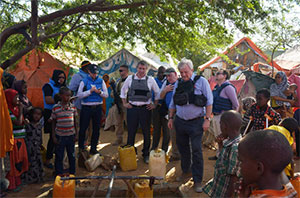 UN Emergency Relief Coordinator Visits Somalia. Credit: UN Photo/Tobin Jones
In recent years, conflicts have broken out across the world with no sign of slowing down or stopping. In times like this, millions of people globally are in dire need of humanitarian aid. Famine, warfare, natural disasters, and economic decline plague a host of nations, including Palestine, Sudan, Chad, Lebanon, and Haiti, to name a few. Humanitarian aid provides millions of people with critical services including healthcare, food, clean drinking water, psychosocial support, housing, and access to education. UN agencies such as the UNDP, UNICEF, the World Food Programme (WFP), UNHCR, UNRWA, and UNEP work with the UN Office for the Coordination of Humanitarian Aid (OCHA) and local organizations to come up with the best possible strategies to support affected communities. At the same time, humanitarian aid and those working on the frontlines are consistently threatened by both actors directly involved in conflict as well as those who are meant to contribute to the international humanitarian regime at large. The near-collapse of United States international aid structures in 2025, including the termination of 83% of USAID’s 6,300 global initiatives, has left millions of people without access to vital humanitarian assistance. 98 million people in 2025, only 65% of people targeted for humanitarian assistance, received the help they needed. In contrast, 123 million people received some form of humanitarian assistance in 2024, and OCHA’s 2026 Global Humanitarian Overview estimates that 239 million people are in need of assistance in 2026. IPS is well-positioned to discuss current initiatives to provide aid and relief through in-depth reporting and opinion content.

The Week with IPS

NEXT STOP - SDGs
Tracking global progress towards a sustainable world
Tracking global progress towards a sustainable world
