Languages
Saturday, October 17, 2026



News and Views from the Global South
Aid

Gov’t Actions, Not Religion, ‘Tipping Point’ for African Youths Joining Violent Extremism
Government action, rather than religious ideology, is a stronger predictor for radicalization in Africa, according to a two-year landmark study by the United Nations Development Programme (UNDP).
Monitoring Progress on UN’s Sustainable Development Goals
Two years ago, world leaders joined together to endorse a new and ambitious agenda not to reduce poverty but to eradicate it, not to lessen hunger but to end it once and for all, and not to overlook inequality but jointly to attack it.
International Response to the Mexico Earthquake
Until this week, it had been 32 years since Mexico City suffered its last major earthquake. That was of 8.0 magnitude, which was approximately tenfold greater than Tuesday’s 7.1 magnitude. Over 5000 people died, and outside assistance was offered and received.
A Trump Doctrine of Hypocrisy
In his first address on the global stage of the General Assembly, United States’ President Donald Trump touted an “America First” approach at the very institution that is meant to inspire collaboration between nations.
Macron Defends Globalist Approach at UN General Assembly
French President Emmanuel Macron delivered a sombre speech at the United Nations General Assembly yesterday, denouncing Myanmar’s “ethnic cleansing,” and calling for better protection of refugees in the world.
Latest Major Hurricane Leaves Dominica “Devastated”
As Hurricane Maria continues to barrel its way across the Caribbean, details are slowly emerging of the number of deaths and the extent of the devastation left in its wake in Dominica.
Bangladesh Needs to Shore up Its Flood Defence
Bangladesh is a disaster-prone country with floods hitting almost every year, leaving a trail of destruction despite having early warning systems. Now experts say it is time for the delta nation to think more seriously about how to deal with the recurring onslaughts of floods more effectively by strengthening its flood defence.
“We are a World in Pieces”
I am here in a spirit of gratitude and humility for the trust you have placed in me to serve the world’s peoples. “We the peoples”, and our United Nations, face grave challenges. Our world is in trouble. People are hurting and angry. They see insecurity rising, inequality growing, conflict spreading and climate changing.
Out of Africa: Understanding Economic Refugees
Not a single month has passed without dreadful disasters triggering desperate migrants to seek refuge in Europe. According to the International Organization for Migration (IOM), at least 2,247 people have died or are missing after trying to enter Europe via Spain, Italy or Greece in the first half of this year. Last year, 5,096 deaths were recorded.
Rohingya: A Trail of Misfortune
Forsaken and driven out by their home country Myanmar, tens of thousands of Rohingyas are struggling to survive in Bangladesh’s border districts amid scarcities of food, clean water and medical care, mostly for children and elderly people.
Why Aung San Suu Kyi Chooses Silence
On 23rd August, just days before thousands of Rohingyas began fleeing their homes from Rakhine State, Aung San Suu Kyi’s recently appointed Rakhine Advisory Commission, established in 2016, submitted its final report. The engaging of an independent Commission, tasked with recommending newer ways of improving the lives of Rohingya Muslims, Myanmar’s most deeply persecuted minority group, carried some weight of diplomacy.
At Key Finance Meet, Mongolia Seeks Path to a Greener Economy
Rapid growth of a coal-fired economy often leads to environmental degradation, and Mongolia is a case in point.
Dear Nobel Laureate, 19 September is 144 hours too late
Dear Nobel Laureate Aung San Suu Kyi, We learned today that you will address the Rohingya issue via television in Myanmar on 19 September - over 144 hours from now.

Myanmar Rohingya Face “Textbook Example of Ethnic Cleansing”
As hundreds of thousands of Rohingya Muslims flee violence in Myanmar’s Rakhine State, thousands that remain in the country face mass atrocities at a scale never seen before.
Dear Nobel Laureate Aung San Suu Kyi,
When you were finally able to accept your Nobel Peace Prize, you spoke eloquently of the ultimate aim of a world in which “every corner is a true sanctuary where the inhabitants will have the freedom and the capacity to live in peace.”
Floods, Hurricanes, Droughts… When Climate Sets the Agenda
When officials and experts from all over the world started the first-ever environmental summit hosted by China, they were already aware that climate and weather-related disasters were already seriously beginning to set the international agenda – unprecedented floods in South Asia, strongest ever hurricanes Harvey and Irma, and catastrophic droughts striking the Horn of Africa, among the most impacting recent events.
Refugee Camps “bursting at the seams” in Bangladesh
A dramatic increase in the number of refugees fleeing Myanmar is placing a huge strain on already very limited resources in Bangladesh, the UN refugee agency (UNHCR) said.
How Aid in Cash, Not Goods, Averted a Famine in Somalia
In February, when the government of Somalia sounded an alarm to the UN about risks of a famine in the country, the UN’s Office of Coordination of Humanitarian Affairs (OCHA), besides quickly shuffling a response team, was acting from a steep sense of history. The Office, instead of sending out massive aid packages, distributed cash vouchers to families who could spend it to buy goods according to their needs.
Cholera in North-Eastern Nigeria: An Endemic Outbreak
A recent cholera outbreak in North-Eastern Nigeria has resulted in at least 186 suspected cases and 14 deaths as of Sep. 1, according to Borno State’s Ministry of Health.
Ethiopia’s Internally Displaced Overlooked Amid Refugee Crises
Grasping its limp leg, a woman drags the carcass of one of her few remaining black-headed sheep away from her family’s domed shelter fashioned out of sticks and fabric that stands alone amid the desiccated scrubland a few kilometers from the town of Dolo Odo in the southeast of Ethiopia near the border with Somalia.
What Charities and Relief organizations do to alleviate poverty in the Arab region
Extreme poverty remains one of the world’s biggest challenges. According to the United Nations, 767 million people live in extreme poverty around the world. Although world society has managed to lift nearly 1 billion people out of extreme poverty – in 1999 it was estimated that 1.7 billion were affected by extreme poverty – the unprecedented rise of conflict and of violence in the Arab region has worsened the socioeconomic situation of vulnerable population segments in many countries. On 22 February 2017, the Under-Secretary-General for Humanitarian Affairs and Emergency Relief Coordinator of the United Nations –Stephen O’Brien – stated to the United Nations Security Council that 67% of the population in Syria is living under conditions considered as extreme poverty. In another Arab country affected by war and conflict – Yemen – the World Bank estimates that poverty affects 62% of the population, whereas the World Bank’s estimates this number to be at approximately 22% for Iraq or even as high as 40% in territories controlled by DAESH. Inevitably, conflict and violence have worsened the situation in the Arab region.« Previous Page — Next Page »





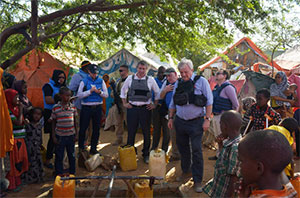 UN Emergency Relief Coordinator Visits Somalia. Credit: UN Photo/Tobin Jones
In recent years, conflicts have broken out across the world with no sign of slowing down or stopping. In times like this, millions of people globally are in dire need of humanitarian aid. Famine, warfare, natural disasters, and economic decline plague a host of nations, including Palestine, Sudan, Chad, Lebanon, and Haiti, to name a few. Humanitarian aid provides millions of people with critical services including healthcare, food, clean drinking water, psychosocial support, housing, and access to education. UN agencies such as the UNDP, UNICEF, the World Food Programme (WFP), UNHCR, UNRWA, and UNEP work with the UN Office for the Coordination of Humanitarian Aid (OCHA) and local organizations to come up with the best possible strategies to support affected communities. At the same time, humanitarian aid and those working on the frontlines are consistently threatened by both actors directly involved in conflict as well as those who are meant to contribute to the international humanitarian regime at large. The near-collapse of United States international aid structures in 2025, including the termination of 83% of USAID’s 6,300 global initiatives, has left millions of people without access to vital humanitarian assistance. 98 million people in 2025, only 65% of people targeted for humanitarian assistance, received the help they needed. In contrast, 123 million people received some form of humanitarian assistance in 2024, and OCHA’s 2026 Global Humanitarian Overview estimates that 239 million people are in need of assistance in 2026. IPS is well-positioned to discuss current initiatives to provide aid and relief through in-depth reporting and opinion content.

The Week with IPS

NEXT STOP - SDGs
Tracking global progress towards a sustainable world
Tracking global progress towards a sustainable world
