Languages
Friday, October 16, 2026



News and Views from the Global South
Aid

Small Entrepreneurs Emerge as Backbone of Bangladesh’s Rural Economy
She was born in the early 1950’s to an ultra-poor family in Kundihar, a remote village of Banaripara of Barisal division in Bangladesh. She was a beautiful baby and her father named her ‘Shahndah Rani’ which means ‘Queen of Evenings’. But in reality her life was far from that of a queen.
On Climate Finance, “The SIDS Can’t Wait”
 Saint Lucia's Prime Minister Allen Chastanet warns that the clock is running out for small states such as those in the Caribbean as they struggle to develop infrastructure capable of withstanding changes in weather conditions - and that wealthier nations need to step up levels of aid.
Global Warming Puts Asia’s Vital Yields at High Risk
While mainstream media have been widely reporting on the dramatic consequences of tropical storm Harvey in the United States, which has been characterised as the fiercest hurricane to hit this country in over a decade, global warming is expected to have a significant impact on “future yields of everything from rice to fish, particularly in countries situated closer to the equator,” the United Nations warned.
St. Lucia’s PM on Climate Change: “Time Is Against Us”
A Caribbean Community (CARICOM) prime minister has reiterated the call for developed countries to assist Small Island Developing States (SIDS) in their quest to combat the effects of climate change.
Building Climate Resilience in Coastal Communities of the Caribbean
Ceylon Clayton is trying to revive a sea moss growing project he and friends started a few years ago to supplement their dwindling earnings as fishermen.
Buffalo Revive Local Economy in Remote Bay of Bengal Islands
Visitors might be confused after arriving in Char Chatkimarai, a tiny island of eight square miles situated in the extreme south of Bangladesh close to the Bay of Bengal. Many might think they have just landed in an amazing part of a big national park of buffalo.
South Asia Faces Fury of Floods
Aid agencies warn of a serious unfolding humanitarian crisis as floodwaters continue to inundate new areas of three South Asian countries, forcing millions of people to flee their homes for shelters.
Women Build Rural Infrastructure in Bangladesh
Breaking all the social barriers and taboos, poor women in Bangladesh are now engaged in rural development works across the country as labourers.
Promise or Peril? Africa’s 830 Million Young People by 2050
Last month, Spanish charity workers rescued 167 migrants arriving from Africa aboard a small boat.
Jordan Makes Strides Toward Inclusive Green Economy
Jordan may be one of the smallest economies in the Middle East, but it has high ambitions for inclusive green growth and sustainable development despite the fact that it lies in the heart of a region that has been long plagued with wars and other troubles, says the Director-General of the Global Green Growth Institute (GGGI) Dr. Frank Rijsberman.
Why Breastfeeding Is One of the “Smartest Investments” for All Countries
The United Nations Children’s Fund (UNICEF) has released new findings on the economic gains—besides the obvious health benefits—of breastfeeding.
World Still Lagging on Indigenous Rights 10 Years After Historic Declaration, UN Experts Warn
The world’s indigenous peoples still face huge challenges a decade after the adoption of an historic declaration on their rights, a group of United Nations experts and specialist bodies has warned. Speaking ahead of the International Day of the World’s Indigenous Peoples on 9 August, the group says States must put words into action to end discrimination, exclusion and lack of protection illustrated by the worsening murder rate of human rights defenders.
Zaatari Camp Marks Fifth Year With 80,000 Refugees
Jordan’s Zaatari camp, which opened in 2012 as a makeshift camp to house Syrian refugees fleeing the war, marked its fifth year on June 28.
Has Disability Risen among the Elderly?
The Rights of Persons with Disabilities Act 2016 (or RPD Act) is laudable in its intent and procedural detail, but mostly silent on disabilities among the elderly. Indeed, for this reason alone, it is arguable that its overarching goal—“The appropriate Government shall ensure that the persons with disabilities enjoy the right to equality, life with dignity and respect for his or her integrity equally with others” —is mere rhetoric, if not a pipe dream.
Central America Fights Climate Change with Minimal Foreign Aid
Despite the fact that Central America is one of the regions most vulnerable to climate change, it has half-empty coffers when it comes to funding efforts against the phenomenon, in part because it receives mere crumbs in foreign aid to face the impacts of the rise in temperatures.
Last Mile Connectivity to Bangladesh’s Impoverished North
Life for Bangladesh’s rural people, particularly in its remote north, is still miserable. Seasonal flooding, river erosion, and the low quality of rural infrastructure and lack of connectivity have made things harder for poor northerners.
“The Time is Now” to Invest in Youth, Girls
The demographic dividend: though not a new concept, it is one of the major buzzwords at the UN this year. But what does it really mean? There are 1.8 billion young people between the ages of 10 and 24 around the world, the most in the history of humankind.
Yemen Records 400,000 Cholera Cases
The directors of the UN Children’s Fund (UNICEF), World Food Programme (WFP) and World Health Organization (WHO) released a joint statement today shedding light on a deadly cholera epidemic engulfing war-torn Yemen.
Migrant Contributions to Development: Creating a “New Positive Narrative”
Despite the “undeniable” benefits of migration, barriers including public misconceptions continue to hinder positive development outcomes, participants said during a series of thematic consultations here on safe, orderly, and regular migration.
Nigeria’s Ticking Time Bomb
In the dusty arid town of Dikwa, tens of thousands of Nigerians queue for hours in sweltering 40-degree heat for water. Fatuma is one of 100,000 people displaced in the Borno State town, the epicentre of Nigeria’s conflict. She sifts through remnants of food aid seeds, drying them out to prepare them to eat. Food is a scarcity here. Fatuma used to live on three meals a day. Today she is happy if aid agencies can provide her with a single meal.
No Justice, No Peace for Yemeni Children
Human rights groups are urging the UN Secretary-General to include the Saudi-led Coalition (SLC) in a child rights’ “shame list” after documenting grave violations against children.« Previous Page — Next Page »





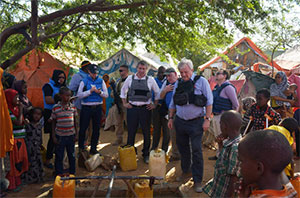 UN Emergency Relief Coordinator Visits Somalia. Credit: UN Photo/Tobin Jones
In recent years, conflicts have broken out across the world with no sign of slowing down or stopping. In times like this, millions of people globally are in dire need of humanitarian aid. Famine, warfare, natural disasters, and economic decline plague a host of nations, including Palestine, Sudan, Chad, Lebanon, and Haiti, to name a few. Humanitarian aid provides millions of people with critical services including healthcare, food, clean drinking water, psychosocial support, housing, and access to education. UN agencies such as the UNDP, UNICEF, the World Food Programme (WFP), UNHCR, UNRWA, and UNEP work with the UN Office for the Coordination of Humanitarian Aid (OCHA) and local organizations to come up with the best possible strategies to support affected communities. At the same time, humanitarian aid and those working on the frontlines are consistently threatened by both actors directly involved in conflict as well as those who are meant to contribute to the international humanitarian regime at large. The near-collapse of United States international aid structures in 2025, including the termination of 83% of USAID’s 6,300 global initiatives, has left millions of people without access to vital humanitarian assistance. 98 million people in 2025, only 65% of people targeted for humanitarian assistance, received the help they needed. In contrast, 123 million people received some form of humanitarian assistance in 2024, and OCHA’s 2026 Global Humanitarian Overview estimates that 239 million people are in need of assistance in 2026. IPS is well-positioned to discuss current initiatives to provide aid and relief through in-depth reporting and opinion content.

The Week with IPS

NEXT STOP - SDGs
Tracking global progress towards a sustainable world
Tracking global progress towards a sustainable world
