Languages
Friday, October 16, 2026



News and Views from the Global South
Aid

WHO Urges Govt’s to Raise Taxes on Tobacco
Seven million people die each year from tobacco-related deaths, according to a new report published by the World Health Organisation today.
Educating Children One Radio Wave at a Time
Nigeria’s conflict has displaced more than a million children, leaving them without access to education. However, an innovative radio program aims to transform this bleak scenario.
Promoting Sustainable Population Growth, Key to Raising Human Rights Standards
The world population has witnessed a remarkable growth during the recent decades. In 1965, it stood at 3.3 billion people. In 2017 –52 years later-- the global population reached a staggering 7.5 billion people corresponding to more than a doubling of the Earth’s residents over the last half-century.
An African Atlas for Youth and Sustainable Development
As its population changes, Africa has the potential to transform its society into one that is productive and prosperous, according to a new report.
Funding Climate Resilience Benefits All Nations – Yes, the U.S. Too
A leading climate change mitigation and adaptation activist and former climate negotiator in the Caribbean says that the United States could protect its economic and political interest by helping the region to go green.
Caribbean Seeks to Climate-Proof Tourism Industry
The tourism industry is the key economic driver and largest provider of jobs in the Caribbean after the public sector. Caribbean tourism broke new ground in 2016, surpassing 29 million arrivals for the first time and once again growing faster than the global average.
Insurance: A Valuable Incentive for Small Farmers’ Climate Resilience
Frequent extreme weather and climate shifts pose a challenge to already vulnerable groups such as smallholder farmers in the developing world. Between 2004 and 2014, farmers are said to have endured the brunt of the 100-billion-dollar cost of climate-related disasters.
More Bang for Your Buck: Saving Lives by Investing in the Poorest
Investing in the health of the poorest communities saves almost twice as many lives, according to a UN agency’s analysis.
The High Cost of Ageing
Evidence shows that health systems must be recast to accommodate the needs of chronic disease prevention.
UN Response Teams Underfunded as Costs Hit Staggering $23.5 Billion
UN response teams that help the most vulnerable people in the world are still largely underfunded, a new status report has revealed. The funding available to the teams is no match for the record number of people—141 million—who need assistance today.
No Wall for Ethiopia, Rather an Open Door—Even for Its Enemy
It’s one thing to read about the exodus of souls flowing out of Eritrea, it’s quite another to look into the tired eyes, surrounded by dust and grime, of a 14-year-old Eritrean girl who’s just arrived on the Ethiopian side of the shared border.
Children Now More Than Half of the 65 Million Displaced
Around 20 people are newly displaced every minute of the day, according to a new report. In its annual Global Trends report, the UN’s refugee agency UNHCR has recorded unprecedented and concerning levels of displacement around the world.
The World Society Needs to Express Greater Solidarity for Refugees Worldwide
The world is heading into troubled waters as we are witnessing an unprecedented movement of people – refugees, migrants and internally displaced persons (IDPs) alike – fleeing from misery, poverty and conflicts. The refugee crisis that has swept across Europe and the Middle East is becoming the 21st century’s most protracted crisis with no immediate solution in sight. The world has not witnessed a more complex movement of people since the end of the Second World War; thousands of human beings undertake perilous and treacherous journeys in hope for a better and a safer future. Many of them perish during these hazardous journeys.
Achieving Universal Health Coverage (UHC) in Kenya through Innovative Financing
Every year, one million Kenyans are driven below the poverty line by healthcare-related expenditures. Poverty predisposes them to disease and slows all aspects of growth in the economy.
IFAD’s President Houngbo Calls for Investment in Climate-Smart Agriculture for Poverty-Free Future
Implementing climate-smart agriculture is critical to reduce hunger and poverty, according to International Fund for Agricultural Development’s (IFAD) new president Gilbert Houngbo.
New Alert: Refugee Numbers Outpace Resettlement Spots
Against the backdrop of increasing refugee numbers around the globe, fuelled by crisis and insecurity, and an ever-widening gap in places to resettle them, the top United Nations official dealing with refugee issues has called on governments to “step up” and deliver places for refugees in line with the commitments they have made.
Child Labor in the Arab Region Does Not Belong to the 21st Century
Today marks the 2017 World Day against Child Labor to reaffirm the goal to eliminate all forms of child labor. This year’s annual theme highlights a subject that is often neglected, namely the importance of addressing child labor in conflict areas and in disaster settings.
Heavy Toll of Disrupted Farming, Higher Prices and Displaced Livelihoods
Large agricultural harvests in some regions of the world are buoying global food supply conditions, but protracted fighting and unrest are increasing the ranks of the displaced and hungry elsewhere, according to a United Nations new report.
This Is the Nation of 170 Million Enslaved Children
Globally over 1.5 billion people live in countries that are affected by conflict, violence and fragility. Meantime, around 200 million people are affected by disasters every year—a third of them are children. And a significant proportion of the 168 million children engaged in child labour live in areas affected by conflict and disaster. These are the facts. Up to you to reflect on the immediate future of humankind.
Aggression against children in the Arab region needs to come to an end
On 20 February 1997, the United Nations General Assembly adopted Resolution 51/77 to promote the rights of children. This Resolution was considered a milestone in promoting and advancing the right of children in conflict and wars.
AIDS Pandemic Far From Over: 37 Million Living with HIV Globally
During the process of developing the Sustainable Development Goals it was clear to me how relevant and innovative the approach to ending AIDS had been and how important it would continue to be.« Previous Page — Next Page »





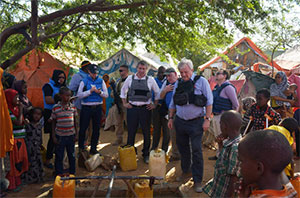 UN Emergency Relief Coordinator Visits Somalia. Credit: UN Photo/Tobin Jones
In recent years, conflicts have broken out across the world with no sign of slowing down or stopping. In times like this, millions of people globally are in dire need of humanitarian aid. Famine, warfare, natural disasters, and economic decline plague a host of nations, including Palestine, Sudan, Chad, Lebanon, and Haiti, to name a few. Humanitarian aid provides millions of people with critical services including healthcare, food, clean drinking water, psychosocial support, housing, and access to education. UN agencies such as the UNDP, UNICEF, the World Food Programme (WFP), UNHCR, UNRWA, and UNEP work with the UN Office for the Coordination of Humanitarian Aid (OCHA) and local organizations to come up with the best possible strategies to support affected communities. At the same time, humanitarian aid and those working on the frontlines are consistently threatened by both actors directly involved in conflict as well as those who are meant to contribute to the international humanitarian regime at large. The near-collapse of United States international aid structures in 2025, including the termination of 83% of USAID’s 6,300 global initiatives, has left millions of people without access to vital humanitarian assistance. 98 million people in 2025, only 65% of people targeted for humanitarian assistance, received the help they needed. In contrast, 123 million people received some form of humanitarian assistance in 2024, and OCHA’s 2026 Global Humanitarian Overview estimates that 239 million people are in need of assistance in 2026. IPS is well-positioned to discuss current initiatives to provide aid and relief through in-depth reporting and opinion content.

The Week with IPS

NEXT STOP - SDGs
Tracking global progress towards a sustainable world
Tracking global progress towards a sustainable world
