Languages
Thursday, October 22, 2026



News and Views from the Global South
Aid

Child Labor in the Arab Region Does Not Belong to the 21st Century
Today marks the 2017 World Day against Child Labor to reaffirm the goal to eliminate all forms of child labor. This year’s annual theme highlights a subject that is often neglected, namely the importance of addressing child labor in conflict areas and in disaster settings.
Heavy Toll of Disrupted Farming, Higher Prices and Displaced Livelihoods
Large agricultural harvests in some regions of the world are buoying global food supply conditions, but protracted fighting and unrest are increasing the ranks of the displaced and hungry elsewhere, according to a United Nations new report.
This Is the Nation of 170 Million Enslaved Children
Globally over 1.5 billion people live in countries that are affected by conflict, violence and fragility. Meantime, around 200 million people are affected by disasters every year—a third of them are children. And a significant proportion of the 168 million children engaged in child labour live in areas affected by conflict and disaster. These are the facts. Up to you to reflect on the immediate future of humankind.
Aggression against children in the Arab region needs to come to an end
On 20 February 1997, the United Nations General Assembly adopted Resolution 51/77 to promote the rights of children. This Resolution was considered a milestone in promoting and advancing the right of children in conflict and wars.
AIDS Pandemic Far From Over: 37 Million Living with HIV Globally
During the process of developing the Sustainable Development Goals it was clear to me how relevant and innovative the approach to ending AIDS had been and how important it would continue to be.
A UN of the Future to Effectively Serve all Member States
Through a series of recent global agreements on sustainable development, climate change, sustaining peace, disaster risk reduction, and financing for development, Member States have provided a broad vision of the future they want. I am committed to advancing meaningful reforms to adapt the United Nations to this complex world, so that it can effectively serve all of its Member States in achieving that future and managing shared challenges and opportunities along the way.
The Worsening Humanitarian Crisis in Syria
The cruel conflict in Syria continues to tear families apart, inflicts brutal suffering on the innocent, and leaves them pleading for protection and justice. I readily acknowledge that there have been reports of a significant drop in violence in some areas of the country, but such steps forward continue to be counter-weighted by the reality of a conflict that continues to devastate the civilian population.
In a “World of Plenty,” G7 Must Fight Famine
World leaders must step up and take action in fighting famine to prevent further catastrophic levels of hunger and deaths, said Oxfam.
Why the G7 Must Fund Health & Nutrition
The G7 Summit, held annually among the leaders of the world’s most powerful economies (Canada, France, Germany, Italy, Japan, the United Kingdom, the United States, and the EU), plays an important role in shaping responses to global challenges—theoretically at least.
Slow Growth Stalls SDGs’ Progress
The world will not be on track to eradicate poverty by 2030 if current growth trends continue, a UN task force found.
Community Seed Banks: Securing Diversity for Climate Change Adaptation
For thousands of years, farmers have used genetic diversity to cope with weather variability and changing climate conditions. They have stored, planted, selected and improved seeds to continue producing food in a dynamic environment.
“Horrific” Increase in Worldwide Displacement
Over 30 million people were newly internally displaced in 2016 by conflict and disasters, according to a new report.
The ‘Public’ in Public Health
The discourse must move beyond a top-down approach to listen to the people and formulate best insurance practices

Africa and India – Sharing the Development Journey
Africa, like India, is a continent of rich and compelling diversity. Both continents share a similar landscape, a shared colonial history, and similar economic and demographic challenges. This helps both India and Africa work especially well with each other.
Kenya’s Drought: Response Must Be Sustainable, Not Piecemeal
A malnutrition emergency Food security in Kenya has deteriorated significantly since the end of 2016. UNICEF reports a significant increase in severe acute malnutrition. Nearly 110,000 children under-five need treatment, up from 75,300 in August 2016.

Using Agriculture and Agribusiness to Bring About Industrialisation in Africa
No region of the world has ever moved to industrialised economy status without a transformation of the agricultural sector. Agriculture, which contributes 16.2% of the GDP of Africa, and gives some form of employment to over 60% of the population, holds the key to accelerated growth, diversification and job creation for African economies.
SLIDESHOW: Drought Highlights Ethiopia’s IDP Dilemma
 Displaced pastoralists gather around newly arrived drums of brown water as a water truck speeds off to make further deliveries to settlements that have sprung up along the main road running out of Gode, one of the major urban centers in Ethiopia’s Somali region.
Falling Between the Sun-Scorched Gaps: Drought Highlights Ethiopia’s IDP Dilemma
Displaced pastoralists gather around newly arrived drums of brown water as a water truck speeds off to make further deliveries to settlements that have sprung up along the main road running out of Gode, one of the major urban centers in Ethiopia’s Somali region.
Towards a Global Role for ACP?
The African, Caribbean and Pacific Group of States (ACP) met this week in Brussels for the 105th Session of its Council of Ministers to discuss the key question of how these 79 countries could play a more effective role for their own citizens and in the international arena.
Collective Amnesia in Famine Response and Resilience-Building
The emerging drought-induced humanitarian crisis—prevailing in countries from Niger in West Africa to Somalia in East Africa—and conflict-driven famine conditions in South Sudan, Somalia, and Northeast Nigeria, have become a regular phenomenon.
Climate-Smart Agriculture – From Tanzania to Vietnam
As part of efforts to move towards "climate-smart" agriculture, several countries have shared In a meeting in Rome new experiences on how to produce food in ways that help farmers cope with the impacts of climate change and to reduce greenhouse gas emissions in agriculture.« Previous Page — Next Page »





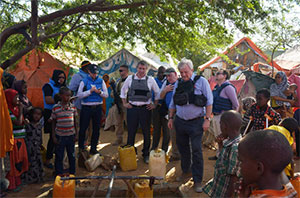 UN Emergency Relief Coordinator Visits Somalia. Credit: UN Photo/Tobin Jones
In recent years, conflicts have broken out across the world with no sign of slowing down or stopping. In times like this, millions of people globally are in dire need of humanitarian aid. Famine, warfare, natural disasters, and economic decline plague a host of nations, including Palestine, Sudan, Chad, Lebanon, and Haiti, to name a few. Humanitarian aid provides millions of people with critical services including healthcare, food, clean drinking water, psychosocial support, housing, and access to education. UN agencies such as the UNDP, UNICEF, the World Food Programme (WFP), UNHCR, UNRWA, and UNEP work with the UN Office for the Coordination of Humanitarian Aid (OCHA) and local organizations to come up with the best possible strategies to support affected communities. At the same time, humanitarian aid and those working on the frontlines are consistently threatened by both actors directly involved in conflict as well as those who are meant to contribute to the international humanitarian regime at large. The near-collapse of United States international aid structures in 2025, including the termination of 83% of USAID’s 6,300 global initiatives, has left millions of people without access to vital humanitarian assistance. 98 million people in 2025, only 65% of people targeted for humanitarian assistance, received the help they needed. In contrast, 123 million people received some form of humanitarian assistance in 2024, and OCHA’s 2026 Global Humanitarian Overview estimates that 239 million people are in need of assistance in 2026. IPS is well-positioned to discuss current initiatives to provide aid and relief through in-depth reporting and opinion content.

The Week with IPS

NEXT STOP - SDGs
Tracking global progress towards a sustainable world
Tracking global progress towards a sustainable world
