Languages
Saturday, October 17, 2026



News and Views from the Global South
Aid

UN Security Council Must Halt Disastrous March of Myanmar’s Ethnic Cleansing of Rohingya
Abdu Salam stayed in his village as Myanmar soldiers and local vigilantes burned down dozens of homes there last August. He stayed as news spread of atrocities that soldiers had committed in other Rohingya villages across northern Rakhine State. He stayed because Hpon Nyo Leik village was his home, the only home he’d known, and he wanted to protect his family’s property and right to live there.
Pyeongchang Olympics: A New Cornerstone for Peace and Prosperity
All eyes are on the 23rd Olympic Winter Games and 12th Paralympic Winter Games in PyeongChang this February. Top athletes will carry their national flags in an opening ceremony which has come to epitomize the international community. Sports fans worldwide eagerly await the Olympics, and this time there is cause for cautious optimism that sport diplomacy may lower tensions on the Korean Peninsula itself. Leaders, diplomats and citizens from the world over will witness North and South Korean athletes walking side by side. For this, there could be few better places than PyeongChang, which means peace (Pyeong) and prosperity (Chang): goals integral to the mission of the United Nations and the 2030 Sustainable Development Agenda.
“No Time to Waste” in Ending FGM
More than 200 million women around the world have experienced some kind of female genital mutilation (FGM) and more could be at risk, a UN agency said.
Gaza Health Sector on Verge of Collapse
UN agencies have sounded the alarm on the rapidly deteriorating humanitarian situation in Gaza, pointing to the devastating repercussions of the ongoing fuel shortages.
Three Opportunities for Humanitarians in 2018
As 2018 begins, the challenges of humanitarian crises are momentous. Humanitarians are responding to large-scale emergencies in the Democratic Republic of Congo (DRC), Iraq, Syria and Yemen.
UN Refugee Agency Calls for Aid and Peace in South Sudan
As South Sudan quickly becomes Africa’s largest refugee and humanitarian crisis, the world must come to its aid, said the UN refugee agency. The UN Refugee Agency (UNHCR) has launched a global appeal to support displaced persons amid South Sudan’s rapidly deteriorating humanitarian situation.
Business Unusual will Drive Africa’s Quest to achieve Health Care for All
Africa’s quest for health continues to be held back by a combination of factors such as natural disasters and pandemics, prevailing high rates of communicable and rising incidence of non-communicable diseases, sedentary lifestyles, road accidents and greater population mobility.
Survival of Indigenous Tribes in Bangladesh Starts at School
Just before sundown on Jan. 30, a group of women day labourers from the Shantal indigenous community are in a rush to wind up their work harvesting potatoes in a field in the village of Boldipukur, some 15 km away from Rangpur district in northern Bangladesh.
Women on the Front Lines of Halting Deforestation
In Zimbabwe, the bulk of rural communities and urban poor still get their energy supplies from the forests, leading to deforestation and land degradation.
Tackling Inequality – The Myth that Davos Can Change the World
When the World Economic Forum (WEF) concluded in Davos, Switzerland last week, the outcome of the annual talk-fest was seemingly predictable—plenty of unrestrained platitudes but, surprisingly, less of the American populist, protectionist rhetoric.
Aid Group Shines Spotlight on the Neglected
Though 2017 was marked by stories of humanitarian disasters around the world, many crises remain under the radar with devastating consequences for those affected, a new report says.
Groups Condemn U.S. Cuts to Palestinian Refugee Agency
International organizations have criticized the United States’ decision to cut more than half of planned funding to a UN agency serving Palestinian refugees.
Davos: a Tale of Two Mountains
As the elite in the world of finance gather in the Swiss luxury town of Davos, rallies are taking place around the world as citizens demand for solutions to rising inequality. At the same time as the World Economic Forum’s rich and powerful hold forth about fixing the crisis of inequality they created, a new movement called the Fight Inequality Alliance is telling another story that is growing around the world.
Fate of the Rohingyas – Part Two
With discussions underway between Bangladesh and Myanmar about the repatriation of more than a half a million Rohingya refugees, many critical questions remain, including how many people would be allowed back, who would monitor their safety, and whether the refugees even want to return to violence-scorched Rakhine state.
Policy Support Gap for “Climate-Smart” Agriculture
Conditioned that ploughing is the sure way to produce crops, Zimbabwean farmer Handrixious Zvomarima surprised himself by trying a different method. He planted cowpea seeds directly without tilling the land. It worked.
Perpetrators of Crimes against Humanity Must be Brought to Justice
On the occasion of the 2017 International Day of Human Solidarity observed on 20 December, the Chairman of the Geneva Centre for Human Rights Advancement and Global Dialogue Dr. Hanif Hassan Ali Al Qassim calls for peace for and human solidarity with, the Rohingya minority in Myanmar.
Long Maligned for Deforestation, Charcoal Emerges from the Shadows
“We have various financial obligations that push us to charcoal making. Top on the list is farming inputs and school fees,” explains Arclay Moonga, a charcoal producer and chairperson of the recently formed Choma District Charcoal Association in Southern Zambia.
Rohingyas: Lurching from Crisis to Crisis
Ferdous Begum was cleaning her child after he had defecated in the open, using leaves she collected from a nearby tree at Bangladesh’s Teknaf Nature Park. The settlement is packed with Rohingya refugees who fled military persecution in Myanmar since August.
SLIDESHOW: Tales of the 21st Century – Rohingyas Without a State
 The world has witnessed innumerable images of the long walk to 'freedom' of Rohingya women, children and men. Some trudged for endless hours and days, many carrying elderly parents and babies in baskets, with the women suffering the unimaginable trauma having been victims of rape, torture and harassment.
Rohingya Refugees Endure Lingering Trauma
Twelve-year-old Rubina still struggles with the horrors she witnessed in her homeland in Myanmar before fleeing to neighbouring Bangladesh three months ago.
Money Talks at One Planet Summit in Paris
As funding to combat climate change has lagged behind lofty words, the One Planet Summit in France this week invited governments and business leaders to put money on the table.« Previous Page — Next Page »





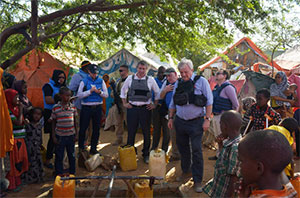 UN Emergency Relief Coordinator Visits Somalia. Credit: UN Photo/Tobin Jones
In recent years, conflicts have broken out across the world with no sign of slowing down or stopping. In times like this, millions of people globally are in dire need of humanitarian aid. Famine, warfare, natural disasters, and economic decline plague a host of nations, including Palestine, Sudan, Chad, Lebanon, and Haiti, to name a few. Humanitarian aid provides millions of people with critical services including healthcare, food, clean drinking water, psychosocial support, housing, and access to education. UN agencies such as the UNDP, UNICEF, the World Food Programme (WFP), UNHCR, UNRWA, and UNEP work with the UN Office for the Coordination of Humanitarian Aid (OCHA) and local organizations to come up with the best possible strategies to support affected communities. At the same time, humanitarian aid and those working on the frontlines are consistently threatened by both actors directly involved in conflict as well as those who are meant to contribute to the international humanitarian regime at large. The near-collapse of United States international aid structures in 2025, including the termination of 83% of USAID’s 6,300 global initiatives, has left millions of people without access to vital humanitarian assistance. 98 million people in 2025, only 65% of people targeted for humanitarian assistance, received the help they needed. In contrast, 123 million people received some form of humanitarian assistance in 2024, and OCHA’s 2026 Global Humanitarian Overview estimates that 239 million people are in need of assistance in 2026. IPS is well-positioned to discuss current initiatives to provide aid and relief through in-depth reporting and opinion content.

The Week with IPS

NEXT STOP - SDGs
Tracking global progress towards a sustainable world
Tracking global progress towards a sustainable world
