Languages
Saturday, October 17, 2026



News and Views from the Global South
Aid

China Needs to Avoid ‘Belt and Road’ Debt Problems
Chinese officials have been adept at ascribing a vision for the “Belt and Road” initiative (BRI) that garners support from a wide array of countries, as well as international institutions like the World Bank and International Monetary Fund (IMF).
Rohingya Crisis May Be Genocide, UN Officials Say
In the wake of persistent violence against the Rohingya community, UN officials have expressed growing fears that genocide is being incited and committed in Myanmar.
Three Ways the Global Compact Can Better Serve Refugees
The UN High Commissioner for Refugees has a tall task: deliver a “Global Compact for Refugees” to the United Nations’ General Assembly by the end of 2018.
The Politicization of Humanitarian Aid Through Budget Cuts
Ahead of the pending ‘list of shame,’ the Secretary-General’s Annual Report on Children and Armed Conflicts, child protection actors share concerns about the politicization of humanitarian aid putting child protection capacities at a disadvantage.
Helping Women, Period
The United Nations Headquarters and Brooklyn Bridge were lit up on Thursday night not to help tourists navigate the major landmarks but to bring attention to a key issue that many women and girls face today: period poverty.
The Government of Kenya and United Nations Partnership to Achieve Universal Health Care Inspires Many in Silicon Valley and the Stanford, U.C. Berkeley Communities
Recently, some of us from the Stanford University and U.C. Berkeley community had the privilege of hosting Siddharth Chatterjee, the United Nations Resident Coordinator for Kenya and his team at the Silicon Valley, where he spoke at the 2018 African Diaspora Investment Symposium. The Kenya team also met with academics, Directors of Centers and students as well as some of brilliant technology leaders in Silicon Valley at Facebook and Google.
We Must Protect the Future for Palestinian Refugee Girls
As people across the globe marked International Women’s Day (IWD) on March 8, the safe and secure education and possibilities for the future of millions of young girls and women who are Palestinian refugees across the Middle East remained in danger.
Syria’s ‘Human Catastrophe’
Despite calls for a ceasefire, violent clashes have continued and humanitarian access remains limited in Syria’s Eastern Ghouta, leaving the international community extremely concerned. Since the Syrian government intensified its attacks in recent weeks, more than 700 civilians, many of them children, have been killed in Eastern Ghouta.
IOM Deputy Director General Addresses Dubai Humanitarian Aid and Development Conference
IOM Deputy Director General Laura Thompson yesterday (05/03) called for improved humanitarian financing structures at the 15th Dubai International Humanitarian Aid and Development Conference and Exhibition (DIHAD).
DRC: A Crisis the World Can No Longer Afford to Ignore
The numbers are hard to fathom. Nearly two million people driven from their homes in 2017 alone. The worst cholera epidemic of the past 15 years, with over 55,000 cases and more than 1,000 deaths. Countless others killed, maimed or sexually assaulted.
Women Peace Laureates Condemn Inaction on Rohingya “Genocide”
Nobel Laureates Mairead Maguire, Shirin Ebadi and Tawakkol Karman met with more than 100 women refugees in camps in the coastal Cox’s Bazar region of Bangladesh this week, as well as travelling to the “no man’s land” where thousands of Rohingya have been stranded between Myanmar and Bangladesh.
Monsoon Season Threatens More Misery for Rohingyas
More than half a million Rohingya refugees crammed into over 30 makeshift camps in Cox’s Bazar in southeast Bangladesh face a critical situation as the cyclone and monsoon season begins in a few weeks’ time.
Security Council Resolutions are Meaningful Only When Implemented
As this is the first time I have the opportunity to address a UN body after the Security Council resolution of last Saturday on Syria, allow me please to say a few words in that regard.
Inclusive Green Growth Must Shape Thailand’s Future, Says GGGI Chief
Energy efficiency in industries presents a unique opportunity for Thailand’s environmental and economic policies as regional trends push towards more inclusive and sustainable green cities for the country and its neighbors, says the Director-General of the Global Green Growth Institute (GGGI) Dr. Frank Rijsberman.
Dung-Eating Earthworms Restore Soil Nutrients in Bangladesh
In Kaliganj village, 20 kilometres south of Rangpur city in Bangladesh, small farmers are turning to vermicomposting after crop yields started dropping. The problem was that soil fertility eroded due to organic nutrient depletion.
Understanding Child Soldier Recruitment Needed to Help Curb Crisis
It is not known exactly how many child soldiers there are in the world, but current estimates tell us that in 2018, the number is likely to be in the tens of thousands.
A Step Towards the Light: Ending Human Trafficking
A new initiative aims to use data to shed light on a pervasive multi-billion dollar criminal industry: human trafficking. Created by the International Organization for Migration and Polaris, the Counter-Trafficking Data Collaborative (CTDC) is the world’s first human trafficking data portal.
Oxfam’s Sexual Abuse Episode Must Inspire a Culture Shift
Sexual abuse allegations against Oxfam staff, and failings in the charity’s response to them, delivered a body blow to an organisation renowned for years of humanitarian and development work. At the very least the accusations will leave a stain on the reputation of a charity that works in some of the toughest environments in the world, and has made a positive difference in the lives of the most vulnerable.
African Migration to Europe, Not a Crisis but an Opportunity
An increasingly common justification for European development assistance to Africa is the notion that it will reduce migration from the South. While this sounds intuitive and makes for an appealing argument, the research shows that it is highly unlikely.
Development, Self-Interest & Countries Left Behind
The world’s wealthiest countries today promote development abroad in a way that is relatively new. For centuries, some of these countries colonized the developing world. As former colonies gained independence they were caught in the international power struggle of the Cold War, often led by dictators who found it in their interest to serve as pawns in great power proxy conflicts.
Combating Africa’s Inequalities
Nelson Mandela, shortly after becoming the first democratically elected president of South Africa, spoke to both his countrymen and women—indeed, for Africans everywhere—when he declared, “We must work together to ensure the equitable distribution of wealth, opportunity and power in our society.”« Previous Page — Next Page »





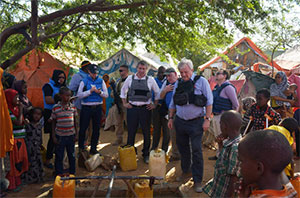 UN Emergency Relief Coordinator Visits Somalia. Credit: UN Photo/Tobin Jones
In recent years, conflicts have broken out across the world with no sign of slowing down or stopping. In times like this, millions of people globally are in dire need of humanitarian aid. Famine, warfare, natural disasters, and economic decline plague a host of nations, including Palestine, Sudan, Chad, Lebanon, and Haiti, to name a few. Humanitarian aid provides millions of people with critical services including healthcare, food, clean drinking water, psychosocial support, housing, and access to education. UN agencies such as the UNDP, UNICEF, the World Food Programme (WFP), UNHCR, UNRWA, and UNEP work with the UN Office for the Coordination of Humanitarian Aid (OCHA) and local organizations to come up with the best possible strategies to support affected communities. At the same time, humanitarian aid and those working on the frontlines are consistently threatened by both actors directly involved in conflict as well as those who are meant to contribute to the international humanitarian regime at large. The near-collapse of United States international aid structures in 2025, including the termination of 83% of USAID’s 6,300 global initiatives, has left millions of people without access to vital humanitarian assistance. 98 million people in 2025, only 65% of people targeted for humanitarian assistance, received the help they needed. In contrast, 123 million people received some form of humanitarian assistance in 2024, and OCHA’s 2026 Global Humanitarian Overview estimates that 239 million people are in need of assistance in 2026. IPS is well-positioned to discuss current initiatives to provide aid and relief through in-depth reporting and opinion content.

The Week with IPS

NEXT STOP - SDGs
Tracking global progress towards a sustainable world
Tracking global progress towards a sustainable world
