Languages
Friday, October 16, 2026



News and Views from the Global South
Aid

New GCF Project Signals Paradigm Shift for Water-Scarce Barbados
At the start of 2017, the Caribbean Drought and Precipitation Monitoring Network (CDPN) warned eastern Caribbean countries that they were facing “abnormal climate conditions” and possibly another full-blown drought.
First They Came for the Rohingya
In recent months, international media coverage of Myanmar has focused on the plight of the Rohingya people in the west of the country. And for good reason: Since August 2017, brutal army attacks on this Muslim ethnic minority have sent more than 750,000 people — 90 percent of the Rohingya population living in Rakhine state — fleeing over the border to Bangladesh, in what can only be described as a coordinated campaign of genocide.
Caribbean Eyes Untapped Potential of World’s Largest Climate Fund
The Caribbean Community Climate Change Centre (CCCCC) also known as the 5Cs, is looking for ways to boost the region’s access to the Green Climate Fund (GCF).
Africa Lags Behind in Bridging Inequalities
“If you wish to move mountains tomorrow, you must start by lifting stones today”—so goes an African proverb, crystallising the solutions to the continent’s socio-economic inequalities.
“International Solidarity” at Yemen Donor Conference
The international community has pledged over two billion dollars towards urgently needed humanitarian assistance to Yemen during a UN event.
I Am a Migrant: Integrating Through Syrian ‘Hummus’
Khaled left Syria in 2015, when his country was already in its fourth year of war. He is 27 years old and can clearly remember what his life was like then in Damascus: a happy life, with a happy family, in a happy country.
Who’s Getting Financial Inclusion Funding in Sub-Saharan Africa?
For the first time in over a decade, Sub-Saharan Africa is a top priority for international funders investing in financial inclusion, with 30 percent of all active projects focused on the region.
Senegalese Returnees from Libya, Niger Face Uncertain Future
Bouba Diop looks in delight at his uncle’s newly refurbished food canteen in the poor township of Keur Massar on the outskirts of the Senegalese capital Dakar.
Bridging the Humanitarian Needs with Long-term Resilience in Dominica
Six months ago, on 18 September 2017, Category 5 Hurricane Maria struck Dominica wreaking unimaginable disaster. Thirty-one people died, thirty-three more remain missing. Roads, bridges, schools, hospitals and over 40 percent of homes were destroyed or severely damaged.
Conflicts Force Up Global Hunger Levels
Largely driven by conflict, the number of hungry people has dramatically increased around the world, reversing decades of progress, according to a new report.
Chemical Weapons in Syria? Time for Outrage
US Defense Secretary James Mattis dropped a political bombshell last week when he said the U.S. has no evidence to confirm reports that the Syrian government had used the deadly chemical sarin on its citizens.
Former UN Chief Takes the Helm of Global Green Growth Institute
In the face of climate change and growing energy demand in developing countries, Ban Ki-moon, the new president and chair of the Global Green Growth Institute (GGGI), unveiled his vision for a more sustainable path by helping countries in their transition to greener economies and achieving the Sustainable Development Goals (SDGs).
Accelerating Universal Health Coverage in Kenya-How do we get there?
The Government of Kenya has prioritized universal health coverage (UHC) in its Big 4 agenda over the next 5 years. This is a significant and perhaps the most important strategic priority. Why? Every year over a million Kenyans get trapped into poverty because of a catastrophic out of pocket payments due to health reasons.
New Platform Will Support Youth Projects on Water and Climate
Young people around the globe with good ideas on how to deal with water and climate challenges now have a platform to show their projects to the world and attract funding and other contributions to realise their dreams.
A New Low for Security Council as Russia Takes Syrian Human Rights Off the Table
There is nothing controversial about saying the UN Security Council has failed Syria. Diplomats have openly admitted it, journalists have written about it, human rights organizations have declared it - several times over in the past seven years. But what happened this week was deplorable and unacceptable, even by the very low standards we now have for the Council when it comes to Syria.
Asian & African Migrants Continue To Face Exploitation in Mideast
With more and more people living outside their country of origin, it is becoming increasingly clear that stronger legal parameters -- within and between nations --- are required to protect the most vulnerable of migrants from denial of access to fundamental rights.
A Breath of Fresh Air in India
With India’s citizens clamouring for breathable air and efficient energy options, the country’s planners are more receptive than ever to explore sustainable development options, says Frank Rijsberman, Director-General of the Global Green Growth Institute (GGGI).
No Ordinary Match
The parched earth made for a tough football pitch, but the youth of Loresho Primary school were determined. It was blue against yellow- two teams competing for the coveted prize of pride and victory.
Dowry Death or Murder?
Dowry deaths rose from about 19 per day in 2001 to 21 per day in 2016. It is indeed alarming that the rise in dowry deaths is unabated despite greater stringency of anti-dowry laws. In 1961, the Dowry Prohibition Act made giving and taking of dowry, its abetment or the demand for it an offence punishable with imprisonment and fine or without the latter. This was an abysmal failure as dowries became a nationwide phenomenon, replacing bride price. More stringent laws followed. The Criminal Law Amendment Act in 1983 inserted a new section (498-A) to deal with persistent and grave instances of dowry demand and such offences were punishable with imprisonment extendable to three years. As cases of brutal harassment and dowry deaths continued to rise, another Act was passed in 1986, relating specifically to the offence of dowry death.
Is UN’s Ambitious Global Compact the Last Word on the Migrant Crisis?
As the death toll keeps mounting and the humanitarian crises continue unabated, the life of the average migrant or refugee has largely turned out to be an unmitigated nightmare.
China Needs to Avoid ‘Belt and Road’ Debt Problems
Chinese officials have been adept at ascribing a vision for the “Belt and Road” initiative (BRI) that garners support from a wide array of countries, as well as international institutions like the World Bank and International Monetary Fund (IMF).« Previous Page — Next Page »





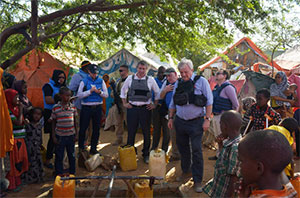 UN Emergency Relief Coordinator Visits Somalia. Credit: UN Photo/Tobin Jones
In recent years, conflicts have broken out across the world with no sign of slowing down or stopping. In times like this, millions of people globally are in dire need of humanitarian aid. Famine, warfare, natural disasters, and economic decline plague a host of nations, including Palestine, Sudan, Chad, Lebanon, and Haiti, to name a few. Humanitarian aid provides millions of people with critical services including healthcare, food, clean drinking water, psychosocial support, housing, and access to education. UN agencies such as the UNDP, UNICEF, the World Food Programme (WFP), UNHCR, UNRWA, and UNEP work with the UN Office for the Coordination of Humanitarian Aid (OCHA) and local organizations to come up with the best possible strategies to support affected communities. At the same time, humanitarian aid and those working on the frontlines are consistently threatened by both actors directly involved in conflict as well as those who are meant to contribute to the international humanitarian regime at large. The near-collapse of United States international aid structures in 2025, including the termination of 83% of USAID’s 6,300 global initiatives, has left millions of people without access to vital humanitarian assistance. 98 million people in 2025, only 65% of people targeted for humanitarian assistance, received the help they needed. In contrast, 123 million people received some form of humanitarian assistance in 2024, and OCHA’s 2026 Global Humanitarian Overview estimates that 239 million people are in need of assistance in 2026. IPS is well-positioned to discuss current initiatives to provide aid and relief through in-depth reporting and opinion content.

The Week with IPS

NEXT STOP - SDGs
Tracking global progress towards a sustainable world
Tracking global progress towards a sustainable world
