Languages
Wednesday, October 14, 2026



News and Views from the Global South
Aid

Unlocking Private Finance for Developing Countries’ Green Growth
Climate finance has never been more urgently needed, with massive investments in climate action required to meet the goals of the Paris Agreement and avoid the devastating effects of a warmer planet.
Agricultural Trade Liberalization Undermined Food Security
Agriculture is critical for achieving the Sustainable Development Goals (SDGs). As the Food and Agriculture Organization (FAO) notes, ‘From ending poverty and hunger to responding to climate change and sustaining our natural resources, food and agriculture lies at the heart of the 2030 Agenda.’
Africa Gains Momentum in Green Climate Solutions
Promoting the widespread use of innovative technologies will be critical to combat the hostile effects of climate change and reduce greenhouse gas emissions, and many African countries are already leading the way with science-based solutions.
Climate Finance: The Paris Agreement’s “Lifeblood”
As negotiators concluded ten days of climate talks in Bonn last week, climate finance was underlined as a key element without which the Paris Agreement’s operational guidelines would be meaningless.
To Have Children or Not: The Importance of Finding a Balance
While the world’s population has changed dramatically over the last 50 years, little is still understood about fertility transition and the reasons behind it. Over the last half a century, the global fertility rate has halved, reaching a level of 2.5 births per woman.
U.S. Signals New Approach to Horn of Africa Ally
The April inauguration of Ethiopia’s new Prime Minister came amid much fanfare and raised expectations for the future of true democracy in Ethiopia, while far less publicized though relevant developments in the American capital could also play a significant role in shaping that future.
“I Wake Up Screaming”: Gaza’s Children Bear the Brunt of Violence
Reham Qudaih wakes up nightly to the same nightmare: her father shot, lying on the ground in a pool of blood. “In my dreams he is on the ground shot. When I have that dream – which I’ve had more than once I wake up screaming,” she told the Norwegian Refugee Council (NRC).
Economies Flourish and Traffickers Profit from the Struggles of Low-Skilled Migrants
I was 14-years-old the first time I came face to face with a human trafficker. The Lord’s Resistance Army (LRA) raided my home. Ruthless, they demanded virgins and young girls. In a horrifying escape, I endured a treacherous, long journey that ended in an internally displaced people’s camp. I was lucky. Many Ugandan children were not. By the end of the nineteen years’ civil war, UNICEF estimated that the LRA had abducted some 20,000 children.
Belt and Road Initiative Vows Green Infrastructure with Connectivity
"My son in primary school did not attend a birthday celebration because it was cancelled due to bad air -- and we live in Seoul, a great place to live," said Dr. Frank Rijsberman, director-general of the Global Green Growth Institute (GGGI).
Low Awareness Restrains Growth of Solar Technologies
Every year, Amos Chandiringa, 43, a farmer in Nemaire village in Makoni district in northeastern Zimbabwe, laboriously waters his tobacco nursery with a watering can. The toil of the job often leaves him without the energy or time to do other household chores.
Protecting the Health & Rights of People on the Move
A staggering 258 million people migrated internationally in 2017. While many of these migrants chose to leave their home countries in search of jobs, education, or to reunite with family, many others had no choice but to leave--to escape poverty, violence or a dearth of opportunities for a better life.
In South Sudan, Denial of Humanitarian Aid is a War Tactic
When I visited South Sudan last year, I heard story after story about health professionals and humanitarian workers being prevented from doing critical work. Government officials regularly increased fees for nonprofits trying to alleviate the effects of conflict, stopped humanitarian convoys from delivering life-saving supplies, and erected bureaucratic obstacles designed to impede access to civilians in need.
Leading from the Front: Zambia Launches Plant a Million Trees Initiative
As global climate experts meet in Bonn this week to discuss how to take climate action forward, Zambia counts itself amongst the leaders as President Edgar Lungu officially launches the Plant a Million (PAM) trees Initiative.
Revving Up Green Growth
While sustainable development may still seem elusive to some, a new initiative wants to pave a path for nations working towards a greener future. Partnering for Green Growth and the Global Goals 2030, or P4G, is a new partnership initiative that aims to boost countries’ efforts in achieving the globally adopted Sustainable Development Goals (SDGs).
Myanmar Unlikely to Resolve Rohingya Problem Without International Help
The lead-up to the Australia-ASEAN Summit in Sydney on 16-18 March 2018 was characterised by widespread and well-publicised protests in Sydney against human rights abuses occurring in several ASEAN member countries – namely Cambodia, Myanmar and Vietnam.
From Declaration to Action: Improving Immunization in Africa
Inviolate Akinyi, a 46-year-old grandmother, is certain that her grand-daughter needs to get all her vaccines for her to grow up healthy and strong. She uses a mix of private and public clinics in Kibera, one of the largest informal settlement in Nairobi, to get the 15-month-old the shots she needs.
Illicit Trade in Oil & Fuel: an Emerging Global Policy Challenge
Illicit trade in any of its forms—alcohol, tobacco, pharmaceuticals, diamonds, timber, ivory and oil—sits at the nexus of two social-economic disorders that challenge global stability.
Kidnapped, Abducted and Abandoned…
Kidnappings and abductions have soared since 2001. The National Crime Records Bureau (NCRB) shows that their share in total crimes against women nearly doubled from 10% in 2001 to 19% in 2016. More striking is the fact that 11 women were kidnapped or abducted every day in Delhi in 2016. What these statistics do not reveal are brutal gang-rapes of kidnapped minors and women, multiple sales to husbands who treat them as animals, unwanted pregnancies, police inaction, and frequent abandonment with nowhere to go—not even to their maternal homes—because of the stigma of a being a “prostitute”.
Child Soldiers Released, But Risk Remains
More than 200 child soldiers were released by armed groups in war-torn South Sudan, and help will be needed to ensure their safe and bright future, according to a UN agency. The release took place in Western Equatoria State and follows a similar release last month that saw 300 children freed.
New GCF Project Signals Paradigm Shift for Water-Scarce Barbados
At the start of 2017, the Caribbean Drought and Precipitation Monitoring Network (CDPN) warned eastern Caribbean countries that they were facing “abnormal climate conditions” and possibly another full-blown drought.
First They Came for the Rohingya
In recent months, international media coverage of Myanmar has focused on the plight of the Rohingya people in the west of the country. And for good reason: Since August 2017, brutal army attacks on this Muslim ethnic minority have sent more than 750,000 people — 90 percent of the Rohingya population living in Rakhine state — fleeing over the border to Bangladesh, in what can only be described as a coordinated campaign of genocide.« Previous Page — Next Page »





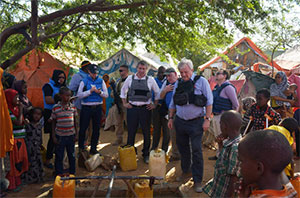 UN Emergency Relief Coordinator Visits Somalia. Credit: UN Photo/Tobin Jones
In recent years, conflicts have broken out across the world with no sign of slowing down or stopping. In times like this, millions of people globally are in dire need of humanitarian aid. Famine, warfare, natural disasters, and economic decline plague a host of nations, including Palestine, Sudan, Chad, Lebanon, and Haiti, to name a few. Humanitarian aid provides millions of people with critical services including healthcare, food, clean drinking water, psychosocial support, housing, and access to education. UN agencies such as the UNDP, UNICEF, the World Food Programme (WFP), UNHCR, UNRWA, and UNEP work with the UN Office for the Coordination of Humanitarian Aid (OCHA) and local organizations to come up with the best possible strategies to support affected communities. At the same time, humanitarian aid and those working on the frontlines are consistently threatened by both actors directly involved in conflict as well as those who are meant to contribute to the international humanitarian regime at large. The near-collapse of United States international aid structures in 2025, including the termination of 83% of USAID’s 6,300 global initiatives, has left millions of people without access to vital humanitarian assistance. 98 million people in 2025, only 65% of people targeted for humanitarian assistance, received the help they needed. In contrast, 123 million people received some form of humanitarian assistance in 2024, and OCHA’s 2026 Global Humanitarian Overview estimates that 239 million people are in need of assistance in 2026. IPS is well-positioned to discuss current initiatives to provide aid and relief through in-depth reporting and opinion content.

The Week with IPS

NEXT STOP - SDGs
Tracking global progress towards a sustainable world
Tracking global progress towards a sustainable world
