Languages
Wednesday, October 28, 2026



News and Views from the Global South
Aid

Opinion: From Inequality to Inclusion
Recent years have seen a remarkable resurgence of interest in economic inequality, thanks primarily to growing recognition of some of its economic, social, cultural and political consequences in the wake of Western economic stagnation.
Rich Gulf Nations Tight-Lipped on Growing Refugee Crisis
As Western and Central European nations seem overwhelmed by the growing refugee crisis – triggered mostly by the inflow of hundreds and thousands of displaced people largely from Syria, Libya, Afghanistan and Iraq – one lingering question remains unanswered: why aren’t some of the rich Arab Gulf nations reaching out to help these hapless refugees?
Women Revolutionise Waste Management on Nicaraguan Island
A group of poor women from Ometepe, a beautiful tropical island in the centre of Lake Nicaragua, decided to dedicate themselves to recycling garbage as part of an initiative that did not bring the hoped-for economic results but inspired the entire community to keep this biosphere reserve clean.
European Residents Offer Support, Homes to Refugees
As the migration crisis in Europe continues to grow and government response remains slow, European citizens have taken it upon themselves to act by opening up their homes to those in need.
Europe Invaded Mostly by “Regime Change” Refugees
The military conflicts and political instability driving hundreds of thousands of refugees into Europe were triggered largely by U.S. and Western military interventions for regime change – specifically in Iraq, Afghanistan, Libya and Syria (a regime change in-the-making).
Two Indigenous Solar Engineers Changed Their Village in Chile
Liliana and Luisa Terán, two indigenous women from northern Chile who travelled to India for training in installing solar panels, have not only changed their own future but that of Caspana, their remote village nestled in a stunning valley in the Atacama desert.Killing of Aid Workers Threatens Humanitarian Response in Yemen
With 21 million Yemeni civilians caught in the grips of a conflict that has been escalating since March, the killing of two local aid workers Wednesday could worsen their misery, as a major humanitarian organisation considers the future of its operations in parts of the war-torn country.U.N. Officials Warn of Dengue Outbreak in War-Torn Yemen
An outbreak of dengue fever in Yemen’s most populated governorate has prompted urgent calls from the World Health Organisation (WHO) for a “humanitarian corridor” to facilitate the flow of medicines to over three million civilians trapped in the war-torn area.
Will New Sri Lankan Government Prioritize Resettlement of War-Displaced?
The new Sri Lankan government that was voted in on Aug. 17 certainly didn’t inherit as much baggage as its predecessors did during the nearly 30 years of conflict that gripped this South Asian island nation.
Europe Squabbles While Refugees Die
As tens of thousands of refugees continue to flee conflict-ridden countries, including Afghanistan, Iraq, Libya and Syria, Western European governments and international humanitarian organisations are struggling to cope with a snowballing humanitarian crisis threatening to explode.
Emerging Industrial Power Rises From Aid Beneficiary to Donor Nation
Back in 1996, when South Korea voluntarily quit the 132-member Group of 77 (G77) – described as the largest single coalition of developing nations -- it joined the 34-member Organisation for Economic Cooperation and Development (OECD), long known as the “rich man’s club” based in Paris.
Deliberate Targeting of Water Sources Worsens Misery for Millions of Syrians
Imagine having to venture out into a conflict zone in search of water because rebel groups and government forces have targeted the pipelines. Imagine walking miles in the blazing summer heat, then waiting hours at a public tap to fill up your containers. Now imagine realizing the jugs are too heavy to carry back home.
Majority of Child Casualties in Yemen Caused by Saudi-Led Airstrikes
Of the 402 children killed in Yemen since the escalation of hostilities in March 2015, 73 percent were victims of Saudi coalition-led airstrikes, a United Nations official said Monday.
U.N. Aid Agencies Launch Emergency Hotline for Displaced Iraqis
In the hopes of better responding to the needs of over three million displaced Iraqis, United Nations aid agencies today launched a national hotline to provide information on emergency humanitarian services like food distribution, healthcare and shelter.
UAE Wins Hearts and Minds at World Exhibition in Milan
She only turned nine last June. But Mahra Mustafa has become a celebrity at the Expo Milan. She stars as Sara in ‘The Family Tree’, a short film on the UAE’s heritage being screened at the United Arab Emirates pavilion. Sara is in fact the face of young, dynamic and innovative Emirates.
U.N. Official Says Human Suffering in Yemen ‘Almost Incomprehensible’
With a staggering four in five Yemenis now in need of immediate humanitarian aid, 1.5 million people displaced and a death toll that has surpassed 4,000 in just five months, a United Nations official told the Security Council Wednesday that the scale of human suffering is “almost incomprehensible”.
U.N. Relief Agency Pledges to Open Schools ‘On Time’ for Half a Million Palestinian Refugees
Overcoming a serious funding shortfall, and caught between numerous regional conflicts, the United Nation’s humanitarian agency for Palestinian refugees announced on Aug. 19 that it would nevertheless open schools on time for the roughly half-a-million children who rely on the international community for their education.
Humanitarian Response in Afghanistan Falters in the Face of Intensifying Conflict
As the number of civilians impacted by the intensifying conflict in Afghanistan rises along with the fighting, humanitarian agencies are struggling to meet the needs of the wounded, hungry and displaced.
U.N. Marks Humanitarian Day Battling Its Worst Refugee Crisis
The United Nations is commemorating World Humanitarian Day with “inspiring” human interest stories of survival – even as the world body describes the current refugee crisis as the worst for almost a quarter of a century.
Time to Work Out a Plan C for Greece
Just over a month ago, Greek citizens were asked to go to the polls for a referendum that posed the country with an unprecedented existential dilemma and challenged the EU with the possibility of its collapse.
The U.N. at 70: Leading the Global Agenda on Women’s Rights and Gender Equality – Part Two
The efforts of the United Nations and the global women’s movement to promote the women’s rights agenda and make it a top international priority saw its culmination in the creation of U.N. Women, by the General Assembly in 2010.« Previous Page — Next Page »





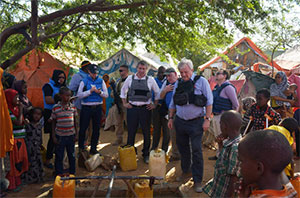 UN Emergency Relief Coordinator Visits Somalia. Credit: UN Photo/Tobin Jones
In recent years, conflicts have broken out across the world with no sign of slowing down or stopping. In times like this, millions of people globally are in dire need of humanitarian aid. Famine, warfare, natural disasters, and economic decline plague a host of nations, including Palestine, Sudan, Chad, Lebanon, and Haiti, to name a few. Humanitarian aid provides millions of people with critical services including healthcare, food, clean drinking water, psychosocial support, housing, and access to education. UN agencies such as the UNDP, UNICEF, the World Food Programme (WFP), UNHCR, UNRWA, and UNEP work with the UN Office for the Coordination of Humanitarian Aid (OCHA) and local organizations to come up with the best possible strategies to support affected communities. At the same time, humanitarian aid and those working on the frontlines are consistently threatened by both actors directly involved in conflict as well as those who are meant to contribute to the international humanitarian regime at large. The near-collapse of United States international aid structures in 2025, including the termination of 83% of USAID’s 6,300 global initiatives, has left millions of people without access to vital humanitarian assistance. 98 million people in 2025, only 65% of people targeted for humanitarian assistance, received the help they needed. In contrast, 123 million people received some form of humanitarian assistance in 2024, and OCHA’s 2026 Global Humanitarian Overview estimates that 239 million people are in need of assistance in 2026. IPS is well-positioned to discuss current initiatives to provide aid and relief through in-depth reporting and opinion content.

The Week with IPS

NEXT STOP - SDGs
Tracking global progress towards a sustainable world
Tracking global progress towards a sustainable world
