Languages
Tuesday, October 6, 2026



News and Views from the Global South
Aid

U.N.’s Post-2015 Development Agenda Under Fire
The U.N.’s highly ambitious post-2015 development agenda, which is expected to be finalised shortly, has come fire even before it could get off the ground.
Opinion: Developing Nations Set to Challenge Rich Ahead of SDG Summit
The final round of negotiations on the Sustainable Development Goals – the successor to the Millennium Development Goals, due to be inaugurated in September at the U.N. General Assembly – is now underway in New York.
Opinion: European Federalism and Missed Opportunities
"A serious political and social crisis will sweep through the euro countries if they do not decide to strengthen the integration of their economies. The euro zone crisis did not begin with the Greek crisis, but was manifested much earlier, when a monetary union was created without economic and fiscal union in the context of a financial sector drugged on debt and speculation.”
Clean Water Another Victim of Syria’s War
Caught in the grips of a summer heat-wave, in a season that is seeing record-high temperatures worldwide, residents of the war-torn city of Aleppo in northern Syria are facing off against yet another enemy: thirst.
Mideast Arms Build-up Negative Fallout from Iran Nuclear Deal
The nuclear agreement concluded last week between Iran and six big powers, the United States, Britain, France, Russia, China and Germany, is threatening to trigger a new Middle East military build-up – not with nuclear weapons but with conventional arms, including fighter planes, combat helicopters, warships, missiles, battle tanks and heavy artillery.
Opinion: Addis Outcome Will Impact Heavily on Post-2015 Agenda – Part 2
The United Nations is the only universal forum that connects systemic issues to the global partnership for development. The latter recognises North-South cooperation based on historical responsibility and varying levels of development and capacity among member states of the U.N.
Africa Advised to Take DIY Approach to Climate Resilience
African countries would do well to take their own lead in finding ways to better adapt to and mitigate the changes that climate may impose on future generations instead of relying only on foreign aid.
Opinion: Third FfD Conference Fails to Finance Development – Part One
The third Financing for Development (FfD) conference in Addis Ababa concluded last Thursday, July 16, in bad faith as developed countries rejected a proposal for a global tax body and dismissed developing countries’ compromise proposal to strengthen the existing U.N. committee of tax experts.
Opinion: A BRICS Bank to Challenge the Bretton Woods System?
The formal opening of the BRICS Bank in Shanghai on Jul. 21 following the seventh summit of the world’s five leading emerging economies held recently in the Russian city of Ufa, demonstrates the speed with which an alternative global financial architecture is emerging.
Caribbean Seeks Funding for Renewable Energy Mix
A leading geothermal expert warns that the small island states in the Caribbean face “a ticking time bomb” due to the effects of global warming and suggests a shift away from fossil fuels to renewable energy is the only way to defuse it.
Opinion: Strengthen Tax Cooperation to End Hunger and Poverty Quickly
By the end of this year, the 15-year time frame for the Millennium Development Goals will end, with good progress on several indicators, but limited achievements on others.
Opinion: Mandela Day – Where Do We Stand Today?
Today Jul. 18 is Mandela Day, the annual international day in honour of the late Nelson Mandela, the first democratically-elected President of the Republic of South Africa.
Civil Society Sceptical Over “Action Agenda” to Finance Development
Despite high expectations, the third International Conference on Financing for Development (FfD) ended on a predictable note: the United Nations proclaimed it a roaring success while most civil society organisations (CSOs) expressed scepticism over the final outcome.
Pledges for Humanitarian Aid Fall Far Short of Deliveries
When international donors pledge millions of dollars either for post-conflict reconstruction or for humanitarian aid, deliveries are rarely on schedule: they are either late, fall far below expectations or not delivered at all.
New Malaria Strategy Would Double Current Funding
Although malaria is both preventable and curable, it still killed an estimated 584,000 people in 2013, the majority of them African children.IMF Steps Up Lending to Achieve Sustainable Development
As the Third International Conference on Financing for Development opens in the Ethiopian capital, Addis Ababa, Monday, all eyes are on the United Nation’s post-2015 development agenda, billed as the most ambitious and far-reaching poverty eradication plan in the organisation’s history.
Earthquakes Don’t Kill, Buildings Do – Or Is It Inequity?
70-year-old Chiute Tamang was working in his field when the earth shook on Apr 25. He grabbed a tree. His wife and daughter were inside the house at the time, but managed to run out. In the blink of an eye, the building turned into a heap of stones. They were the lucky ones.“Get to Zero, Stay at Zero” – The Comprehensive Plan to End Ebola
"The threat is never over until we rebuild," Sierra Leone's President Ernest Bai Koroma stressed at an Ebola Recovery Conference Friday in New York.
Global Tax Body Sticking Point at Financing Conference in Addis
When the four-day-long international conference on Financing for Development (FfD) concludes in the Ethiopian capital later this week, one of the lingering questions in the minds of departing delegates may well be: did we really achieve anything concrete after years of negotiations?
Opinion: FfD Must Deliver for Least Developed Countries
Three years ago the United Nations initiated a conversation on a successor to the Millennium Development Goals (MDGs) and how the global community can lay foundations for an ambitious endeavour to eradicate extreme poverty, protect the planet, reduce vulnerability to shocks and ultimately raise the dignity of all humanity.
Water and Sanitation Urged as Focal Points at Addis Ababa
Ahead of the all-important International Financing for Development Conference in Addis Ababa, a top water charity has called upon world leaders to prioritise programmes for water, sanitation and good hygiene, so that no one is left behind.« Previous Page — Next Page »





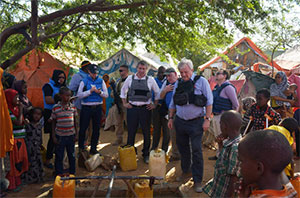 UN Emergency Relief Coordinator Visits Somalia. Credit: UN Photo/Tobin Jones
In recent years, conflicts have broken out across the world with no sign of slowing down or stopping. In times like this, millions of people globally are in dire need of humanitarian aid. Famine, warfare, natural disasters, and economic decline plague a host of nations, including Palestine, Sudan, Chad, Lebanon, and Haiti, to name a few. Humanitarian aid provides millions of people with critical services including healthcare, food, clean drinking water, psychosocial support, housing, and access to education. UN agencies such as the UNDP, UNICEF, the World Food Programme (WFP), UNHCR, UNRWA, and UNEP work with the UN Office for the Coordination of Humanitarian Aid (OCHA) and local organizations to come up with the best possible strategies to support affected communities. At the same time, humanitarian aid and those working on the frontlines are consistently threatened by both actors directly involved in conflict as well as those who are meant to contribute to the international humanitarian regime at large. The near-collapse of United States international aid structures in 2025, including the termination of 83% of USAID’s 6,300 global initiatives, has left millions of people without access to vital humanitarian assistance. 98 million people in 2025, only 65% of people targeted for humanitarian assistance, received the help they needed. In contrast, 123 million people received some form of humanitarian assistance in 2024, and OCHA’s 2026 Global Humanitarian Overview estimates that 239 million people are in need of assistance in 2026. IPS is well-positioned to discuss current initiatives to provide aid and relief through in-depth reporting and opinion content.

The Week with IPS

NEXT STOP - SDGs
Tracking global progress towards a sustainable world
Tracking global progress towards a sustainable world
