Languages
Sunday, November 8, 2026



News and Views from the Global South
Education

MALAYSIA: Proposal to Liberalise Campuses Weak – Students
For nearly four decades undergraduates in this country were banned from owning loud hailers - a powerful symbol of dissent in the 1970s.UKRAINE: Russian Language Toned Down
Russian speakers in Ukraine say the lack of state recognition for the biggest linguistic minority in Europe amounts to discrimination, but opponents argue that recognition will endanger the development of Ukrainian language.IRAQ: Students Fail, Like So Much Else
Living from one crisis to another, without electricity or freedom to move under a collapse of security, massive numbers of Iraqi students are failing their exams.
HEALTH: Time To Base Public Policy On Rights
Preaching abstinence to the young has not worked, nor has sex work been eradicated. Experts gathered here for the 17th International AIDS Conference say it is time to put public policies under the microscope and see why they have failed.
Q&A: “Condoms Have To Be Used To Be Useful”
Of the over 30 million people living with HIV, half are women and the rate of infections in women is rising, particularly in sub-Saharan Africa. What’s more, women’s rights groups say gender inequalities are fuelling the epidemic - there is an irrefutable feminisation of HIV.RUSSIA: Plan Putina Faces Pitfalls
Now as Russian Prime Minister, Vladimir Putin has started to pursue vigorously his own long-term strategic development plan that was used to garner votes during the last presidential elections.CHINA: Cheap Schools Carried Terrible Cost
The silence surrounding investigations into why so many schools collapsed during China's massive earthquake in May suggests Beijing's reluctance to face up to the fact that the failure of government education policies is partly to blame for the deaths of thousands of children.POLITICS-US: Vets Mull Wins and Losses in Benefits Fight
You could hear the joy in Patrick Campbell's voice as he reflected on U.S. President George W. Bush's signing Monday of a new GI Bill of Rights for veterans returning home from Iraq and Afghanistan.
SOMALIA: Fighting for an Education
"I like to study, even though there is fighting everywhere in Mogadishu," says Bashir Gedi, a 15-year-old student in the Somalian capital. "Education is more important for me because if I can get an education, then I can help rebuild my country."HEALTH-PORTUGAL: Latin American Doctors Fill the Breach
Portugal is trying to fill the vacuum left by the departure of many of the 2,000 Spanish doctors who have been contributing to the normal functioning of hospitals and clinics in the interior of the country, with Argentine, Cuban and Uruguayan doctors.LATIN AMERICA: Quality of Life at School Boosts Learning
The school environment is the factor that makes the greatest difference in student learning in Latin America and the Caribbean, according to UNESCO’s Second Regional Comparative and Explanatory Study (SERCE). Equality in the education system, however, is still a distant goal.SOUTH PACIFIC: Poverty Breeds Child Labour and Sex Tourism
Beyond the fabulous palm-fringed beaches and cascading waterfalls of the islands of the Pacific is a sordid reality - child labour and commercial sexual exploitation of children.CANADA: Apology Must Be Backed By Action, Native Leaders Say
In a long-sought acknowledgement of the federal government's role in creating Canada's racist residential school system as part of its cultural assimilation policies, Prime Minister Stephen Harper delivered a formal apology to Canadian First Nations in the House of Commons in Ottawa last week.PAKISTAN: Call to Demilitarise Aid
U.S. aid to Pakistan needs to put far greater emphasis on education and far less on the military than it has to date, a Brussels conference has been told.GREECE: And What an 18th Birthday Gift
Eighteen years after their birth in Greece, children of immigrants are suddenly made migrants, and asked to prove their right to live in a country where they were born and raised.PARAGUAY: University Students on the March Again
After nearly two decades of apathy, the university student movement in Paraguay has made a comeback, demanding a law to grant them rebates on public transport fares and opposing a draft law on higher education reform.NEPAL: Education Far More than ABCs – Experts
Far more than just the learning of ABCs and 123s, education should be playing a transformative role in children’s lives if it is to ensure them a better and more ‘equal’ and gender-responsive future.NEPAL: Gender Inequality in Education Has Deep Roots
A shortage of female teachers, lack of proper training, inadequate delivery of services and indifferent attitudes combine to add to gender inequality in education in this small Himalayan nation.LABOUR-SRI LANKA: Working Children Get Second Chance
Sujit is 22-years-old and studying hard to graduate in 2010 as a professional electrician. The handsome young man, speaking at a workshop on eliminating child labour, talked proudly of how his life changed dramatically when he was given the opportunity to enter an electrical course and re-start his life again.ECONOMY-AFRICA: HIV/AIDS Reduces Children’s Education Chances
Children who live in communities with an HIV prevalence rate of 10 percent or more have half a year of schooling less than children in other communities.EDUCATION-ASIA: Girls Should Go to School, Stay There
It is not enough that girls go to school - they must also remain in school and complete their education, a goal that educators, policymakers and communities all need to brush up on.« Previous Page — Next Page »





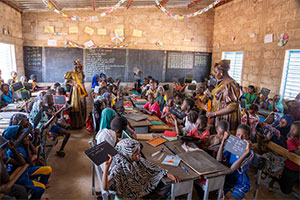 Two teachers work in a classroom in Forces Vives School in Dori, Burkina Faso. Credit: UNICEF/UNI978361
Safe and uninterrupted education is a fundamental right for all children. Education is paramount to global development, as it has been proven that investing in education – especially for girls and children – contributes significantly to economic growth and prosperity. Although more than 1 billion children go to school, many are subjected to conditions that are not conducive to a proper learning environment, including makeshift facilities, a lack of supplies, violence in classrooms, inadequate sanitation, untrained instructors, and widespread school closures. Since 2015, there have been immense gains in education with an increase of 109 million children in school. However, as of 2023, 272 million children are still out of school.
High poverty levels in developing countries also impede children’s access to a proper education. For example, from the early to mid 2000s, Sub-Saharan African nations witnessed a dramatic decline in trained teachers due to inadequate funding in the education sector. Furthermore, major cuts to United States international aid threaten an estimated 23 million additional children's access to education, as USAID‑funded school programmes across Africa and Asia face closure.
Various other factors contribute to the decline of education, notably hunger, which has increased as conflict and climate change interfere with global food production and dissemination. Meanwhile, certain social and cultural practices also impede children’s access to education, with gender inequality, discrimination, child labour, and child marriages preventing millions of children from attending school. Economic conditions such as the inaccessibility of higher education also affect disenfranchised communities across the world. In extreme situations, such as warfare where educational facilities are destroyed in their totality, notably in Gaza and Sudan, entire generations of children might grow up without access to education. Rebuilding educational infrastructure is a long and arduous process, especially when violence persists across generations, and this significantly stunts the development of societal prosperity and stability.
IPS is dedicated to telling the shocking truths about worldwide education through impassioned opinion pieces and comprehensive articles, highlighting global issues that impede worldwide education and the courses of action being taken by organizations such as UNICEF and Education Cannot Wait.

The Week with IPS

NEXT STOP - SDGs
Tracking global progress towards a sustainable world
Tracking global progress towards a sustainable world
