Languages
Tuesday, October 20, 2026



News and Views from the Global South
Education

Holistic Education Support in Colombia Extended to Counter Snowballing Learning Crisis
The largest external displacement crisis in Latin America’s recent history is unfolding as countries open their borders to an influx of refugees from Venezuela following unprecedented political turmoil, socio-economic instability, and a humanitarian crisis.
Politics Behind the Removal of Mughal History From Textbooks Say Academics
The removal from school textbooks of chapters covering the Mughal period of Indian history spanning three centuries has raised a storm of protests from academics.
Global Solidarity Needed to Address Taliban’s Attacks on Women’s Rights
Matiullah Wesa’s crime was to try to ensure young people got an education in Afghanistan. His recent forceful abduction by the Taliban offers the latest stark reminder that global solidarity and coherent action from the international community are needed to prevent the complete loss of the rights of women and girls in Afghanistan.
Education Cannot Wait Interviews H.E. Mr. Khalifa bin Jassim Al-Kuwari, Director-General, Qatar Fund for Development
Mr. Khalifa Jassim Al-Kuwari is the Director General of the Qatar Fund for Development (QFFD), managing the State of Qatar’s foreign aid and international development activities. Since 2014, he led the establishment, strategy-setting, operationalization, partnerships and funding programmes of the Qatar Fund for Development in various developing countries.

Positioning Education in Emergencies as Top Priority on International Agenda

The United Nations High Commissioner for Refugees, Filippo Grandi, speaks at the Education Cannot Wait (ECW) High-Level Financing Conference in February 2023 in Geneva. The event mobilized a record US$826 million for ECW and the global challenge to support the education of the 222 million girls and boys living in crises, positioning education in emergencies as a top priority on the international agenda.

Detoxifying Security: Recommendations for the G7 Summit on Nuclear Weapons
The current war in Ukraine has shown that nuclear deterrence is deeply flawed. It relies on the assumption of “rational actors” in power and credibility of threats, which we know are far from reality, especially in times of conflicts.
Transforming Education With Equitable Financing
With schools now reopened around the world, countries are called to take transformative action on education financing to recover and accelerate learning for all children, especially the poorest and most marginalized.
WORLD AUTISM AWARENESS DAY 2023
This is David. He is becoming an exceptional chess player. This is Mai. She loves beaches and the ocean. This is Kwame.

Our Wonderful Differences Enriches Societies
When is too much Autism awareness still not enough? This thought recurs every April as we near World Autism Day on April 2, and parents reach out to me after reading enthusiastic and well-meaning news and journal articles – which are actually harmful and hurtful.
Education Cannot Wait to Extend Multi-Year Resilience Programme in Colombia: Total Funding Tops US$28 Million
Education Cannot Wait (ECW) Executive Director Yasmine Sherif announced today that ECW intends to continue to expand its investments in Colombia. ECW’s support to the current Multi-Year Resilience Programme exceeds US$12 million, and the Fund has allocated an additional US$12 million for the next three-year phase, which, once approved, will bring the overall investment in Colombia to over US$28 million.
Quo Vadis Republic of Mauritius?
On 12th March 2023, The Republic of Mauritius celebrates 55 years of post-independence history. It would be an understatement to just say that there has been a lot of water under the bridge on our journey to self-determination!.. Indeed, we have made massive progress since we lowered the Union Jack and unfurled our own flag. It was and remains a moment of great pride whenever I see our flag in any international event, I participate in.
Burkina Faso Home to Almost Half of Closed Schools in Central & West Africa
Over a million children in Burkina Faso are currently affected by school closures with 6,134 academic institutions shut as of February 2023, an increase of over 40 per cent since the end of the last school year.
Keep Moving …
Only forty-five days into our new Strategic Plan 2023-2026, Education Cannot Wait secured 55 percent of its total requirement for the coming four years, reaching $826 million at #HLFC2023. This is a significant milestone for education in emergencies and protracted crises, and ECW will continue to pursue fund-raising year-round in the coming four years. The goal is to reach the target of 20 million children and adolescents affected by armed conflicts, climate-induced disasters and forced displacement.
Breaking Barriers: Why Free & Public Education Should be Every Woman’s Right
This month, government and civil society organization representatives gathered in New York for the United Nations’ 67th session of the Commission on the Status of Women (CSW) to discuss technology as a tool to facilitate access to education for women and girls.
Excluded Afghan Girls Forced to Seek Education in Pakistan
Hundreds of young women and girls are moving to Pakistan to continue their studies after the Taliban’s restrictions on women’s education in Afghanistan.
International Women’s Day, 2023
Empower Her
On International Women’s Day, let us remind ourselves of the power of education. We have all benefited from an education that less than a century ago was not a given for a girl and which still remains a distant utopia for millions of young girls.

International Women’s Day, 2023
Five Sharp Questions on Female Empowerment
International Women's Day is right around the corner and it presents an obvious opportunity to dig into what female and empowerment means for different people.

Forget ChatGPT: The Greatest Tech Breakthrough Would Be Getting Cell Phones to Rural Women
While 100 million people worldwide are using the AI chatbot ChatGPT to get ahead on homework and try out for top jobs at Google, more than 370 million women in developing countries lack the services of a simple cell phone.
The Brutal War on Ukraine Must End
Today with heavy hearts we mark 365 days of a brutal against Ukraine. Through this illegal act of aggression, over 450 children have been killed and another 900 injured. The shelling and bombing has damaged 3,000 educational institutions, and completely destroyed 420 schools and learning centers. As many as 5.7 million children have had their education disrupted, with no end in sight.
BRAC ‘Resets’ Program Aimed at Empowering Adolescent Girls in Africa
BRAC’s Empowerment and Livelihood Program (ELA) has benefitted tens of thousands of girls, and its recently released report shows an organization willing to adapt to the circumstances to continue to ensure adolescent girls and young women receive meaningful sexual and reproductive health rights support.
Climate Crisis is a Child Crisis and Climate-Resilient Children, Teachers and Schools Must Become Top International Agenda
From southern Ethiopia to northern Kenya and Somalia, the most severe drought in the last 40 years is unfolding. It is simply too hot to go to school on an empty stomach, and close to 3 million children are out of school, with an additional 4 million at risk of dropping out entirely across the Horn of Africa.« Previous Page — Next Page »





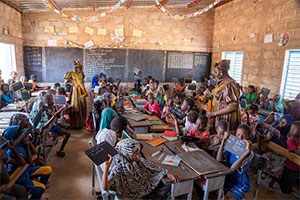 Two teachers work in a classroom in Forces Vives School in Dori, Burkina Faso. Credit: UNICEF/UNI978361
Safe and uninterrupted education is a fundamental right for all children. Education is paramount to global development, as it has been proven that investing in education – especially for girls and children – contributes significantly to economic growth and prosperity. Although more than 1 billion children go to school, many are subjected to conditions that are not conducive to a proper learning environment, including makeshift facilities, a lack of supplies, violence in classrooms, inadequate sanitation, untrained instructors, and widespread school closures. Since 2015, there have been immense gains in education with an increase of 109 million children in school. However, as of 2023, 272 million children are still out of school.
High poverty levels in developing countries also impede children’s access to a proper education. For example, from the early to mid 2000s, Sub-Saharan African nations witnessed a dramatic decline in trained teachers due to inadequate funding in the education sector. Furthermore, major cuts to United States international aid threaten an estimated 23 million additional children's access to education, as USAID‑funded school programmes across Africa and Asia face closure.
Various other factors contribute to the decline of education, notably hunger, which has increased as conflict and climate change interfere with global food production and dissemination. Meanwhile, certain social and cultural practices also impede children’s access to education, with gender inequality, discrimination, child labour, and child marriages preventing millions of children from attending school. Economic conditions such as the inaccessibility of higher education also affect disenfranchised communities across the world. In extreme situations, such as warfare where educational facilities are destroyed in their totality, notably in Gaza and Sudan, entire generations of children might grow up without access to education. Rebuilding educational infrastructure is a long and arduous process, especially when violence persists across generations, and this significantly stunts the development of societal prosperity and stability.
IPS is dedicated to telling the shocking truths about worldwide education through impassioned opinion pieces and comprehensive articles, highlighting global issues that impede worldwide education and the courses of action being taken by organizations such as UNICEF and Education Cannot Wait.

The Week with IPS

NEXT STOP - SDGs
Tracking global progress towards a sustainable world
Tracking global progress towards a sustainable world
