Languages
Friday, October 23, 2026



News and Views from the Global South
Education

Drought, Conflict and Forced Displacement Push Ethiopian Children Out of School
 A joint mission to Ethiopia by Education Cannot Wait (ECW), and Norway's International Development Minister has drawn attention to one of the world’s largest education crises that have left 3.6 million children out of school. The number of out-of-school children has spiked from 3.1 million to 3.6 million, according to UNICEF. However, ECW-funded schools provide children with ‘whole-of-child’ interventions, including school feeding, psychosocial support, teacher training, school materials, accelerated learning, gender transformative approaches, and the construction and rehabilitation of school facilities.

The Digital Divide: Africa the Least Connected with 60 percent of the Population Offline
The digital divide – between the world’s rich and poor nations —remains staggeringly wide. For over 2.7 billion people, many of them living in developing and least developed countries (LDCs), meaningful connectivity remains elusive, according to a UN report released during the 17th Internet Governance Forum in Addis Ababa, last month.
Dignity, Freedom and Justice
As we commemorate Human Rights Day, let us recall the opening preamble of the Universal Declaration of Human Rights of 1948: “Whereas recognition of the inherent dignity and of the equal and inalienable rights of all members of the human family is the foundation of freedom, justice and peace in the world… “
The Climate Crisis Disrupts the Education of 40 Million Children Every Year
The United Kingdom Foreign, Commonwealth and Development Office (FCDO) issued a ground-breaking Position Paper today that draws clear linkages between the climate crisis and global education crisis.
Climate Change Meets Conflict Pushing Millions of Children in Ethiopia Out of School
A silent catastrophe is unfolding in Ethiopia on the backdrop of years of inter-communal conflict and the most prolonged and severe drought in recent years. High inflation and food insecurity in the drought-ravaged country is among the worst in the world.
Toward Free Education for All Children – Momentum Building to Expand the Right to Millions
Education is fundamental for children’s development and a powerful catalyst for improving their entire lives. International human rights law guarantees everyone a right to education. But it surprises many to learn that the international human rights framework only explicitly guarantees an immediate right to free primary education—even though we know that a child equipped with just a primary education is inadequately prepared to thrive in today’s world.
Working Together for an Inclusive World
ECW works together with governments, UN agencies, civil society and the private sector for an inclusive world where all children with disabilities are able to go to school in safe and accessible learning environments. We work together for an inclusive world where the complex challenges of today offer up the transformative solutions of tomorrow.
Digital Human Rights Need to be Enshrined in Law
The upcoming consultation on the Global Digital Compact presents a unique opportunity to ensure that human rights in the digital world are protected in international common standards.
Every Child Has a Right to Realize the Human Potential
On World Children’s Day, we must remember what it means to be a child born with a right to reach the human potential. Nothing is more precious, more priceless, than a child growing towards that potential. And nothing is more despicable than to ignore the innocence and learning needs of a child in the process of becoming…
The Innovation Imperative for Small States
Small states take the path less travelled. They face challenges unfamiliar to many: scarce resources, smaller economies and the real impact of climate change.
Academics’ Strike Puts Spotlight on Nigeria’s Brain Drain
For eight months, the halls of Nigeria's universities and colleges remained silent – the result of a lecturers' strike brought upon by a wage and conditions of service dispute.
We Own Our Choice to Finance Education
There is a stillness to the tent as I enter. This is a place of loss and pain, yet also a place of resilience and hope; everything coming together all at once.
Education Cannot Wait Interviews Theirworld President Justin van Fleet
Justin van Fleet, Ph.D, is President of Theirworld and Executive Director of the Global Business Coalition for Education. Justin previously served as the Director of the International Commission on Financing Global Education Opportunity and Chief of Staff to the United Nations Special Envoy for Global Education and prior to that as a Fellow at the Brookings Institution’s Center for Universal Education.
COP 15: It’s Time to Decide on a Future
It is no secret that humankind’s past actions have accelerated the deterioration of ecosystems, negatively impacting our economies, societies, health, and cultures. It is estimated that humans have altered over 97% of ecosystems worldwide, to date. One million species are currently threatened with extinction (IPBES). The writing on the wall is clear. Our planet is in crisis. The sobering reality is that if we continue on our current trajectory, biodiversity and the services it provides will continue to decline, jeopardizing the achievement of the Sustainable Development Goals and our lives as we know them. The decline in biodiversity is expected to further accelerate unless effective action is taken to address the underlying causes of biodiversity loss. These causes are often justified by societal values, norms and behaviors. Some examples include unsustainable production and consumption patterns, human population dynamics and trends, and technological innovation patterns.
Education Cannot Wait and UNICEF, with Partners, Call for Substantial Increase in Funding for Crisis-Affected Children in the Democratic Republic of the Congo
The Director of Education Cannot Wait (ECW), Yasmine Sherif, and the UNICEF Representative, Grant Leaity, called on donors worldwide to provide US$45 million in urgent, additional funding to support ECW’s Multi-Year Resilience Programme in the Democratic Republic of Congo (DRC), a country facing one of the world’s most overlooked crises.
How Digital Can Drive a Green Recovery
As much of the world was starting to glimpse recovery from the COVID-19 pandemic, it now finds itself amid a cost-of-living crisis brought on by disruptions in global energy and food markets that are the result of conflict and climate change.
How to Get on Track to Eradicate Extreme Poverty
As we approach 2030, the Sustainable Development Goals look harder than ever to achieve. Shocks to the global economy caused by climate change, COVID-19, and conflict threaten humanity's survival. For the most vulnerable, trends are moving in the wrong direction with an additional 75 to 95 million people now living in extreme poverty compared to pre-pandemic World Bank projections. By the end of this year more than 657 million people will still be living in extreme poverty substantially more than in 2018.
Sharing Minds Can Change the World (Part 2)
When Elena Seungeun Lee discovered the extent of education inequity, she decided to do something about it. She started a YouTube channel, We Learn to Share, to teach online what she learned at school. We Learn to Share has become a student-led global NGO dedicated to bridging educational gaps, with more than 50 teenage volunteers from 11 countries and 29 high schools, and three universities around the world. We Learn to Share is solely led and run by teenagers who have beautiful sharing minds. This video was produced by Elena and fellow student Hyunsung Julie Lee.

Education Cannot Wait Interviews Sigrid van Aken, CEO Novamedia/Postcode Lottery Group
Sigrid van Aken is the CEO of Novamedia/Postcode Lottery Group, a private company with a social purpose, that brings together business and ideals. It sets up and operates Postcode Lotteries worldwide to raise funds for charity. With a lucky winning postcode (zipcode), neighbours win together. At the same time, thanks to these player communities, vital funding is raised for charities and good causes (yearly €825 million), making the Postcode Lottery Group the 3rd largest private charity donor in the world after the Bill & Melinda Gates Foundation and the Wellcome Trust.

What Stray Dogs Need in Thailand: Family and Love
When I started living in Thailand, I noticed something peculiar that I had never seen in other countries I had visited before. It was the stray dogs. I ran into so many stray dogs when jogging on the streets.
Deadly Smoke: Feeding Children Kills Cafeteria Staff
During my summer break this year, I read a news article about five school cafeteria workers who had died of lung cancer. Due to these incidents, a union of cafeteria workers, wearing their aprons and holding their lunch trays, held a protest in front of the President’s office on a scorching summer day. And it made us think about the devastating working conditions for the school lunch employees. Isn’t it so disheartening that we eat our school lunch at the expense of their health?« Previous Page — Next Page »





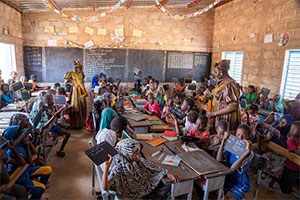 Two teachers work in a classroom in Forces Vives School in Dori, Burkina Faso. Credit: UNICEF/UNI978361
Safe and uninterrupted education is a fundamental right for all children. Education is paramount to global development, as it has been proven that investing in education – especially for girls and children – contributes significantly to economic growth and prosperity. Although more than 1 billion children go to school, many are subjected to conditions that are not conducive to a proper learning environment, including makeshift facilities, a lack of supplies, violence in classrooms, inadequate sanitation, untrained instructors, and widespread school closures. Since 2015, there have been immense gains in education with an increase of 109 million children in school. However, as of 2023, 272 million children are still out of school.
High poverty levels in developing countries also impede children’s access to a proper education. For example, from the early to mid 2000s, Sub-Saharan African nations witnessed a dramatic decline in trained teachers due to inadequate funding in the education sector. Furthermore, major cuts to United States international aid threaten an estimated 23 million additional children's access to education, as USAID‑funded school programmes across Africa and Asia face closure.
Various other factors contribute to the decline of education, notably hunger, which has increased as conflict and climate change interfere with global food production and dissemination. Meanwhile, certain social and cultural practices also impede children’s access to education, with gender inequality, discrimination, child labour, and child marriages preventing millions of children from attending school. Economic conditions such as the inaccessibility of higher education also affect disenfranchised communities across the world. In extreme situations, such as warfare where educational facilities are destroyed in their totality, notably in Gaza and Sudan, entire generations of children might grow up without access to education. Rebuilding educational infrastructure is a long and arduous process, especially when violence persists across generations, and this significantly stunts the development of societal prosperity and stability.
IPS is dedicated to telling the shocking truths about worldwide education through impassioned opinion pieces and comprehensive articles, highlighting global issues that impede worldwide education and the courses of action being taken by organizations such as UNICEF and Education Cannot Wait.

The Week with IPS

NEXT STOP - SDGs
Tracking global progress towards a sustainable world
Tracking global progress towards a sustainable world
