Languages
Thursday, October 8, 2026



News and Views from the Global South
Education

Corruption Swallows a Huge Dose of Water
While the United Nations marked this year’s World Water Day on March 22 focusing on the connection between water and jobs, a new report has rung loud alarm bells about the heavy impact of corruption on the massive investments being made in the water sector.Will Children of Colombia Know Peace at Last?
“No child in Colombia today knows what it is like to live in a country at peace,” said UN Children’s Fund’s (UNICEF) Representative in Colombia Roberto De Bernardi during the launch of a new report.
Water and Sanitation Challenges Amidst Social Inequality in Urban Areas in India
During the month of March 2016 and ironically very close to the World Water Day, the Supreme Court of India had to step in to resolve a water sharing dispute between three contiguous states including the National Capital Region. That, this was not the first time that the Supreme Court had to intervene is a stark indicator of the extent of the water crisis that is confronting India, a country that aspires to be a global power. Earlier Supreme Court had to step in to resolve a bitter dispute on water sharing between two Southern states of India – Karnataka and Tamil Nadu.
Reaping the Gender Dividend
For the first time, an all-female flight crew recently operated a Royal Brunei Airlines jet from Brunei to Jeddah in Saudi Arabia. Such a feat certainly appears noteworthy in a country where gender segregation is pervasive. When women are still not permitted to drive a car; where there are separate entrances for men and women in banks, is there a possibility of an all-female crew operating a Saudi Airlines plane from Jeddah to Brunei? Not immediately, as there are disturbing signs that the limited gains on the gender front might face reversals.
The List of Shame
He stood there at the reception, with a sling bag filled with documents. He worked for a courier company. He was 10 years old. He was handsome. And he had the brightest eyes I had ever seen before.Dhaka’s Risky Streets with Kids Driving Buses, Human Hauliers
In any country, one has to be an adult to qualify as a driver. But in Bangladesh, one does not have to obey that law to become a driver – and that literally means it is “allowed”.
Increasing Women’s Access to Skills and Jobs
"My daughter and I were a burden on my parents,” says 20-year-old Moushumi Akter Mou from Mirpur. Married off at the age of 14, Mou could not complete her schooling. After her daughter was born, her husband remarried, leaving her feeling vulnerable and hopeless. “I felt that if I had a job, my life might be worthwhile.”
Enriching Education in Bangladesh
About a year ago, seven year-old Afroza Khatun dropped out of school as her mother could not continue supervising her homework. The interruption in her grade II lessons was soon noticed by a teacher of an information education centre known as ENRICH, a state-funded programme which aims at supporting children who drop out to continue their education from the primary level (up to grade II).
Public Primary Boarding Schools in Pastoral Communities
Jonathan Tipapa is a nine year-old boy whose daily journey to and from school exposes him to many dangers that have seen him come close to dropping out of school -- like many of his friends who can be seen running after cows even on school days. He attends Enkutoto primary school in the expansive Narok South Constituency in the Rift Valley region, approximately 70 miles from the capital Nairobi.Toys of Violence
In this age of advanced technology, where violent forms of entertainment thrive on the screen and in cyberspace, parenting becomes a challenging task, as children want to emulate what they see. The adoption of a resolution last year by the Sindh Assembly demanding a ban on the manufacturing, import and sale of toy guns often used in actual hold-ups was a step in the right direction.
Schools are in for Summer
“We are extremely jubilant over the rebuilding of our school that the Taliban destroyed it in 2013, due to which we used to sit without a roof,” Mujahida Bibi, a student of 8th grade in Government Girls Middle School North Waziristan Agency, told IPS.Political Violence, “Rational Ignorance”, and “Political Illiteracy” in Bangladesh
There was yet another shocking headline in this daily (February 22): “Priest killed, devotee shot”. Some “unknown” assailants raided a Hindu temple, slit the throat of a priest, and shot a devotee at Panchagarh in northern Bangladesh. This wasn't a random violent crime. Of late, there is nothing exceptional about premeditated attacks on minority communities or on people holding divergent views on religion and politics across the country.
Radio rage in India
It is 8 am in Anugondanahalli village about 70 kms from India's IT hub of Bengaluru, capital of the southern Indian state of Karnataka. A group of farmers are huddled around a radio set sipping hot tea and tuned in to Sarathi Jhalak, a local community radio station (CRS) broadcasting on FM 90.4. On air is a programme about climate change that has everybody hooked. Experts are sharing simple tips on how farmers can pro-actively minimise the impact of erratic weather on their crops.
The New Normal in Fata
A military operation by Pakistan’s army has been proving fatal for Taliban militants who held sway over vast swathes of the Federally Administered Tribal Areas (Fata) for over a decade. They crossed over the border from Afghanistan and took refuge in Fata after their government was toppled by US-led forces towards the end of 2001. After a few years, when they got a toe-hold in the region, they extended their wings to all seven districts of Fata. Not any more.
Women and Girls Imperative to Science & Technology Agenda
Can you imagine an entire day without access to your mobile phone, laptop, or even to the internet? In our rapidly changing world, could you function without having technology at your fingertips?
Activists Accuse India of Violating UN Convention on Child Rights
Civil rights groups and child welfare activists have strongly protested against the enactment of a new Juvenile Justice Act by the Indian parliament, lowering the age of a legally defined juvenile for trial from 18 to 16- years old in heinous crimes cases.The State We’re In: Ending Sexism in Nationality Laws
Everyone has the right to be born with a nationality – safe, fearless and free – and secure in their human right to equally transfer, acquire, change or retain it. There is no reason why over 50 countries should still have sexist nationality and citizenship laws, which largely discriminate against women, potentially putting them and their families in danger and denying them the rights, benefits and services that everyone should enjoy.
One Fish Two Fish, No Fish: Rebuilding of Fish Stocks Urgently Needed
A major new study has revealed that the global seafood catch is much larger and declining much faster than previously known.
Tanzania: Girls Struggle to Avoid Forced Marriage, Yearn to Learn
Maria was barely 16 when her father removed her from school to marry her off to a man 20 years older than she was just so that the family could receive eleven cows as her dowry.
Fire a Hot Topic in Youth Employment in South Africa
Nolukhanyo Babalaza finished her final year of high school and received her diploma in 2000, but this was not an immediate passport to a good life. She was frustrated to see some people making it while she struggled to afford basic things like everyday food.
Science: Not Just a Western Sector, It Can Help Africa Too
Small-scale farmer Augustine Sibanda has grown resilient traditional sorghum varieties passed down through generations but has increased his yields after he adopted improved seed varieties developed through research.« Previous Page — Next Page »





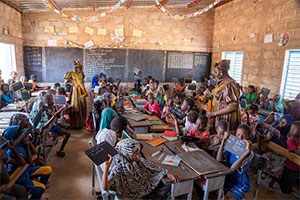 Two teachers work in a classroom in Forces Vives School in Dori, Burkina Faso. Credit: UNICEF/UNI978361
Safe and uninterrupted education is a fundamental right for all children. Education is paramount to global development, as it has been proven that investing in education – especially for girls and children – contributes significantly to economic growth and prosperity. Although more than 1 billion children go to school, many are subjected to conditions that are not conducive to a proper learning environment, including makeshift facilities, a lack of supplies, violence in classrooms, inadequate sanitation, untrained instructors, and widespread school closures. Since 2015, there have been immense gains in education with an increase of 109 million children in school. However, as of 2023, 272 million children are still out of school.
High poverty levels in developing countries also impede children’s access to a proper education. For example, from the early to mid 2000s, Sub-Saharan African nations witnessed a dramatic decline in trained teachers due to inadequate funding in the education sector. Furthermore, major cuts to United States international aid threaten an estimated 23 million additional children's access to education, as USAID‑funded school programmes across Africa and Asia face closure.
Various other factors contribute to the decline of education, notably hunger, which has increased as conflict and climate change interfere with global food production and dissemination. Meanwhile, certain social and cultural practices also impede children’s access to education, with gender inequality, discrimination, child labour, and child marriages preventing millions of children from attending school. Economic conditions such as the inaccessibility of higher education also affect disenfranchised communities across the world. In extreme situations, such as warfare where educational facilities are destroyed in their totality, notably in Gaza and Sudan, entire generations of children might grow up without access to education. Rebuilding educational infrastructure is a long and arduous process, especially when violence persists across generations, and this significantly stunts the development of societal prosperity and stability.
IPS is dedicated to telling the shocking truths about worldwide education through impassioned opinion pieces and comprehensive articles, highlighting global issues that impede worldwide education and the courses of action being taken by organizations such as UNICEF and Education Cannot Wait.

The Week with IPS

NEXT STOP - SDGs
Tracking global progress towards a sustainable world
Tracking global progress towards a sustainable world
