Languages
Friday, October 9, 2026



News and Views from the Global South
Education

Science: Not Just a Western Sector, It Can Help Africa Too
Small-scale farmer Augustine Sibanda has grown resilient traditional sorghum varieties passed down through generations but has increased his yields after he adopted improved seed varieties developed through research.
Maternal and Child Health Key to Kenya’s Economic Growth
On Friday, 06 November 2015, we had the honor of meeting the First Lady of Kenya Ms Margaret Kenyatta, a tireless advocate for “every woman and every child”, during the launch of the Beyond Zero campaign in Mandera County, North-Eastern Kenya, a place which has often been described as ‘the worst place on earth to give birth’.
Once Bitten, Twice Shy: Teen Mother Fights the Odds and Wants to be a Nurse
Being a single mother at the age of 19 is not what most teenage girls want for themselves. But this is the life Esther Mkwakwasa is living in Namphungo village in Mulanje District. Orphaned at the age of 14, Esther saw herself being moved from one foster home to another until she got pregnant.
India’s Children: Plagued by Preventable Diseases from Poor Sanitation
Though the state of Karnataka in India counts for a higher Human Development Index of 0.478 against the national average of 0.472 in the subcontinent, the continued deficit in water and sanitation continues and the children there are bearing the brunt of the lack of infrastructure.
TAIWAN: Polls Harken End of Nuclear Power
Taiwan may soon be the first nation in Asia to resolve to become a nuclear free nation after four decades of reliance on nuclear power.
Jamaica’s Drought Tool Could Turn the Table on Climate Change
On a very dry November 2013, Jamaica’s Meteorological Service made its first official drought forecast when the newly developed Climate Predictability Tool (CPT) was used to predict a high probability of below average rainfall in the coming three months.
Agroecology in Africa: Mitigation the Old New Way
Millions of African farmers don’t need to adapt to climate change. They have done that already.
India Needs to “Save its Daughters” Through Education and Gender Equality
Women constitute nearly half of the country's 1.25 billion people and gender equality -- whether in politics, economics, education or health -- is still a distant dream for most. This fact was driven home again sharply by the recently released United National Development Programme’s Human Development Report (HDR) 2015 which ranks India at a lowly 130 out of 155 countries in the Gender Inequality Index (GII). India trails behind most Asian countries, including lesser developed Bangladesh and Pakistan which rank 111 and 121 respectively, and fares not much ahead of war-ravaged Afghanistan at 152.
Wrong Time of the Month: a Rights Gap for Developing Countries’ Girls
The onset of menstruation is a landmark event in the life of a young woman. Yet many complications and challenges accompany such an event. One in 10 adolescent girls miss school and eventually drop out due to menstruation-related issues.
Hail to the Cowpea: a Blue Ribbon for the Black-Eyed Pea
2016 is the International Year of Pulses, and we at the International Institute of Tropical Agriculture are proud to be organizing what promises to be the landmark event, the Joint World Cowpea and Pan-African Grain Legume Research Conference.
2015 – A Giant Leap for Womankind (Part 2)
Against the backdrop of escalating extremism and conflict globally, 2015 also marked the 15th anniversary of Security Council resolution 1325 on Women and Peace and Security (WPS ) with a Global Study and Review on its effective implementation strongly addressing the impact of conflict on women and their essential role in conflict prevention, peacemaking and peace building. The landmark UNSC resolution 2242 (October 2015) calls for effective and accelerated implementation of the WPS Agenda by all actors.
2015 – A Giant Leap for Womankind (Part 1)
2015, the final year of the United Nation’s Millennium Development Goals (MDGs), heralds the beginning of the most critical fifteen years for the realization of the new Sustainable Development Agenda that the international community launched along with renewed Climate Change and Financing for Development (FfD) compacts.
Kitchen Gardens are Victory Gardens in Boosting Nutrition and Incomes in Western Kenya
Busia County in western Kenya is home to an array of indigenous vegetables. But for decades there has been a shift in popular taste leading to leading to little interest in what is indigenously grown. This relegated the vegetables to the periphery with most farmers cultivating kale and cabbages among other more exotic varieties.
Initiatives Revive Palestinian Heritage Boosting Economy and ‘Homeland’
Deep into the subtly monochrome landscape of the southern West Bank, Abu Ismaeel’s tent stands out amongst bare rolling hills that stretch into the horizon. A lonely gate, with no fence around it, signals the official entrance to two large tents in the Rashayda Desert.UN Sees Key Role for Women in Post-2015 Development Agenda
The United Nations, which has launched an intense world-wide campaign to ensure the full implementation of its post-2015 development agenda, is unequivocal in asserting that gender equality and women’s empowerment are indispensable to the realization of the 17 Sustainable Development Goals (SDGs) adopted by world leaders last September.
Malnutrition a Silent Emergency in Papua New Guinea
High up in the mountainous interior of Papua New Guinea (PNG), the most populous Pacific Island state of 7.3 million people, rural lives are marked by strenuous work toiling land in rugged terrain with low access to basic services.
Climate Smart Coffee and Banana Set to Boost East African Farmers’ Income
 Ugandan farmers are increasingly inter-planting coffee, the country’s primary export, and banana, a staple food, as a way of coping with the effects of climate change.
World’s Poor Trailing Far Behind Rich in Digital Technology
The world’s developing nations, numbering over 130, are still lagging far behind the 34 rich industrialized countries in the race for digital technology.
Disabled Persons Not Part of AIDS Success in Zimbabwe
Wheelchair-bound, her body now skeletal from full blown AIDS, disabled 38-year-old Melisa Chigumba attempts to wave away a swarm of flies hovering around her face as she sits outside her home in Chachacha, a remote area in Shurugwi, 278 kilometers south of the capital, Harare.
Weak Agriculture Finance Feeds Malnutrition in Zimbabwe
Successive poor harvests have diminished Ndodana Makhalima's household food stocks and the family’s nutrition status. A subsistence farmer in Lupane, about 110 kilometres north of Zimbabwe’s second city, Bulawayo, 56 year-old Makhalima has learnt to live with hunger on his door step.
Water and Sanitation: Bridging the Gender Gap on India’s Seas
Jeeja Behera, 34, the wife of a fisherman in the village of Sannapatna in India’s cyclone prone Puri district, dreads the onset of the cyclone season between October and January every year due to the lack of water, sanitation and hygiene in cyclone shelters.« Previous Page — Next Page »





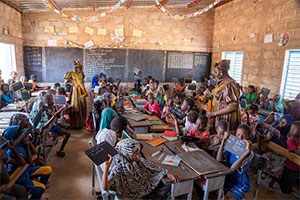 Two teachers work in a classroom in Forces Vives School in Dori, Burkina Faso. Credit: UNICEF/UNI978361
Safe and uninterrupted education is a fundamental right for all children. Education is paramount to global development, as it has been proven that investing in education – especially for girls and children – contributes significantly to economic growth and prosperity. Although more than 1 billion children go to school, many are subjected to conditions that are not conducive to a proper learning environment, including makeshift facilities, a lack of supplies, violence in classrooms, inadequate sanitation, untrained instructors, and widespread school closures. Since 2015, there have been immense gains in education with an increase of 109 million children in school. However, as of 2023, 272 million children are still out of school.
High poverty levels in developing countries also impede children’s access to a proper education. For example, from the early to mid 2000s, Sub-Saharan African nations witnessed a dramatic decline in trained teachers due to inadequate funding in the education sector. Furthermore, major cuts to United States international aid threaten an estimated 23 million additional children's access to education, as USAID‑funded school programmes across Africa and Asia face closure.
Various other factors contribute to the decline of education, notably hunger, which has increased as conflict and climate change interfere with global food production and dissemination. Meanwhile, certain social and cultural practices also impede children’s access to education, with gender inequality, discrimination, child labour, and child marriages preventing millions of children from attending school. Economic conditions such as the inaccessibility of higher education also affect disenfranchised communities across the world. In extreme situations, such as warfare where educational facilities are destroyed in their totality, notably in Gaza and Sudan, entire generations of children might grow up without access to education. Rebuilding educational infrastructure is a long and arduous process, especially when violence persists across generations, and this significantly stunts the development of societal prosperity and stability.
IPS is dedicated to telling the shocking truths about worldwide education through impassioned opinion pieces and comprehensive articles, highlighting global issues that impede worldwide education and the courses of action being taken by organizations such as UNICEF and Education Cannot Wait.

The Week with IPS

NEXT STOP - SDGs
Tracking global progress towards a sustainable world
Tracking global progress towards a sustainable world
