Languages
Saturday, November 21, 2026



News and Views from the Global South
Food and Agriculture
ENERGY: Planting New Seeds for the Take-Off
A salty, crunchy salad herb known to gourmands as samphire could revolutionise agriculture in the Middle East by providing food, fodder and fuel without using a single drop of freshwater.
Q&A: The Two Faces of Agriculture
The challenge of the 21st century is to transform agriculture into a good administrator of biodiversity and reverse its destructive capacity, without restricting its mission to feed a growing world population, said Achim Steiner, executive director of the United Nations Environment Programme.
RELIGION: Fighting Hunger – A Matter of Faith
The world's major religions might disagree on theology and matters like the foods we ought to eat and the days we should rest on, but when it comes to fighting hunger, they see eye to eye.
URUGUAY: Pulling Small Dairy Farmers Out of Poverty
"The problem is when you're too small, just too small," says Claudia Pérez, a small-scale dairy farmer in Uruguay, glancing to her left, where her pasture ends just 50 metres from her modest rural home.BIODIVERSITY: India Bans Farming of GM Aubergine
After India’s Environment Minister Jairam Ramesh announced Tuesday a ban on the cultivation of Bt brinjal, the country’s first genetically modified (GM) food crop, food security experts and activists said this major farming country has been saved from a biodiversity disaster.DEVELOPMENT: Crisis Could Open Doors for Change, Says UNCTAD
As the financial crisis continued to threaten world economies last year, the White House chief of staff Rahm Emanuel famously declared: "You never want a serious crisis to go to waste."
Q&A: ”There’s a Limit to Fish Harvesting”
The perilous state of the world's fish stocks has received less media attention than the more visible, palpable environmental problems like air pollution. Isabella Lövin is seeking to redress that balance. Her 2007 book ‘Tyst hav' (Silent Seas) hit the best-seller list in her native Sweden, garnering her three awards, including the title of 'Journalist of the Year'.
PERU: Women Combine Invention, Tradition to Improve Rural Diets
Although Huancavelica is the poorest region of Peru, it has more than just poverty, malnutrition and unmet needs. There are also women using their creativity, efforts and traditional indigenous knowledge to improve the diets of their families and communities.
PHILIPPINES: Street Kids Learn to Save in Times of Crisis
Since he dropped out of elementary school, 17-year old Cenen has been making a living for himself driving a borrowed motorised sidecar in the crowded streets of Binondo, a bustling business district in Manila, capital of the Philippines.
KENYA: Insuring Pastoralists Against Increasing Risks
The droughts in the Turkana region were less severe when she was growing up, says Laura Letapalel, and pastoralists could still find some grass and water for their animals. Now, she laments, the droughts are longer and there is nothing to eat.
PHILIPPINES: Economic Recovery Unfelt by Urban Poor – NGOs
Every day, 60-year old Felisa scavenges for garbage around the bustling streets of Manila, the urban capital of the Philippines.WORLD SOCIAL FORUM: Reconciling Social and Environmental Needs
One of the greatest challenges facing the world today is to attend to the urgent social needs of the planet’s population, and particularly the one billion people living "on the brink of survival", while dealing with the equally urgent demands of the environment.CUBA: Zeolite, Mineral of a Thousand Uses
Cuba, which has major reserves of zeolite, aims to boost exploitation of the mineral, whose properties and uses in products and technologies contribute to protecting the environment.BIODIVERSITY: EU Farmers Face Genetic Contamination of Seeds
Biodiversity, already decaying fast as a result of climate change and intensive farming, is under further threat by genetic modification (GM) of seeds, says a leading German ecological activist.AFGHANISTAN: Officials’ Optimism on Economy Belies Deep Poverty
Afghanistan may be one of the poorest countries in the world, but official figures do not quite paint a picture of a country deep in the throes of poverty and underdevelopment.ECONOMY-EUROPE: Czechs Bank on Cooperatives for Revival
The Czech Republic’s strong heritage of cooperative movements, dating from the interwar period, is serving as inspiration for new initiatives in the post-communist era and acting as "harbingers of a new global economic system".POLITICS: U.S. Taking New Tack on Afghan Poppies
Counter-narcotics and counterinsurgency often go hand-in-hand in Afghanistan, where the opium poppy trade bankrolls much of the Taliban's operations and greases political corruption.
ZIMBABWE: One Million Casualties of Land Reform
The seizure of large commercial farms - almost all white-owned - has continued despite the formation of a unity government in Zimbabwe. The country's farm workers say they are the biggest losers.
CHILE: Water a Matter of National Security
In its proposed constitutional reform, the Chilean government recognises that the availability of freshwater is a matter of national security. Environmentalists applaud the initiative, but some business groups are worried it will hurt their bottom line.DEVELOPMENT: Hunger Feeds More Hunger
German philosopher Friedrich Nietzsche was way off the mark when he wrote the famous line "what does not destroy me, makes me stronger" - at least when it comes to hunger.
ZIMBABWE: Water Scarcity No Obstacle To Bulawayo Farmers
A project in Zimbabwe's second city, Bulawayo, is creatively using "marginal water" to ease water scarcity while helping residents provide food and earn a living.« Previous Page — Next Page »


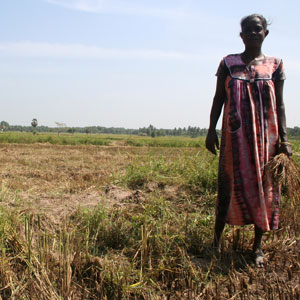
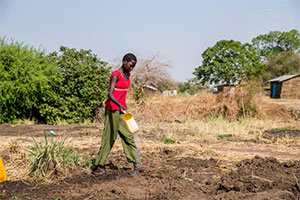 Farming on the Outskirts of Juba. Credit: UN Photo/JC McIlwaine
Promoting human and planetary health is a central focus of the United Nations, as laid out in the 2030 Sustainable Development Goals (SDGs). World hunger and unsustainable farming practices continue to be pressing concerns for the world. According to the 2025 State of Food Security and Nutrition in the World report by the Food and Agriculture Organization (FAO), 673 million people faced hunger in 2024. There are stark regional disparities, with the FAO projecting that 60% of the world population facing hunger will reside in Africa by 2030. Globally, the prevalence of food insecurity has remained consistently higher for women than men.
Sustainable and efficient national food systems are essential in preserving health, education, environmental well-being, peace, economy, and security. However, creating sustainable food systems can be a challenging endeavor, as food production takes a heavy toll on the environment. The agricultural sector accounts for a significant portion of greenhouse gases. Finding safe, sustainable, and ethical strategies to feed the world is crucial in ensuring planetary longevity. A recent initiative from 2023, the EU Regulation on Deforestation-free Products (EUDR), seeks to advocate for sustainable food systems. The main driver of deforestation is the expansion of agricultural land used to produce commodities like cattle, wood, cocoa, coffee, etc. The EUDR is part of the 2020 European Green New Deal and the EU Biodiversity Strategy for 2030 and aims to limit Europe’s consumption of products linked with deforestation by requiring that companies prove that their products are deforestation-free. Despite aiming to achieve major strides in sustainability, policies such as EUDR also raise socioeconomic concerns for targeted countries. Many emerging Latin American economies are impacted by the policy, and have raised the question of how developing countries can grapple with the tensions between economic development and advancing sustainability.
IPS has been at the forefront of providing compelling and insightful stories on communities facing hunger as well as the cost of food production. IPS uses statistics from FAO, the World Food Programme (WFP) and the International Fund for Agricultural Development (IFAD) to bring relevant and hard-hitting facts to readers. This gathering of information and data from such organizations helps bring the best stories from IPS journalists working in the different regions in consultation with experts on the ground.

The Week with IPS

NEXT STOP - SDGs
Tracking global progress towards a sustainable world
Tracking global progress towards a sustainable world