Languages
Tuesday, October 27, 2026



News and Views from the Global South
Food and Agriculture

El Niño’s Impact on Central America’s Small Farmers Is Becoming More Intense
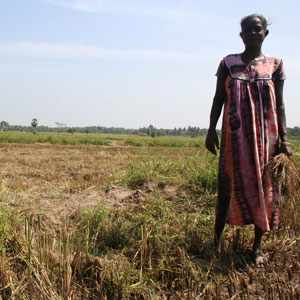
The effects of El Niño on agriculture in Central America are once again putting pressure on thousands of small farmer families who are feeling more vulnerable economically and in terms of food, as they lose their crops, due to climate change.
The Frogs Are Drying Up! Let’s Explore What We Can Do!
Have you ever seen a dried frog? We have, and it’s making us rethink our impact on the environment. Frogs are incredibly sensitive to dry conditions, and they are facing the threat of extinction due to global warming. Amphibians, like frogs, make up a significant portion of endangered species, with 41 percent vulnerable compared to only 25 percent for mammals like polar bears.
Growing Appetite for Nutrient-Rich Native Indigenous Australian Foods
Growing up in Sydney, Kalkani Choolburra, a Girramay, Kuku Yalanji, Kalkadoon and Pitta Pitta woman from Far North Queensland, would frequently travel with her family up and down Australia’s eastern seaboard. Her grandfathers and uncles would bring fresh catch of dugong, her favourite bush food, and she would go hunting for the short-necked turtle with her aunties and female cousins.
Innovative Family Farm in Cuba Uses Mix of Clean Energies
Combining technologies and innovations to take advantage of solar, wind, hydro and biomass potential has made the Finca del Medio farm an example in Cuba in the use of clean energies, which are the basis of its agroecological and environmental sanitation practices.
Food Loss and Waste: An Unacceptable Reality
In recent years, the population of Latin America and the Caribbean has seen a worrying increase in hunger figures, especially among the poorest in the region.
Wrecked by Climate Change, Farmers in Kashmir Shift to Lavender Cultivation
Mohammad Subhan Dar diligently tends to some bright purple plants on a four-acre farm in Bijbehara, a hamlet south of Kashmir’s capital, Srinagar. As you draw nearer, you’ll be mesmerized by the sight of sprawling lavender fields, where about 10 to 15 farmers, including Dar, prepare for a promising harvest.
Traffic on the Paraná Waterway Triggers Friction between Argentina and Paraguay
In addition to being a majestic river - the second longest in South America after the Amazon - the Paraná River is the waterway through which a large part of the area's primary goods are exported. Today, its economic importance has sparked an unexpected diplomatic conflict between Argentina and the countries with which it shares the basin.
Zimbabwe’s Food Security Ambitions in El Niño’s Crosshairs
Zimbabwe is riding a wave of food security assurances after what officials said was last year’s bumper grain harvest, but recent El Niño forecasts could test the country’s agriculture production ambitions.
Poverty & Hunger Eradication Targeted to Miss UN’s 2030 Deadline by Wide Margins
When the UN’s 193 member states reviewed the current status of the 17 Sustainable Development Goals (SDGs), including the eradication of extreme poverty and hunger by 2030, the verdict was mostly failures—and with little or no successes. The hunger/poverty nexus was best characterized by Alvaro Lario, President of the International Fund for Agricultural Development (IFAD), who warned last week that under current trends, 575 million people will still be living in extreme poverty in 2030—and as many people suffering from hunger by 2030 as in 2015 (600 million people).
Why Root Crops Are the Future of Food Security in Africa
Despite the dominance of the “Big Three” cereal crops and a steady rise in meat consumption, an overlooked food sector is projected to become ever more central to Africa’s food security and rural economic growth between now and 2050.
Treated Wastewater Is a Growing Source of Irrigation in Chile’s Arid North
The reuse of treated wastewater in vulnerable rural areas of Chile's arid north is emerging as a new resource for the inhabitants of this long, narrow South American country.
Elevating Farmers’ Income Through Organic Poultry Rearing
Even after toiling hard for an entire year, Shivaji Rao, a 37-year-old farmer, would find it hard to cover the basic expenses of his family. He cultivates maize from his one-and-a-half-acre land in India’s Southern State of Telangana.
Diversify American Cropping and Food Systems
A few weeks ago, my husband and I drove from Illinois to Iowa to visit a friend. I was excited about my over 5 hours’ drive. Sadly, 60 minutes into the drive, my excitement fiddled out. I was bored. Field after field, as far as my eyes could see, all I saw was either corn or soybean. I also noticed that the field margins were empty-with no sight of wildflowers.
African Startups Mull Home-Grown Solutions to Combat Climate Change
A group of young African startups made their presence known at the Africa Climate Summit in Nairobi, Kenya, hoping to play a big role in promoting home-grown climate-oriented solutions.
Hunger in East Africa Is a True Testament to Climate Injustice
From 2017, Shamso Isac has helplessly witnessed the demise of all her sources of income. Failed rain seasons and dried-up water sources meant a lack of pasture, which led to the death of her livestock. Widespread hunger exacerbated by rising food costs forced her to relocate to Burlhedi internally displaced persons camp in Baidoa in the Southwest state of Somalia. She recalls walking for weeks seeking a place she could get food for her family. When her child asks for something to eat or drink, she has nothing to offer; all she can do is cry, overwhelmed by the utter hopelessness she feels.
Toothless Global Financial Architecture Fuelling Africa’s Climate Crisis
As thousands convene in Kenya’s capital, Nairobi, for the Africa Climate Summit, the first time the African Union has summoned its leaders to solely discuss climate change under the theme ‘Driving Green Growth and Climate Finance Solutions for Africa and the World’, the backdrop is a country on the frontlines of a climate crisis.
Africa’s Potential: Leading Food System Transformation and Climate Resilience
When a continent with 65% of the world’s arable land struggles to feed its 1.4 billion people, we know something is wrong. The African and global food systems need a rethink. The urgent and pressing need to address a more productive, transparent, equitable food system, poverty and the far-reaching effects of climate change requires us to forge alliances among diverse stakeholders and sectors.
Invasive Species, Fast-Riding Horsemen Galloping the Biodiversity Apocalypse
Mango farmer Eufria Nyadome used to earn USD 60 from selling a 20-litre bucket of fresh mangoes and now can barely make USD 20 even though her mango trees are giving a good yield. She is throwing away buckets of rotten mangoes.
New Challenges in Agriculture in the Face of the El Niño Phenomenon
The climatic phenomenon known as "El Niño" is intensifying its presence worldwide. Projections are not favorable for the countries of the Latin America region. Below-normal rainfall is expected in Honduras, Guatemala, El Salvador, Nicaragua, northern Venezuela, Colombia, Bolivia, inland Peru, Guyana, and Suriname.
Mushroom Workers Want a Union
The Yakima River runs southeast from the Cascade Mountains through central Washington state to merge with the Columbia a little north of Oregon. From the small city of Yakima on down, its course broadens from a winding canyon into a wide valley bounded by austere low ridges of gray-green sagebrush and tawny grasses. In mid-April, the new leaves of the willows and cottonwoods light up the riverbanks with luminous chartreuse.
From Challenges to Solutions: Unleashing Africa’s Potential for Achieving SDGs
September 2023 marks the halfway point to the deadline for achieving the 2030 Agenda and the Sustainable Development Goals (SDGs). Yet, globally we are still far off-track, and Africa is only halfway towards achieving the SDGs, with nearly 600 million Africans still lacking access to electricity and 431 million people living in extreme poverty.« Previous Page — Next Page »





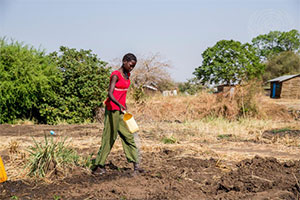 Farming on the Outskirts of Juba. Credit: UN Photo/JC McIlwaine
Promoting human and planetary health is a central focus of the United Nations, as laid out in the 2030 Sustainable Development Goals (SDGs). World hunger and unsustainable farming practices continue to be pressing concerns for the world. According to the 2025 State of Food Security and Nutrition in the World report by the Food and Agriculture Organization (FAO), 673 million people faced hunger in 2024. There are stark regional disparities, with the FAO projecting that 60% of the world population facing hunger will reside in Africa by 2030. Globally, the prevalence of food insecurity has remained consistently higher for women than men.
Sustainable and efficient national food systems are essential in preserving health, education, environmental well-being, peace, economy, and security. However, creating sustainable food systems can be a challenging endeavor, as food production takes a heavy toll on the environment. The agricultural sector accounts for a significant portion of greenhouse gases. Finding safe, sustainable, and ethical strategies to feed the world is crucial in ensuring planetary longevity. A recent initiative from 2023, the EU Regulation on Deforestation-free Products (EUDR), seeks to advocate for sustainable food systems. The main driver of deforestation is the expansion of agricultural land used to produce commodities like cattle, wood, cocoa, coffee, etc. The EUDR is part of the 2020 European Green New Deal and the EU Biodiversity Strategy for 2030 and aims to limit Europe’s consumption of products linked with deforestation by requiring that companies prove that their products are deforestation-free. Despite aiming to achieve major strides in sustainability, policies such as EUDR also raise socioeconomic concerns for targeted countries. Many emerging Latin American economies are impacted by the policy, and have raised the question of how developing countries can grapple with the tensions between economic development and advancing sustainability.
IPS has been at the forefront of providing compelling and insightful stories on communities facing hunger as well as the cost of food production. IPS uses statistics from FAO, the World Food Programme (WFP) and the International Fund for Agricultural Development (IFAD) to bring relevant and hard-hitting facts to readers. This gathering of information and data from such organizations helps bring the best stories from IPS journalists working in the different regions in consultation with experts on the ground.

The Week with IPS

NEXT STOP - SDGs
Tracking global progress towards a sustainable world
Tracking global progress towards a sustainable world