Languages
Sunday, October 25, 2026



News and Views from the Global South
Food and Agriculture

Why the UN COP28 Climate Talks Must Serve Farmers to Achieve a “Just Transition”
Food and agriculture is a top agenda item at UNFCCC COP28, as the world considers how to tackle the climate impacts of what we eat and how we produce it. The stage has been set for COP28 to be a “food COP”, but for commitments to translate to action, it must also be a “farmers’ COP”.
Ten African Countries to Benefit From USD 100 Million Released by Green Climate Fund
The Green Climate Fund (GCF) has announced the release of USD 100 million at the ongoing United Nations Framework Convention on Climate Change (UNFCCC) 28th Conference of Parties (COP 28) in Dubai, UAE, to support 10 African countries in adapting food loss reduction solutions.
Pacific Leaders Announce Largest Conservation Effort in History
Pacific people live at the nexus of oceans, climate, and food systems, and the interaction of climate and ocean is raising sea temperatures and threatening habitats and resources vital to the region’s sustenance, Palau’s President Surangel Whipps, Jr., said at the launch of an effort to protect and rejuvenate the region's ecosystems and empower communities through to the year 2050—in what is considered to be the biggest single conservation effort in history—Unlocking Blue Pacific Prosperity.
Why Agroecology Should Be Considered as Key for Climate Negotiations
Students of St Denis Libolina Primary have used agroecology farming techniques to transform the entire school garden and any free space into food forests and gardens for different vegetable varieties, legumes, and herbs. Now the students, who are physically challenged, have challenged their parents, villagers, and farmers in the outskirts of Myanga Township, in Kenya’s Bungoma County, in the Western region, to do the same.
Salvadoran Rural Communities Face Climate Injustice
For decades, poor fishing and farming communities in southern El Salvador have paid the price for the electricity generated by one of the country's five dams, as constant and sometimes extreme rains cause the reservoir to release water that ends up flooding the low-lying area where the families live.
Tackling Agrifood Inequality Can Boost the Bottom Line
Objections to progressive policies are often based on cost. It would be great to have a fairer, more sustainable world, the argument goes, but where will the money come from to pay for it?
Call for Rural Agriculture Investment, Less Food Wastage to Address Global Hunger
The politics of global food consumption remain contentious, with the upcoming COP28 taking place against the backdrop of worsening food deficits in the Global South.
Indigenous Voices and Food Systems Lead the Way at COP28
In a groundbreaking development, indigenous farmer communities are poised to bring the spotlight onto food systems at the upcoming UN Climate Conference (COP28) in Dubai.
Improving Livestock Health Is a Net Positive Move Towards Net Zero
The recent downturn in sales of alternative meat products is only the latest evidence that the world is unlikely to give up animal protein completely in the long run.
Smallholder Farmers Gain Least from International Climate Funding
Smallholder farmers from the Global South benefit from a grossly disproportionate 0.3% of international climate finance despite producing a third of the world's food and despite holding the key to climate-proofing food systems.
Time to Convert Climate Change Rhetoric into Action, Says WFP’s Gernot Laganda
It is crucial to narrow the gaps and ensure that climate finance goes to where people are most vulnerable, says Gernot Laganda, Director of Climate Change Adaptation and Disaster Risk Reduction at the United Nations World Food Programme (WFP)—especially as the most fragile states only receive USD 2.1 per capita while non-fragile states receive USD 161.
Shared Responsibility: Eradicating Hunger in Latin America and the Caribbean
The figures published by the latest Regional Overview of Food Security and Nutrition 2023 are cause for great concern. The document is clear: hunger continues to significantly affect Latin America and the Caribbean.
Recognizing Food & Land-Use Systems as Contributors to Climate Change
For a long time, the agriculture sector has been heralded as a success story for India. Spurred by the Green Revolution, it provided a path-breaking solution to feed the country's burgeoning population starting in the 1960s.
Fighting Malnutrition and Changing Mindsets in Rwanda
Of the many things one might associate with a modern teenager, passion for wholegrain food is probably not the first that comes to mind. An innovative school-meals project in Rwanda, however, has young people singing its praises.
Kashmir’s Apple Industry Faces Dire Threats as Climate Change Takes its Toll
Of Kashmir’s seven million inhabitants, a staggering one million rely directly on apple farming. The region is pivotal in India’s apple and horticulture production, contributing to over 70 percent of the country’s apple supply. This not only provides income to farmers but also sustains a vast network of laborers, traders, and transporters within the fruit economy.
Women Correct Historical Injustices, Build Climate Resilience Through Cash Pooling
Although women account for more than three-quarters of the agricultural labour force and manage 40 percent of small-scale farms, historically, they neither owned nor controlled the land because land rights were passed down to male relatives. It is a historic gender injustice whereby women could only access land through close male relatives.
Innovative Financial Services Transform Agricultural Entrepreneurship in Africa
Smallholder agricultural enterprises in Africa face a lot of challenges getting loans from financial institutions like banks due to the stringent requirements they can hardly fulfil. Investor confidence is usually lacking, given the risks involved in this sector of the economy.
Back to Nature to Avoid Water Collapse in the Capital of Chile
A return to nature is the main solution being promoted by communities and municipalities to avoid the water shortage that threatens to leave Santiago, the capital of Chile, home to more than 40 percent of the 19.5 million inhabitants of this South American country, without water.
What is Happening in Gaza is “Inhumane, illegal, and Unacceptable”
Last August, 91 UN member states, “in a demonstration of solidarity and commitment”, signed a U.S.-Led Joint Communiqué condemning the Use of Food as a Weapon of War. Roughly 345 million people – in 79 countries – face acute food insecurity, often caused or exacerbated by armed conflicts, the US said, pointing out that the joint communiqué was born out of the United States’ resolve to once again use its UN Security Council presidency to draw attention to conflict-induced food insecurity.
Community Solutions Combat Water Shortages in Peru’s Highlands
The lack of water is so severe in Peru's highlands that farming families are forced to sell their livestock because they cannot feed them. "There is no grass or fodder to feed them," says Fermina Quispe, a Quechua farmer from a rural community located at 4,200 meters above sea level.
WORLD FOOD DAY 2023

Water is essential for life on Earth. It makes up 50% of our human bodies. It covers about 70% of the planet’s surface.
« Previous Page — Next Page »





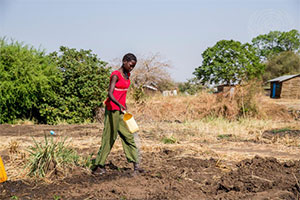 Farming on the Outskirts of Juba. Credit: UN Photo/JC McIlwaine
Promoting human and planetary health is a central focus of the United Nations, as laid out in the 2030 Sustainable Development Goals (SDGs). World hunger and unsustainable farming practices continue to be pressing concerns for the world. According to the 2025 State of Food Security and Nutrition in the World report by the Food and Agriculture Organization (FAO), 673 million people faced hunger in 2024. There are stark regional disparities, with the FAO projecting that 60% of the world population facing hunger will reside in Africa by 2030. Globally, the prevalence of food insecurity has remained consistently higher for women than men.
Sustainable and efficient national food systems are essential in preserving health, education, environmental well-being, peace, economy, and security. However, creating sustainable food systems can be a challenging endeavor, as food production takes a heavy toll on the environment. The agricultural sector accounts for a significant portion of greenhouse gases. Finding safe, sustainable, and ethical strategies to feed the world is crucial in ensuring planetary longevity. A recent initiative from 2023, the EU Regulation on Deforestation-free Products (EUDR), seeks to advocate for sustainable food systems. The main driver of deforestation is the expansion of agricultural land used to produce commodities like cattle, wood, cocoa, coffee, etc. The EUDR is part of the 2020 European Green New Deal and the EU Biodiversity Strategy for 2030 and aims to limit Europe’s consumption of products linked with deforestation by requiring that companies prove that their products are deforestation-free. Despite aiming to achieve major strides in sustainability, policies such as EUDR also raise socioeconomic concerns for targeted countries. Many emerging Latin American economies are impacted by the policy, and have raised the question of how developing countries can grapple with the tensions between economic development and advancing sustainability.
IPS has been at the forefront of providing compelling and insightful stories on communities facing hunger as well as the cost of food production. IPS uses statistics from FAO, the World Food Programme (WFP) and the International Fund for Agricultural Development (IFAD) to bring relevant and hard-hitting facts to readers. This gathering of information and data from such organizations helps bring the best stories from IPS journalists working in the different regions in consultation with experts on the ground.

The Week with IPS

NEXT STOP - SDGs
Tracking global progress towards a sustainable world
Tracking global progress towards a sustainable world