Languages
Tuesday, October 27, 2026



News and Views from the Global South
Food and Agriculture

Digging Africa Deeper into Hunger
Annual Green Revolution Forum ignores widespread failure of its push for industrialized agriculture
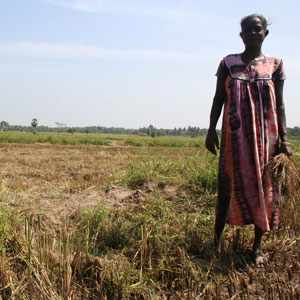
As the adage goes, when you find yourself stuck in a hole, stop digging. As African leaders and their philanthropic and bilateral sponsors prepare for another glitzy African Green Revolution Forum, convening September 5-8 in Dar es Salaam, Tanzania, they are instead handing out new shovels to dig the continent deeper into a hunger crisis caused in part by their failing obsession with corporate-led industrialized agriculture.

Empowering Asia’s Farming Communities through Inclusive Business
When Lisa Huyen first set up her company, Vinasamex, which specializes in certified organic cinnamon and star anise grown in the mountainous and poorer provinces of Viet Nam, she faced daunting challenges including market access and securing financial support from banks.
A Plea for a UN Summit on the Global Food Crisis
A coalition of civil society organizations, (CSOs), including climate activists, anti-poverty campaigners and celebrity chefs, are among those calling for an emergency meeting of world leaders on the global food crisis during the UN General Assembly (UNGA) sessions in New York next month.
Unlocking Africa’s Potential: Strengthening Partnerships for Sustainable Progress
At this year’s G7 summit in Japan, global leaders emphasized the importance of unity as the world navigates grave threats to multilateralism. The message was clear - trusted global platforms for dialogue and solutions are extremely crucial in current times.
Vaccine Equality Is as Vital for Livestock as for People
El Castellar - For 33-year-old mother-of-seven and poultry farmer Helena Kindole in Chanya village in Tanzania, one of the main barriers to growing her chicken business is a lack of access to health services. But not for herself or her family – for her animals.
Unregulated Agrochemicals Harm Health of Rural Residents in Central America
In his green cornfield, Salvadoran farmer Medardo Pérez set about filling the hand-held spray pump that hangs on his back, with the right mixture of water and paraquat, a potent herbicide, and began spraying the weeds.
Building Agricultural Resilience in a Changing Climate: Strategies to Safeguard Crop Production Amidst Extreme Weather Events
Across the U.S., and around the world, extremes in weather patterns, from drought to excessive heat to flooding to wildfires to outbreaks of insect pests and disease have become frequent and are predicted to continue to become more intense because of climate change, and the warming of our planet.
Pre-Colonial Delicacy Could Help Food Security and Climate Change
Kenya’s fight for food security may have just gone ‘Old School’ as Egerton University dons win a grant to help bring back a pre-colonial delicacy that was gradually sliding its way off consumers’ plates. Their project, dubbed ‘Exploring Potential of Togotia (Erucastrum arabicum), a forgotten African leafy vegetable for nutritional security and climate adaptation in Kenya,’ won the grant in October last year in a bid to help farmers and consumers realise the importance of the crop that many, today, term as a weed.
Political Will and Investment Will Score the Goal for Zero Hunger
A world free from hunger is possible, but it demands political will, investment, and effective policies to transform agriculture and rural development, says Alvaro Lario, President of the International Fund for Agricultural Development (IFAD).
Disappearing Fish Spell Hard Times for Women in Zimbabwe
Zimbabwe's ballooning informal sector has, in recent years, spawned the over-exploitation of the country's natural resources, with the fisheries taking some of the most felt battering.
Empowering Women in Assam: Livestock Farming Brings Economic Relief Post-COVID
Seema Devi is a 39-year-old woman hailing from India's northeastern state of Assam. She lives in a village called Milonpur, a small hamlet with no more than 1 000 inhabitants. While most men from the village, including Devi's husband, move to cities and towns in search of work, women are left behind to take care of the house and kids.
G20: Cutting Food Loss and Waste is an Opportunity to Improve Food Security
With the ongoing global food crisis—triggered by the COVID pandemic, disasters, supply chain disruptions, and conflict in Ukraine—food security should be at the top of the G20 agenda when countries gather in India in September 2023.
From Crisis to Resilience: We Need a New Recipe to Combat Hunger
The fragile state of global food systems has reached a crossroads. Recent headlines underscore the profound challenges we now confront.
Zimbabwean Farmers Turn to Agroecology to Feed Their Families
When Nelson Mudzingwa arrived in the Shashe farming area in Mashava in Masvingo, about 294 kilometres from the capital Harare, in the early 2000s, the land was barren, with no hope that the soils could be suitable for farming.
Putin’s Many Paradoxes & Russia’s Weaponisation of Food
Russia’s special military or colonization operation in Ukraine continues to surprise. These surprises come from a decided absence of strategic thinking by Vladimir Putin and the Kremlin.
Clock Is Ticking For Food Security In Africa, Says New IITA Head
“My key message is really simple,” says Dr Simeon Ehui, the newly-appointed Director General of the International Institute of Tropical Agriculture (IITA), which works with partners across sub-Saharan Africa to tackle hunger, poverty and natural resource degradation.
Women Shatter Gender Barriers in Uganda’s Fish Farming Industry
In a groundbreaking turn of events, women in Bugiri District, Eastern Uganda, have defied societal norms and broken into the traditionally male-dominated fish farming industry.
Health, Nutrition & Heroes in Rural Afghanistan
The needs of Afghanistan’s children and families are immense. So are the efforts of those supporting them: teams of community workers made up of family members, teachers in community-based schools, vaccinators, and health workers working around the clock to bring life-saving services in the face of an unfolding humanitarian catastrophe.
Biodigesters Light Up Clean Energy Stoves in Rural El Salvador
A new technology that has arrived in rural villages in El Salvador makes it possible for small farming families to generate biogas with their feces and use it for cooking - something that at first sounded to them like science fiction and also a bit smelly.
New Machine Learning-Based Model Boosting Africa’s Preparedness and Response to Climate Change
Scientists have recently unveiled a first-ever weather forecasting model using artificial intelligence (AI) and machine learning solutions to help vulnerable African countries build resilience to climate impacts.
Water Stress, a Daily Problem in the Agro-Exporting South of Peru
Living without water in a desert area is part of the daily life of Ortensia Tserem, a member of the indigenous Wampis people from the Amazon rainforest of northeastern Peru, who came three years ago to the outskirts of the coastal city of Ica with the dream of better economic opportunities for her family.« Previous Page — Next Page »





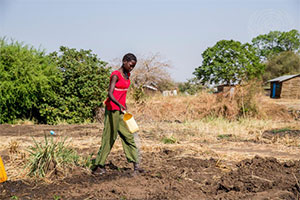 Farming on the Outskirts of Juba. Credit: UN Photo/JC McIlwaine
Promoting human and planetary health is a central focus of the United Nations, as laid out in the 2030 Sustainable Development Goals (SDGs). World hunger and unsustainable farming practices continue to be pressing concerns for the world. According to the 2025 State of Food Security and Nutrition in the World report by the Food and Agriculture Organization (FAO), 673 million people faced hunger in 2024. There are stark regional disparities, with the FAO projecting that 60% of the world population facing hunger will reside in Africa by 2030. Globally, the prevalence of food insecurity has remained consistently higher for women than men.
Sustainable and efficient national food systems are essential in preserving health, education, environmental well-being, peace, economy, and security. However, creating sustainable food systems can be a challenging endeavor, as food production takes a heavy toll on the environment. The agricultural sector accounts for a significant portion of greenhouse gases. Finding safe, sustainable, and ethical strategies to feed the world is crucial in ensuring planetary longevity. A recent initiative from 2023, the EU Regulation on Deforestation-free Products (EUDR), seeks to advocate for sustainable food systems. The main driver of deforestation is the expansion of agricultural land used to produce commodities like cattle, wood, cocoa, coffee, etc. The EUDR is part of the 2020 European Green New Deal and the EU Biodiversity Strategy for 2030 and aims to limit Europe’s consumption of products linked with deforestation by requiring that companies prove that their products are deforestation-free. Despite aiming to achieve major strides in sustainability, policies such as EUDR also raise socioeconomic concerns for targeted countries. Many emerging Latin American economies are impacted by the policy, and have raised the question of how developing countries can grapple with the tensions between economic development and advancing sustainability.
IPS has been at the forefront of providing compelling and insightful stories on communities facing hunger as well as the cost of food production. IPS uses statistics from FAO, the World Food Programme (WFP) and the International Fund for Agricultural Development (IFAD) to bring relevant and hard-hitting facts to readers. This gathering of information and data from such organizations helps bring the best stories from IPS journalists working in the different regions in consultation with experts on the ground.

The Week with IPS

NEXT STOP - SDGs
Tracking global progress towards a sustainable world
Tracking global progress towards a sustainable world