Languages
Friday, October 9, 2026



News and Views from the Global South
Food and Agriculture

Cook Islands Entrepreneur Develops Hydroponics Greenhouse to Boost Local Food Production
Finding ways to be smarter producers of food was a priority in small island developing states (SIDS) before the outbreak of Covid-19. Now the ideas of farmers and entrepreneurs, such as Piri Maao in the Cook Islands, are being avidly sought by governments and development bodies, which are keen to drive resilience and recovery as the pandemic moves into its second year.
Railroads Drive Expansion of Soybean Cultivation in Brazil’s Amazon Region
The sea of soybeans that sprouts every November will spread even further in the state of Mato Grosso if three new railway lines that would boost soy production in central-western Brazil and growing parts of the Amazon rainforest are built.
Eastern Caribbean Youth Join Calls for Resilient Global Food Systems
As the international community prepares for the landmark United Nations Food Systems Summit, a pivotal gathering as part of a global goal to tackle food insecurity, hunger, biodiversity loss, and climate change through sustainable food production, Caribbean youth say the successful transformation of food systems must include young innovators.
Smartphone App Helps Fijians to Grow and Eat Healthier Food
A smartphone app in Fiji is helping users to not only eat better but to help grow food that will contribute to a more nutritious diet.
Woman Farmer Shows Way as Small Island Developing State Battles Pandemic’s Impacts
A woman farmer in Samoa is using innovation and technology to overcome economic hardship as the Pacific Island nation seeks ways to adapt to the challenges resulting from the Covid-19 pandemic.
Solutions to Food Insecurity Top Agenda in Meeting of Small Island Developing States
The urgency of finding solutions to the most pressing development challenges of our times has increased as the Covid-19 pandemic threatens to reverse the global momentum in recent years toward achieving the Sustainable Development Goals (SDGs). And small island developing states (SIDS), with their physical remoteness, restricted land and resources and dependence on trade and tourism, are experiencing growing hardship caused by closed borders and plummeting economies.
How to Feed the World Without Starving the Planet is a $15 Billion Question
A population of more than 9 billion people, hotter temperatures, decaying ecosystems and increasingly severe natural disasters. That is what our world is facing by 2050 because of climate change.
Bolstering Food Security in Marshall Islands
Forty schoolteachers and principals in the Republic of Marshall Islands (RMI) completed a five-day workshop last month equipping schools to play a key role in strengthening the food security efforts in the country.
What Might Help Save Our Planet? Different Approaches to Desertification
I am in the Swedish countryside, lush and beautiful in its late summer attire, having a conversation with the son of a friend of mine. Oskar Olin runs a sheep farm, Stabbehyltan Lamm AB, where he practises holistic management. His three-hundred sheep graze within an area of 30 ha where Oskar every day moves his flock from one pasture to another. It takes between 45 to 90 days before the sheep are back on the same pasture where the rotation began. The animals are thus not overgrazing the area, while they at the same time trample down a protective layer of vegetation, which fertilizes the soil. Carbon is bound in the earth, soil organic matter increases, retaining humidity and accordingly deepen the root systems of wholesome plants.
Digitisation Boosts Mechanised Farming Among Kenyan Farmers
When 33-year-old Kimani Mwaniki, an Irish potato farmer in Elburgon, Nakuru County in Kenya’s Rift Valley, heard about a farmer’s virtual school, he didn’t hesitate to enrol. He was keen to learn how the programme will enable him to get higher crop yields for his market in the capital city Nairobi and elsewhere.
Q&A: Why the World ‘Can’t Afford to Wait’ for Transparent, Equitable Food Systems
The world has been put on notice that there is no time to waste in achieving the goal of food systems transformation.
Hunger Will Not Be Defeated Without a Better Environment, Nutrition and Health
The UN Food Systems Pre-Summit, held from 26 to 28 July in Rome, highlighted, as perhaps never before, that hunger can be defeated if we also manage to protect the environment, promote better nutrition and health. This new mentality and comprehensive approach consist of considering higher levels of economic investment to stimulate trade in agriculture and food and pursue a path towards a sustainable future.
Golden Rice: Triumph for Science
After almost two decades, Golden Rice was approved last week by the Philippines authorities for use as food. This together with the approval of the bioengineered Bt eggplant represents a landmark victory of science over misinformation; it will provide consumers with improved nutrition (Golden Rice) and safer food (Bt eggplant).
Stepping Up to Meet Low-Income Countries’ Pandemic Recovery Needs
Low-income countries have been hard hit by the pandemic. Their large financing needs are only likely to grow as they deal with the crisis and its economic aftermath.
Protecting Plants Will Protect People and the Planet
Back-to-back droughts followed by plagues of locusts have pushed over a million people in southern Madagascar to the brink of starvation in recent months. In the worst famine in half a century, villagers have sold their possessions and are eating the locusts, raw cactus fruits, and wild leaves to survive.
Beware UN Food Systems Summit Trojan Horse
Undoubtedly, the world needs to reform existing food systems to better serve humanity and sustainable development. But the United Nations World Food Systems Summit (UNFSS) must be consistent with UN-led multilateralism. For the first time ever, the World Economic Forum (WEF), a partnership of some of the world’s most powerful corporations, is partnering the UN in launching the Summit, now scheduled for September, with its ‘Pre-Summit’ beginning today.
Rwandan Farmers Pin Hopes on New Tech to Tackle Food Losses
Rwanda is trying to reduce post-harvest loss by relying on new technologies to increase the amount of food available for consumption and help smallholder farmers confront some challenges caused by the overproduction of staple crops.
The Future of Food is in Our Hands
With its political and economic clout, the G20 should lead in delivering sustainable food systems as the world grapples with rising hunger, malnutrition and inequality.
Striving for Sustainability in Global Food Systems
As the global community gears up for the 2021 UN Food Systems Summit in September, it is significant that preparations are also underway by Global Reporting Initiative to deliver a new sector reporting standard for agriculture, aquaculture, and fishing.
Fighting COVID-19, But Thinking About the Post-COVID-19 World
Europe, the United States and other countries have made important progress in reducing the dramatic impact of COVID-19 in key sectors of the economy and population. However, in some parts of Africa, Latin America, Asia and the Middle East, the devastating effects of the pandemic continue to severely affect these sectors. One sector in particular, the food and agriculture sector, has been deeply impacted.
“If Only the Fighting Would Stop “ A Sudanese Woman’s Wish
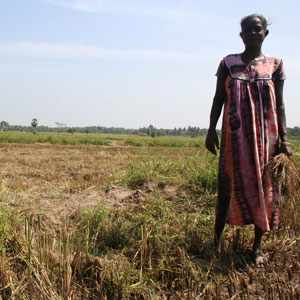
With her bare hands, Roda clears debris and forages scraps from her wrecked teashop after attackers scorched Gumuruk, a town in the Greater Jonglei region where conflict frequently disrupts daily life and stifles progress.« Previous Page — Next Page »





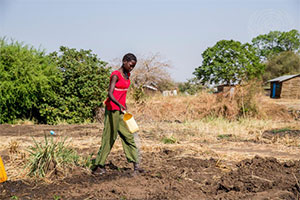 Farming on the Outskirts of Juba. Credit: UN Photo/JC McIlwaine
Promoting human and planetary health is a central focus of the United Nations, as laid out in the 2030 Sustainable Development Goals (SDGs). World hunger and unsustainable farming practices continue to be pressing concerns for the world. According to the 2025 State of Food Security and Nutrition in the World report by the Food and Agriculture Organization (FAO), 673 million people faced hunger in 2024. There are stark regional disparities, with the FAO projecting that 60% of the world population facing hunger will reside in Africa by 2030. Globally, the prevalence of food insecurity has remained consistently higher for women than men.
Sustainable and efficient national food systems are essential in preserving health, education, environmental well-being, peace, economy, and security. However, creating sustainable food systems can be a challenging endeavor, as food production takes a heavy toll on the environment. The agricultural sector accounts for a significant portion of greenhouse gases. Finding safe, sustainable, and ethical strategies to feed the world is crucial in ensuring planetary longevity. A recent initiative from 2023, the EU Regulation on Deforestation-free Products (EUDR), seeks to advocate for sustainable food systems. The main driver of deforestation is the expansion of agricultural land used to produce commodities like cattle, wood, cocoa, coffee, etc. The EUDR is part of the 2020 European Green New Deal and the EU Biodiversity Strategy for 2030 and aims to limit Europe’s consumption of products linked with deforestation by requiring that companies prove that their products are deforestation-free. Despite aiming to achieve major strides in sustainability, policies such as EUDR also raise socioeconomic concerns for targeted countries. Many emerging Latin American economies are impacted by the policy, and have raised the question of how developing countries can grapple with the tensions between economic development and advancing sustainability.
IPS has been at the forefront of providing compelling and insightful stories on communities facing hunger as well as the cost of food production. IPS uses statistics from FAO, the World Food Programme (WFP) and the International Fund for Agricultural Development (IFAD) to bring relevant and hard-hitting facts to readers. This gathering of information and data from such organizations helps bring the best stories from IPS journalists working in the different regions in consultation with experts on the ground.

The Week with IPS

NEXT STOP - SDGs
Tracking global progress towards a sustainable world
Tracking global progress towards a sustainable world