Languages
Sunday, November 8, 2026



News and Views from the Global South
Humanitarian Emergencies

Economic Development vs. Climate Action: Rebutting Deniers and Wafflers
As negotiators meet in Bonn to put together a deal to implement the Paris Agreement, John Holdren, a professor of environmental policy at the John F. Kennedy School of Government, Harvard University, stressed that economic development and climate change mitigation and adaptation are not ‘either-or’ but must be pursued together.
Climate Change Poses Alarming Threat to Food Security in Pacific Islands
A high-level meeting of political leaders -– hosted by the Food and Agriculture Organisation (FAO) -– sounded an ominous warning: that climate change poses an “alarming threat to food systems and food security in the Pacific islands.”
Aid Groups Condemn Yemen Blockade, Warn of ‘Catastrophic’ Famine
If aid deliveries are not resumed, Yemen will experience the worst famine the world has seen in recent decades.
“Refugees Are Nothing but Commodities”
As countless refugees arriving on Italy’s shores report torture, extortion and forced labour in Libyan detention centers, many say they never intended to make the journey to Europe until the chaos in Libya left them no other choice.
Pacific Communities Building Resilience in the Face of Climate Change
In the Pacific, climate change is an ever-present threat, undermining human rights, livelihoods, and security. Pacific Islanders are working with courage and resolve to build the resilience of their communities and to catalyse international actions towards ending global carbon pollution.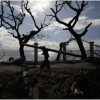
Fighting the Creeping Catastrophe of Climate Change
November 8 marks the fourth anniversary of Haiyan’s landfall in the Philippines. The super typhoon was the strongest ever to make landfall.
4 Reasons for Countries to Enhance Climate Commitments by 2020
The Paris Agreement was widely hailed for drawing all nations together to tackle climate change, based on bottom-up contributions that will be reviewed and strengthened over time. These contributions are aimed at achieving the ambitious but necessary long-term goals of limiting global temperature increase and building resilience to climate impacts.
Climate Change Summit a Step Further, Yes… But Where To?
The UN Climate Change Summit in Bonn is a step further, most experts say. Fine, but towards what?
Got Climate Questions? Climate Watch Has Answers
Negotiators and stakeholders headed to Bonn, Germany, for next week’s UN climate summit continue to confront a range of questions surrounding one essential query: How do we meet the imperative to lower greenhouse gas emissions now — quickly — to minimize the most severe impacts of climate change?
Widespread Natural Disasters Threaten Development Goals
This year in the Caribbean and on the American mainland, hurricanes have left millions of people in need of assistance.
Impending Drought? There’s an App for That – Or Should Be
Fostering and harnessing innovative technologies could significantly reduce the negative impacts from climate change, including drought, water scarcity and food insecurity in African countries.
The Roots of Exodus: Why Are People Compelled to Leave their Homes?
Facts are facts, and one of them is that while everybody talks about the growing forced movement of people --be they migrants or refugees—decision-makers haven’t seriously acted on the root causes of why millions of humans are compelled to leave their homes.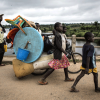
Congo’s Wake Up Call
Late last week, the humanitarian community activated a Level 3 emergency for the Democratic Republic of the Congo (DRC). This trigger in the global humanitarian system is seldom used, and only after serious deliberation by the top echelons of the UN system.
Deliberate Famine Should Be a War Crime, UN Expert Says
The deliberate starvation of civilians could amount to a war crime and should be prosecuted, said an independent UN human rights expert.
Myanmar’s Democracy Feels Strain of Religious Fault Lines
I try to hold on tight as my driver navigates his motorbike over a bumpy and muddy track. His helmet is decorated with a swastika and an eagle, part of an ill-inspired fashion trend called Nazi chic. It's symbolic for a country where hate and racism seen to have become normalized.
Rohingya Crisis Stokes Fears of Myanmar’s Muslims
In a quiet street, the sound of children's voices can be heard from an open window. They are reciting verses of the Koran in unison. The small Islamic school lays hidden in a walled neighborhood where only Muslims live. This is an island of tranquility in Mandalay, the second-largest city of predominantly Buddhist Myanmar.
Lack of International Action on Rohingya Crisis Called a “Disgrace”
As the crisis in Myanmar reaches unprecedented levels, frustration is at its peak as the international community remains slow to respond and act cohesively.
Innovation for Climate-Smart Agriculture Key to Ending Hunger in Kenya
Some parts of Kenya are reeling from the effects of probably the worst drought in the last 20 years. With nearly 3.4 million people food insecure, Kenya’s food security prognosis looks gloomy, with climate change and natural resource depletion set to pose even greater risks in the long term.
One of the World’s Most Dangerous PIaces For Aid Workers
I will travel to the Central African Republic early next week to spend United Nations Day with a peacekeeping operation in order to pay tribute to peacekeepers across the world.
What Do You Really Eat When You Order a Steak, Fish or Chicken Filet?
The world is running out of antibiotics to combat the growing threat of antimicrobial resistance, the UN World Health Organization (WHO) warned while announcing the World Antibiotic Awareness Week on 13-19 November.
New Villages Bloom in the Shadow of a Mountain’s Wrath
Repeated volcanic eruptions of Mount Sinabung since 2010 have displaced thousands of people, leaving villages around the mountain deserted, with volcanic ash, lava and mud covering the soil, trees and empty houses.« Previous Page — Next Page »





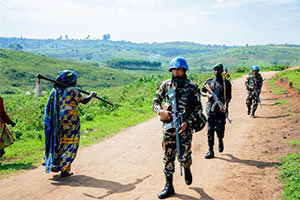 MONUSCO Peacekeepers and FARDC Soldiers Patrol Fataki Area. Credit: UN Photo/Jorkim Jotham Pituwa
Conflict, human rights violations, natural disasters, and famine have been at the forefront of concerns for humanitarian organizations. The escalation of humanitarian crises has led to over 239 million people in need of humanitarian assistance at the start of 2026, as estimated by OCHA’s Global Humanitarian Overview. The 2025 humanitarian appeal received only $12 billion, the lowest funding in over a decade, which has left 24 million fewer people reached in comparison to 2024. Conflict has remained the primary driver of crisis.
Humanitarian emergencies massively impact progress towards the Sustainable Development Goals (SDGs), adversely affecting economic development, inequality, education, planetary well-being, and poverty. Millions of people are faced with reduced access to essential services, including shelter, food, healthcare, and access to clean drinking water. UN Organizations such as UNHCR and the United Nations Children’s Fund (UNICEF) are committed to providing direct relief to affected communities when state governments cannot.
The United Nations 2024 Summit of the Future discussed measures that will be taken to reduce global inequality and promote peacekeeping efforts around the world. The recent UN Climate Change Conference (COP30) in Belém, Brazil, agreed to mobilize $1.3 trillion annually for climate action by 2035, operationalize the loss and damage fund, and triple adaptation finance. However, a fossil fuel transition commitment was not secured, despite climate change and the greenhouse effect being major contributors to humanitarian crises worldwide.
Countries across the world have also rallied to end humanitarian crises, as witnessed in conflicts such as Palestine and Ukraine. IPS is committed to providing relevant and in-depth reports of humanitarian emergencies around the world and their implications.

The Week with IPS

NEXT STOP - SDGs
Tracking global progress towards a sustainable world
Tracking global progress towards a sustainable world