Languages
Sunday, November 8, 2026



News and Views from the Global South
Humanitarian Emergencies

Response to Ethiopia’s Drought: A Story of Success or Anguish?
 Inside a health clinic run by the Catholic Daughters of Saint Anne, a nurse wraps a special tape measure around the upper arm of 2-year-old Rodas cradled in her mother’s arms. The tape reads yellow, meaning “moderately” malnourished, according to the attending nurse.
UN Fighting Losing Battle Over Global Humanitarian Crises
As the global refugee crises continues to worsen by the hour, UN Secretary-General Ban Ki-moon is quick to point out that when he took office in January 2007, the international appeal for funds for humanitarian emergencies was only about 4.0 billion dollars annually.Iraq’s Civilians Continue to Bear the Brunt of Instability: UAE Paper/Newswire
At least 18,802 people were killed in Iraq and another 36,245 were injured; this is the number of civilians killed in violence over the past two years and it is staggering.Declining Oil Prices May Undermine Development and Humanitarian Aid
The sharp decline in oil prices in the world market -– the lowest in nearly 13 years –- is expected to have a devastating impact on both developed and developing nations.
Syria: Minding the Minds II
Baher Kamal, in … And All of a Sudden Syria!: “The “big five,” the United Nations veto powers, have just agreed United Nations Resolution 2254 of 18-12-2015, time to end the Syrian five-year long human tragedy; they waited until 300,000 innocent civilians were killed and 4.5 million humans lost as refugees and homeless at home, hundreds of field testing of state-of-the-art drones made, and daily U.S., British, French and Russian bombing carried out.” No Chinese bombing.
Once Auctioned, What to Do with Syrian Refugees?
Few months ago, an unprecedented "humanitarian auction" was opened in Brussels at the European Commission, shortly after watching the image of the three-year old Syrian child that the sea threw up on the Turkish shores. The "auction" was about deciding upon the number of Syrian refugees to be hosted by each EU country. Germany won the largest batch.
Loneliness and Memories, Syrian Refugees Struggle in Safe Spaces
Emelline Mahmoud Ilyas is an outgoing 35-year-old mother of three from Syria. Sitting in a community centre in Zarqa, Jordan, where she just held a meeting with Jordanian and Syrian parents on the subject of childcare, she remembers the 'journey of death' that led her family to the Hashemite Kingdom.
Syrian Government to Allow Aid, Loosening the Stranglehold on Madaya
The Syrian government says it will allow humanitarian aid into the besieged rebel-held town of Madaya, according to the United Nations, following reports and horrific pictures of residents starving to death. Aid is expected to reach the area by Monday, but for some it is too little and too late.
… And All of a Sudden Syria!
The “big five” – i.e., the most military powerful states on earth (US, UK, France, Russia and China) have just agreed that it would be about time to end the Syrian five-year long human tragedy.
CPJ: Two Thirds of 2015 Journalist Deaths were Acts of Reprisal
Of the 69 journalists who died on the job in 2015, 40 per cent were killed by Islamic militant groups like Al-Qaeda and Islamic State. Startlingly more than two-thirds were targeted for murder, according to a special report by the Committee to Protect Journalists.
Syria - A Light to the World
In November 2015 I visited Syria together with an International Peace delegation. This was my third visit to Syria in the last three years. As on previous occasions I was moved by the spirit of resilience and courage of the people of Syria.
Disunity, the Hallmark of European Union Foreign Policy
The appalling crisis ravaging the Middle East and striking terror around the world is a clear challenge to the West, but responses are uncoordinated. This is due on the one hand to divergent analyses of the situation, and on the other to conflicting interests.
Displacement Climbs, No Respite Near in 2016
Nearly a million people have crossed the Mediterranean as refugees and migrants so far this year, and conflicts in Syria and elsewhere continue to push up levels of human suffering. This makes 2015 likely to exceed all previous years of forced displacement, according to a new United Nations High Commission for Refugees report.
Accord Calls for First Global Conference on Peace
On 21 November 2015, during ACCORD’s 2015 Africa Peace Award celebration, I made a call for the United Nations to convene the first ever UN Global Conference on Peace.UN Seeks Hefty 20 Billion Dollars for Humanitarian Needs in 2016
The world’s refugee crisis – triggered mostly by conflicts and persecutions – will continue to be one of the biggest problems facing the United Nations next year.
Alaa Arsheed: A Refugee’s Sweet Sound of Success
“In Beirut I was like a bird in a cage, I felt like a prisoner. Today, I have the chance to let my dreams come true, make a living with my music, realizing my dad’s project: open a new Alpha – my family’s cultural center, destroyed during the war- to share Syrian culture and help my people in Europe,” Alaa Arsheed, a Syrian refugee, told IPS.Human Rights in Turkey: Is Turkish Press Freedom in Danger?
The last week of November marked another phase of an ongoing shift in the Turkish Government´s approach to human rights issues – Two important events highlighted the ongoing attack freedom of press is suffering in Turkey. First two prominent Turkish journalists were arrested after publishing a story claiming that members of the state intelligence agency had provided weapons to Syrian rebels; second, lawyer and leading human rights defender and Tahir Elçi, President of the Diyarbakir Bar Association in south eastern Turkey, was killed in crossfire while making a press statement on Saturday 28th of November.
Another Himalayan Blunder
South Asian integration remains a distant dream as some member countries like Nepal resent India’s big brotherly dominance in the region. They perceive that they have no stakes in India’s rise as an economic power. Ensuring unrestricted market access perhaps would have made a big difference in this regard. Their resentment has only deepened as this hasn’t happened. Instead they have registered growing trade deficits with India! The on-going travails of the Himalayan kingdom vis-a-vis India exemplify the problematic nature of integration in a region that accounts for 44 per cent of the world’s poor and one-fourth of its’ population.Syrian Refugees, Fleeing Civil War, Reduced to Extreme Poverty, Says New Study
When German Chancellor Angela Merkel defended her immigration policies early this week -- and announced plans to absorb about one million refugees, mostly from Syria -- she was apparently greeted with a nine-minute standing ovation by members of her Christian Democratic Union.Analysis: Kurdish-Led Peace Conference Is Best Hope for Syria
While the war in Syria continues to draw in more outside forces, the work towards finding a political solution to this five-year old conflict carries on. In the past week, no less than three separate conferences were organized by different clusters of opposition groups. Conferences were held in three places: Damascus, Dêrîk – a city in the Kurdish-controlled northern part of Syria – and Riyadh, the Saudi capital, respectively.
Afghan Refugees’ Right To Stay in Pakistan May Expire
“We aren’t happy here but cannot go back to our country because the situation there was extremely bad,” Ghareeb Gul, Afghan refugees told IPS.« Previous Page — Next Page »





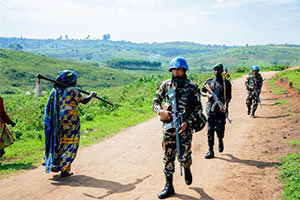 MONUSCO Peacekeepers and FARDC Soldiers Patrol Fataki Area. Credit: UN Photo/Jorkim Jotham Pituwa
Conflict, human rights violations, natural disasters, and famine have been at the forefront of concerns for humanitarian organizations. The escalation of humanitarian crises has led to over 239 million people in need of humanitarian assistance at the start of 2026, as estimated by OCHA’s Global Humanitarian Overview. The 2025 humanitarian appeal received only $12 billion, the lowest funding in over a decade, which has left 24 million fewer people reached in comparison to 2024. Conflict has remained the primary driver of crisis.
Humanitarian emergencies massively impact progress towards the Sustainable Development Goals (SDGs), adversely affecting economic development, inequality, education, planetary well-being, and poverty. Millions of people are faced with reduced access to essential services, including shelter, food, healthcare, and access to clean drinking water. UN Organizations such as UNHCR and the United Nations Children’s Fund (UNICEF) are committed to providing direct relief to affected communities when state governments cannot.
The United Nations 2024 Summit of the Future discussed measures that will be taken to reduce global inequality and promote peacekeeping efforts around the world. The recent UN Climate Change Conference (COP30) in Belém, Brazil, agreed to mobilize $1.3 trillion annually for climate action by 2035, operationalize the loss and damage fund, and triple adaptation finance. However, a fossil fuel transition commitment was not secured, despite climate change and the greenhouse effect being major contributors to humanitarian crises worldwide.
Countries across the world have also rallied to end humanitarian crises, as witnessed in conflicts such as Palestine and Ukraine. IPS is committed to providing relevant and in-depth reports of humanitarian emergencies around the world and their implications.

The Week with IPS

NEXT STOP - SDGs
Tracking global progress towards a sustainable world
Tracking global progress towards a sustainable world