Languages
Saturday, September 19, 2026



News and Views from the Global South
Population

Governments Are Having A Hissy Fit Over It
Yeah, governments are having a hissy fit over it. And their hissy fit is not over the usual concerns of governments such as defense, the economy, trade, inflation, unemployment, crime, or terrorism.
The Land of Immigration: America’s Demographic Past, Present and Future
Of the approximately 280 million immigrants in the world, the country hosting the largest number is America, the land of immigration. One-fifth of the world’s international migrants reside in the US, with those migrants arriving from nearly every country in the world.
Race Against Time as Hunger, Poverty Rise Amid Growing Global Uncertainties
Nearly one in 11 people in the world and one in five people in Africa go hungry every day, a crisis primarily driven by chronic inequality, climate change, conflict and economic instability. At the current pace, hunger and extreme poverty rates show little sign of drastically receding by 2030.
What is Not Good for Democracy in Peru is Not Good for Women
"We are facing a deeply conservative government that is opening the doors to all kinds of setbacks. We have a failed state with a democracy that is no longer a democracy," said Gina Vargas, a Peruvian feminist internationally recognized for her contributions to women's rights.
Tanzanians with HIV Left in Crisis as USAID Funding Ends
At 9 a.m. on Monday, Mariam Msemwa clutched her clinic card tightly as she stood in line at Bagamoyo District Hospital’s HIV Clinic in Tanzania’s coastal region. The 19-year-old had been here many times before, picking up monthly doses of antiretroviral (ARV) drugs that kept her alive. But today was different.When she reached the counter, the nurse flatly told her. “There’s no more free medication, ” she said. “You’ll have to buy it yourself.”
Ending FGM Requires Strengthening Partnerships and Advocacy Efforts
February 6 is the International Day of Zero Tolerance for Female Genital Mutilation (FGM). A practice deemed a gross violation of human rights, tragically the practice persists across multiple countries in Africa, the Middle East, and Asia. Over 230 million women and girls alive today have been subjected to this gruesome practice, and experts warn that at least 27 million more could endure this by 2030.
Tax the Super-Rich. We have a World to Win
Why can’t there be education for every child? Why can’t there be healthcare for everyone who needs it? Why can’t everyone be freed from hunger and deprivation? Though these are promised to all as rights, people are repeatedly told that there is no money.
America’s Scourge: An Ageing Elderly Population
Many Americans, especially the wealthy and successful, have discovered that the US is facing the scourge of an ageing elderly population that is seriously threatening the nation’s prosperity, economic growth and international standing.
African Countries Called Upon to Improve Data Collection
Africa's lack of robust application of statistical research has been flagged as slowing the use of evidence-based data to drive development.
Malnutrition in Nigeria Rises Alarmingly, Urgent Action Needed
In June 2024, 26-year-old Zainab Abdul noticed her two-year-old daughter growing pale, losing weight, and battling diarrhea. She wasn’t surprised. Since jihadist-linked bandits had forced them out of their village in Kadadaba, Zamfara State, in northwestern Nigeria, her family had been living in a refugee camp with limited access to food.
Brazil to Free Classrooms from the Invasion of Mobile Phones
It was necessary to repel the "invasion" of mobile phones in Brazilian classrooms, even to spark a debate about the use of technology in education, according to Silvana Veloso, an educator with extensive experience on the subject.
Rising Opposition Movement Looks to Political Renewal, Stemming Erosion of Democracy in Hungary
The Central European nation of Hungary is officially a democracy. But civil society, the media and democratic norms have increasingly come under threat as the Fidesz-KDNP coalition government, led by Prime Minister Viktor Orbán, has entrenched autocratic rule over the past 14 years. Now a new wave of energy and popularity is driving the younger opposition movement into the spotlight ahead of next year’s parliamentary election.
Fallen Black South African Soldiers From World War I Finally Remembered
It was a solemn ceremony on a bright sunny day on the southern tip of Africa, in Cape Town’s company gardens, amid the grass wooden structures that stand out. The 1,700 carefully constructed brown wooden carvings are standing in a line. These structures represent a new Commonwealth War Graves Commission (CWGC) memorial, which honors the contribution of the hundreds of Black South African military laborers of the First World War. The CWGC remembers the fallen soldiers of both World Wars equally with this first permanent redress tribute.
The Challenges Facing the World’s Fifth Largest Economy
India has surged forward as the world's fifth-largest economy and has now surpassed China to claim the title of the most populous nation. However, this rapid ascent is not without its challenges; rising unemployment and inflation loom large, threatening demographic dividend and its ambitious goal of sustaining a 7 to 8% GDP growth.
Why Russia’s Ban on Child-Free ‘Propaganda’ Impacts Human Rights
“A lot of people are very scared,” says Zalina Marshenkulova. “This is obviously another tool of repression. The state is waging war on the remnants of free-thinking people in Russia and trying to suppress all dissent and freedom,” the Russian feminist activist tells IPS. The warning from Marshenkulova, who left Russia soon after the country’s full-scale invasion of Ukraine in 2022 and now lives in Germany, comes just days after new legislation came into force in her home country banning "child-free propaganda.”
‘It’s Very Tough’: Turning Youth Employment Dreams Into Reality
It’s a bright winter day in Skopje, the capital of North Macedonia in the southern Balkans. By lunchtime, the cafes are full. The atmosphere is busy and social, and it is not difficult to see why the city, home to one-third of the country’s population of 2 million, is the focus of hope for young jobseekers. But, for many, it is not an easy road.
These Billion Humans Simply Do Not Exist
Perhaps demographers would consider designing a new classification system to separate from their estimates of the world’s total population –eight billion plus– the billion humans who live without legal identity and, thus, are deprived from the most basic rights.
Interlinked Solutions Key to Tackling Biodiversity, Water, Food, Health and Climate Change, says IPBES
Biological diversity is on the decline worldwide, and current approaches to address its loss have been piecemeal and ineffective in tackling the crisis facing nature—this is despite estimates that over half of global GDP (USD 58 trillion of economic activity in 2023) is generated in sectors that are moderately to highly dependent on nature, a new report by the Intergovernmental Platform on Biodiversity and Ecosystem Services (IPBES) finds.
Mahrang Baloch—Feted Worldwide, Persecuted at Home
"This recognition by a media outlet highlights the painful stories of abductions, torture, and the genocide of the Baloch people," said 31-year-old political activist Mahrang Baloch, speaking with IPS over the phone from Quetta, Balochistan, in reference to her inclusion on the BBC’s annual list of 100 most inspiring and influential women from around the world for 2024.
Latin America’s Poor Are More Urban and More Vulnerable
Poverty, while declining in Latin America and the Caribbean so far this century, shows a new face, that of the looming vulnerability of the poor as they become less rural and more urban, the United Nations Development Programme (UNDP) says in a new analysis.
Another Tsunami Sweeps Sri Lanka
On 26 December 2004 a powerful Asian tsunami swept over many of Sri Lanka’s coastal provinces, killing thousands of people and wildlife, devastating habitats and even washing away a trainload of passengers far from the rail tracks.« Previous Page — Next Page »


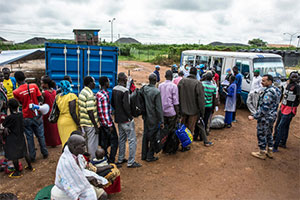 One Thousand Internally Displaced Persons (IDPs) Relocated from Tomping Camp in South Sudan. Credit: UN Photo/Isaac Billy
It took hundreds of thousands of years for the world’s human population to cross one billion in 1804. Approximately 200 years later, the population has multiplied sevenfold. In 2023, the global population crossed 8 billion, and is expected to reach 9 billion before 2050. With the planet more crowded than ever, it is essential to keep track of population trends, urbanization, migration, and reproduction across the world.
Life expectancy has seen significant strides in the past century, largely due to economic development and increased standards of living. On the contrary, trends in global fertility are shifting, with certain regions in Africa and Asia reporting higher rates, while parts of Europe and North America report stagnant or lower rates. This is in part due to differences in sexual and reproductive healthcare, as well as societal and economic conditions around the world. For example, child marriage is prevalent in certain societies, where childbearing is also considered a familial duty. Meanwhile, stagnating economies frequently experience lower marriage and childbearing rates.
The increase in migration and urban development around the world is also linked to global population trends. By 2050, it is expected that approximately 66 percent of all people will live in cities. Furthermore, global crises such as warfare and natural disasters also prompt transnational migration. Transnational migration is linked to a variety of socioeconomic issues in both host and receiving countries: migrants often leave developing countries with less access to educational and economic opportunities and arrive in developed countries where they are frequently the targets of ethnic, racial, and cultural discrimination, and economic exploitation. Recent crises in Europe and the United States demonstrate the importance of advocating for migrants worldwide. As migrants from the Global South are increasingly stripped of their legal and civic rights in unlawful deportations, or targeted in acts of identity-based violence, it is essential to keep track of population trends and protect the human rights of migrant populations. Climate-related disasters are now a major driver of displacement, with nearly half of all new internal displacements in 2025 being disaster-related.
IPS is devoted to covering issues surrounding population trends, migration, and reproduction through its compelling articles, which use both statistics and human stories to provide readers with robust and informative viewpoints.

The Week with IPS

NEXT STOP - SDGs
Tracking global progress towards a sustainable world
Tracking global progress towards a sustainable world
