Languages
Tuesday, October 13, 2026



News and Views from the Global South
Poverty & SDGs

Transforming Africa: Just & Equitable Energy Transition
A global transition to lower-carbon energy sources is crucial for our species' survival given the worsening effects of climate change. With many people increasingly advocating for a rapid shift from an energy system dependent on fossil fuels, questions on how to make this transition arise - one that is just and equitable, especially in the developing world.
If Women Don’t Lead, We’ll Lose the Battle Against Climate Crisis
We are in the midst of so many crises across the Middle East and North Africa (MENA) region: the most unequal, water scarce, least democratic region in the world, with the widest gender gap, multiple armed conflicts raging across it, and fragile states on the brink.
Restore Land to Tackle Multiple Crises
Land is our lifeline on this planet. Yet ‘business as usual’ in how we manage land resources puts our own future on planet Earth in jeopardy, with half of humanity already facing the impacts of land degradation.
How the Russia-Ukraine Conflict Impacts Africa
While Africa is yet to fully recover from the socio-economic repercussions of the COVID-19 pandemic, the Russia-Ukraine conflict poses another major threat to the global economy with many African countries being directly affected.
Upset with the Opulence of the Rich? But the World’s Children Are Paying the Bill
The excesses committed by rich people can be deadly–and in fact they are. Be it about food, energy or overall waste, such excesses have been depleting the world's natural resources and pushing both current and future generations towards the edge of a predictable abyss.
UN “Deeply Troubled” by Impending Cuts on Development Aid by Rich Nations
The four-month-old Russian invasion of Ukraine, which has triggered a hefty increase in military spending among Western nations and a rise in humanitarian and military assistance to the beleaguered country, is now threatening to undermine the flow of Official Development Assistance (ODA) to the world’s poorer nations.
Weathering a ‘Perfect Storm’ of Cascading Crises
Climate change, COVID-19, the war in Ukraine – these crises threaten to derail development for 1.7 billion of the world’s most vulnerable people. The international community must take swift, coordinated action now to put the SDGs back on track.
Food Banks are Early Warning Systems for Emerging Food Crises, but also a Key Solution
For months, the specter of a global hunger crisis has been looming. The war in Ukraine is a compounding factor, blocking key value chains for food and fertilizer just as the world reckons with the impacts of the COVID-19 pandemic on global hunger.
Climate Change Poses Risks: COP27 Presents Unique Opportunity for Africa
Ambassador Maria de Jesus dos Reis Ferreira was appointed in February 2018 as the Permanent Representative of Angola to the UN, the first woman to hold the position.
Without Peace, Hunger Will Continue to Increase
If the war in Ukraine, that was initiated three months ago, does not end, and without a reduction in the growing number of conflicts in other parts of the world, hunger will only continue to increase.
The Risks of Turning Planet Earth into a Giant Desert
The message is clear: three-quarters of the world’s population will be affected by drought by 2050. Does it sound too far in time? Well, your kids might be among the billions of humans living on a desertified planet.
Illegal Immigration Dilemma
Illegal immigration in the 21st century poses a serious dilemma for the world. Governments in virtually every region of the globe appear to be at a loss on how to address the two central dimensions of the dilemma.
Reclaiming Our Future
The Asia-Pacific region is at a crossroads today – to further breakdown or breakthrough to a greener, better, safer future. Since the Economic and Social Commission for Asia and the Pacific (ESCAP) was established in 1947, the region has made extraordinary progress, emerging as a pacesetter of global economic growth that has lifted millions out of poverty.
A Sliver of Hope for Lebanon?
In the midst of what has been an incredibly turbulent period for Lebanon, the conclusion of elections last week ought to be hailed as a chance to focus on the future. This, the first election since the mass uprisings in 2019 against what was seen as a corrupt ruling elite, has shown some signs of the drive for change.
Covid-19: Rise of the Super Rich & Fall of the World’s Poor
Michael Bloomberg, the three-term Mayor of New York city and a billionaire philanthropist, was once quoted as saying that by the time he dies, he would have given away all his wealth to charity – so that his cheque to the funeral undertaker will bounce for lack of funds in his bank account.
‘By Deliberately Ignoring Risk, the World Is Bankrolling Its Own Destruction’
It is often said that a pessimistic person is an optimistic but well-informed person. Here, a good number of people may believe that human wit and inventiveness are capable of facing both the current and the looming disasters, like the impact of climate change, for instance.
What India Needs To Do To Achieve Net-Zero Status by 2070
The recent IPCC report that came out in the month of March 2022 says that, by the end of the century, the temperature rise is likely to be 2 to 3.7 degrees if global emissions, as they stand today, are not curtailed. In fact, according to the report, carbon dioxide (CO2) emissions need to come down by 45 percent globally (compared with 2005) by the end of 2030.
What the Russian Invasion Means for Syria
Moscow’s decision to intervene militarily in Syria in 2015 effectively preserved the Assad regime in Damascus. Russian air power and intelligence support, along with Iranian-backed militias on the ground, allowed the regime to beat the opposition and brutally reassert its control over much of Syria.
As COVID Wanes, Tuberculosis Deaths Must Become Visible
It is time to treat the scourge of Tuberculosis scourge with the same urgency as we did the COVID-19 pandemic.
Debt Distress in Africa: Problems and Ways Forward
The COVID pandemic has had a profoundly negative impact on Africa’s sovereign debt situation. Currently, 22 countries are either in debt distress or at high risk of debt distress.
New Medicines May Help End AIDS– but High Prices & Monopolies Could Keep the Poor Locked Out
Here’s the good news: there are a new set of breakthrough medicines to prevent and treat HIV, known as “long actings” because they can be taken every few months instead of every day, and they are coming on-stream. If, as they are rolled out, they are made available at scale, they could help save many lives and help end the AIDS pandemic.« Previous Page — Next Page »





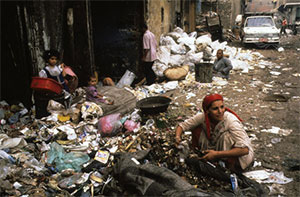 Romani people in Cairo, Egypt, forage through trash. Credit: UN Photo/Armineh Johannes
In 2015, the United Nations adopted the Sustainable Development Goals (SDGs) in an effort to promote “peace and prosperity for people and the planet.” To achieve that goal, it is essential to provide equal opportunities and access to basic services to all people. The 2025 UN SDG Report found that 35% of the 169 SDG targets are on track or making moderate progress, while 18% have reversed compared to the 2025 baseline. One in ten people still live in extreme poverty, one in eleven experience food insecurity, and over 1.1 billion people live in slums without access to clean water and sanitation. It is imperative to acknowledge the societal, technological, economic, and political issues that sustain poverty in countries around the world. Eradicating poverty will require significant frameworks in policy and governance on a national and international scale to ensure that all people will have equal access to basic services and economic opportunities by 2030. Furthermore, a dramatic reduction of United States foreign aid in 2025, including the termination of 83% of USAID programmes, threatens to erode years of fragile development gains.
Throughout the world, violent conflict and natural disasters also contribute to extreme poverty. The complete destruction of infrastructure and blockage of aid has significantly impoverished Palestine since October 7th. The destructive impact of Hurricane Maria in Puerto Rico left $91 billion in damage. An inadequate US government response also revealed significant and enduring questions within the issue of mitigating poverty: how do we rebuild infrastructure after its destruction? How do we restimulate economic development and bring in financial aid after disasters? Similar questions have been raised in the realm of regional cooperation, as devastating floods have wrecked hundreds of thousands of homes across multiple Southeast Asian nations in the past few years. Furthermore, the COVID-19 pandemic has greatly exacerbated the global poverty crisis, particularly in developing countries, setting back the United Nations goal of eradicating poverty by 2030.
IPS is committed to providing comprehensive features that focus on the persisting environmental, sociopolitical, and systemic issues that sustain poverty, and the steps taken worldwide towards poverty eradication.

The Week with IPS

NEXT STOP - SDGs
Tracking global progress towards a sustainable world
Tracking global progress towards a sustainable world

