Languages
Sunday, October 4, 2026



News and Views from the Global South
Poverty & SDGs

Inclusive and Equitable Education in the Pacific
In 2019, the United Nations General Assembly proclaimed 24 January as International Day of Education, in celebration of the role of education for peace and development. The United Nations’ Sustainable Development Goal 4 challenges all nations to “ensure inclusive and equitable quality education and promote lifelong learning opportunities for all” by the year 2030. As we think about this in the context of the COVID-19 pandemic, and the emerging post-COVID-19 environment, what does inclusive and equitable education look like and how do we ensure that lifelong learning opportunities are benefitted by all?
Volunteerism in the Decade of Action
After the pioneer Global Technical Meeting on Volunteerism last July, a recently-held on-line follow up helped gathering new insights from experts and practitioners from the world on how to move forward with positioning volunteering at the center of development agenda.
“Their Hope for a Brighter Future Inspires Us All”
Looking back upon 2020, we all bear the scars of a devastating year; none so much as girls and boys around the world. The COVID-19 pandemic disrupted education for over 1.6 billion children and youth globally and continues to do so. It has also deepened socio-economic inequities and heightened insecurities around the world, further impacting the lives of girls and boys everywhere. Ongoing, protracted conflicts, forced displacement and the worsening climate crisis were no less forgiving.
Protecting Mental Health of Families in a Pandemic
Dealing with COVID-19-related city lockdowns has been exceptionally stressful, particularly for those parents who have had to balance work, personal life, children and elderly, providing home schooling or facilitating virtual learning, managing infection control within the home, and more, all while being disconnected from support services.
Q&A: Why we Must Invest in Educating Children in Crisis-Hit Burkina Faso
Education Cannot Wait (ECW) - the first global fund dedicated to education in emergencies and protracted crises – was on the ground in Burkina Faso last week with its Director, Yasmine Sherif, to launch a new multi-year programme that aims to provide an education to over 800,000 children and adolescents in crisis-affected areas.
As the United States Rejoins the Paris Climate Accord and Boldly Confronts Climate Change Crisis- Forget Not the Youth
On the first day, hours after inauguration of the new Biden-Harris administration, President Biden signed an Executive Order-rejoining the United States in the Paris Climate Accord.
Change Financing Priorities to Address COVID-19, Conference Hears
Innovative financing to resolve COVID-19 crisis was needed, a joint African and Asian parliamentarians’ webinar heard this week. The webinar, facilitated by Asian Population and Development Association (APDA), was aimed at enhancing support for the implementation of International Conference on Population and Development (ICPD)commitments in the face of the pandemic.
A BASIC TRUTH: Facing an Existential Threat, Humanity Must Work Together
COVID-19 is like a rainstorm, a thunderous and powerful rainstorm all over the world. If we didn’t know before, we certainly know now just where the holes are in our roofs, or where there are no roofs. We see ever more clearly who is getting drenched and who is dying, and who remains dry.
COVID-19 Vaccines: How and When Will Lower-Income Countries Get Access?
COVID-19 vaccination programmes are gathering pace in high-income countries, but for much of the world, the future looks bleaker. Although a number of middle-income countries have started rolling out vaccines, widespread vaccination could still be years away.
Legally Speaking, Is Digital Money Really Money?
Countries are moving fast toward creating digital currencies. Or, so we hear from various surveys showing an increasing number of central banks making substantial progress towards having an official digital currency.
Can the World Tackle the Food Insecurity Crisis in 2021?
The COVID-19 pandemic has exacerbated food insecurity and disrupted food systems and food supply chains in developed and developing countries alike. In the United States, millions of Americans struggle to put food on the table. Around the world, according to the United Nations over 270 million are hungry, and this is expected to continue to increase.
Africa’s Free Trade Area Opens for Business
African countries opened their markets on 1st January under the continental free trade agreement and duty-free trading of goods and services across borders is now underway despite the COVID-19 pandemic and other teething problems.
COVID-19 Pandemic Shapes the Future World People Want
The peoples of the world are unanimous - access to basic services such as universal healthcare must become a priority going forward. So too should global solidarity, helping those hardest hit by the COVID-19 pandemic and addressing the climate change emergency.
Shifting Conversations in Multifaceted Policymaking
As the people of Kiribati, Samoa and Tonga gear up as the first nations to welcome 2021, communities around the Asia-Pacific region and beyond look forward to bidding farewell to the most tumultuous year in recent decades.
If Covid-19 is Primarily a ‘First World’ Virus, Why is the Global South in Lockdown?
The currently available Covid-19 vaccines have been authorized for ‘emergency use ‘in Europe and North America. This is due to an apparent spike in Covid-19 flu cases in the northern hemisphere as winter advances. Highly advertised vaccines are being produced and rolled out at ‘warped speed’ by powerful pharmaceutical and bio-technology companies headquartered in Euro-America although their efficacy including how long their immunity lasts is not clear.
Is the COVID-19 Vaccine a Potential Biological Weapon in Reverse?
If the coronavirus is not deemed a biological weapon, is the heavily-publicized Covid-19 vaccine in danger of being weaponized when over 159,000 Palestinians who have tested positive in Occupied Palestinian Territories (OPT) are being denied treatment during a deadly pandemic?
Making African Continental Free Trade Area Work for Women in a Post-COVID-19 World
On 1st January 2021, trading under the African Continental Free Trade Area (AfCFTA) Agreement commenced after months of delays caused by the COVID-19 pandemic.
2021: Year of Living Dangerously?
Goodbye 2020, but unfortunately, not good riddance, as we all have to live with its legacy. It has been a disastrous year for much of the world for various reasons, Elizabeth II’s annus horribilis. The crisis has exposed previously unacknowledged realities, including frailties and vulnerabilities.
This Is Not a Goodbye, Kenya – Asante na Kwaheri ya Kuonana
Happy New Year, Kenya. Several milestones in my personal and professional life have made Kenya a cherished place for me. I started my UNICEF career in Rumbek, South Sudan in June 2000, and my rest and recuperation breaks were in Nairobi. In fact Kenya was the first African country I had ever visited and, frankly, it was love at first sight.

How Women-centred Digital Platforms can Enhance Empowerment
A cherished snapshot of a happy mother and a smiling grandmother is universally associated with a good childhood. In the movies, TV, or media, a broken or depressed mother’s face is hardly seen. But the reality is somewhat different. The measures communities and society take to ensure that women and girls are protected and supported are often questioned.
Wanted: Affirmative Legislation in the Job Market in Nepal
In Nepal, a dominating culture traditionally representing the elites, the so-called higher castes of the society according to the Hindu culture, still endures and prevails.« Previous Page — Next Page »


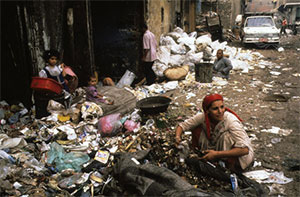 Romani people in Cairo, Egypt, forage through trash. Credit: UN Photo/Armineh Johannes
In 2015, the United Nations adopted the Sustainable Development Goals (SDGs) in an effort to promote “peace and prosperity for people and the planet.” To achieve that goal, it is essential to provide equal opportunities and access to basic services to all people. The 2025 UN SDG Report found that 35% of the 169 SDG targets are on track or making moderate progress, while 18% have reversed compared to the 2025 baseline. One in ten people still live in extreme poverty, one in eleven experience food insecurity, and over 1.1 billion people live in slums without access to clean water and sanitation. It is imperative to acknowledge the societal, technological, economic, and political issues that sustain poverty in countries around the world. Eradicating poverty will require significant frameworks in policy and governance on a national and international scale to ensure that all people will have equal access to basic services and economic opportunities by 2030. Furthermore, a dramatic reduction of United States foreign aid in 2025, including the termination of 83% of USAID programmes, threatens to erode years of fragile development gains.
Throughout the world, violent conflict and natural disasters also contribute to extreme poverty. The complete destruction of infrastructure and blockage of aid has significantly impoverished Palestine since October 7th. The destructive impact of Hurricane Maria in Puerto Rico left $91 billion in damage. An inadequate US government response also revealed significant and enduring questions within the issue of mitigating poverty: how do we rebuild infrastructure after its destruction? How do we restimulate economic development and bring in financial aid after disasters? Similar questions have been raised in the realm of regional cooperation, as devastating floods have wrecked hundreds of thousands of homes across multiple Southeast Asian nations in the past few years. Furthermore, the COVID-19 pandemic has greatly exacerbated the global poverty crisis, particularly in developing countries, setting back the United Nations goal of eradicating poverty by 2030.
IPS is committed to providing comprehensive features that focus on the persisting environmental, sociopolitical, and systemic issues that sustain poverty, and the steps taken worldwide towards poverty eradication.

The Week with IPS

NEXT STOP - SDGs
Tracking global progress towards a sustainable world
Tracking global progress towards a sustainable world

