Languages
Friday, October 9, 2026



News and Views from the Global South
Poverty & SDGs
To Achieve Progress on Gender Equality, Gender Data Must Be at the Forefront
In 1995, world leaders gathered in Beijing for the Fourth World Conference on Women and adopted the Beijing Declaration and Platform for Action. This marked a significant turning point for the global agenda for gender equality. This week, a high-level event will take place as part of the United Nations General Assembly to celebrate the meeting’s 25th anniversary. However, despite ambitious commitments to gender equality, nearly 25 years later, progress still lags far behind.
From Pledges to Policy and Practice: Moving Nature to the Heart of Decision-Making
This week, Heads of State and Government from 64 countries announced one of the strongest pledges yet to reverse the loss of biodiversity and nature’s contributions to people by 2030. Advancing from powerful pledges to concrete policy and action, however, means that nature must be moved to the heart of global, national and local decision-making. It’s time for nature to be reintegrated into everything we do.
Q&A: How Fast Fashion Sits at the Crucial Intersection of Environmental & Gender Justice
Racism “keeps the global north oblivious to the effect of fast fashion addiction on the global south” say environmental and gender justice experts.
No More Excuses – Time for Global Economic Solutions
On 29 September, the world’s heads of state will come together (virtually) at an extraordinary meeting to discuss financing for development during the 75th UN general assembly. This will be crucial in the battle to address the Coronavirus crisis.
Pushing the Reset Button will not Change the Game
Governments have responded to the COVID-19 pandemic with unprecedented intensity. They have taken far-reaching regulatory measures to contain the pandemic and mobilized financial resources on an enormous scale.
Scientists Draw up Guidelines to Help Agri-food Companies Align with 2030 Agenda
In Amuru district, 47 kilometres from Gulu town in northwestern Uganda, the Omer Farming Company has proven that it is possible to farm on thousands of acres of land using methods that conserve the environment and its biodiversity.
SDGs: It’s Not Just About Collecting Data, it’s What You Do With it
The unprecedented challenges posed by COVID-19 have reminded us that we are an interconnected global community. While this crisis rightly has dominated our attention, we must not lose sight of progress on the broader aims of the Sustainable Development Goals and the Paris Climate Agreement.
Nono the Carbon Footprint Bear—Part of Peru’s Ambitious Work on Climate Action
On the eve of its bicentennial, Peru is addressing climate change with the needed sense of urgency and ambition. Our inclusive, ‘whole society’ approach aims to awaken new opportunities that are within reach of all of our citizens. Like COVID-19, climate change is a landmark which will have a clearly established before and after period. Without a doubt, it is paving a path towards sustainable development that will improve the well-being of all Peruvians.
‘Waste is only Waste when you Waste it’ – Could Ecobricks be the Solution to Uganda’s Housing and Pollution Problem?
About 40 kilometres out of Uganda’s capital, Kampala, in the Mpigi area, you can find an entire village hill with houses that have plastic bottles walls and car tyre rooftops.
Peace is the North Star During and the Post COVID-19 Pandemic
Amid various global conflicts in the 1980s and 1990s, the International Day of Peace (IDOP) was established to commemorate the strengthening of the ideals of peace globally. Today, peace is not just the absence of conflict, but a key prerequisite for development. It is in recognition of the crucial linkages between peace, respect for human rights and sustainable development that more than 36 indicators for peace were included across the Sustainable Development Goals (SDGs).
Helping Make Education a Reality for the 75 million Children in Conflict Zones
Aryan is a 15-year-old girl from Afghanistan who lives with her family in a shelter in an undisclosed country in Europe. She doesn’t go to school. But she is hugely creative. And it shows in how she occupies her time during the day — writing poetry and making bracelets and earrings that she hopes to sell online one day.
A World Without Hunger Is Also About Protecting Food
Concern about food loss and waste has become an increasingly important focus of attention when discussing ways to eliminate hunger which, according to the latest FAO report, already exceeds 690 million people.
COVID-19 – Possible Human Rights Crisis in Asia as Disparities Expected to Widen
The negative impact of the coronavirus pandemic is likely to be felt long after the COVID-19 health risk is resolved, a high-level meeting under the auspices of the Asian Population and Development Association (APDA), heard.
Accessibility of Vaccines & Commitment to Ceasefire – Priority Focuses for 75th UNGA
Key focuses of the upcoming 75th session of the United Nations General Assembly (UNGA) High Level Week will be the accessibility of vaccines and a renewed plea for a global ceasefire. “I will make a strong appeal to the international community to mobilise all efforts for the global ceasefire to become a reality by the end of the year,” U.N. Secretary-General António Guterres said on Wednesday.
Leveraging Research for Solution-driven Policymaking in the Era of COVID-19
The United Nations has tasked the Canadian Institutes of Health Research Institute of Population and Public Health (CIHR-IPPH) to lead the research roadmap to identify priorities that will support an equitable global socio-economic recovery from COVID-19 within the broader framework of the Sustainable Development Goals (SDGs). As the world grapples with the impacts of COVID-19, identifying the research agenda and partnering with academic institutions and think tanks have become more essential than ever before.
COVID-19 Worsens Mozambique’s Hunger
Like many Mozambicans in the agricultural sector, 39-year-old Fatima Matavele, a commercial farmer in the district of Chokwe, some 213 kilometres north of the capital, Maputo, has had a tough year. Although the last few years have been hard, 2020 has proven to be the most difficult of all.
Maritime Security in Asia-Pacific Region Under Threat
Maritime security in Asia Pacific is often viewed through a traditional security lens, where the main responsibility falls on maritime law enforcement agencies to protect maritime borders and territorial sovereignty.
INTERVIEW: the top diplomat shepherding the General Assembly through its 75th year
The Turkish diplomat elected to be the president of the 75th session of the UN General Assembly, Volkan Bozkir, is taking on the role as the Organization grapples with an unprecedented pandemic, and questions surrounding the future direction it should take.
Mapping Nature to Create a Global Biodiversity Framework
The year 2020 was considered a “Super Year” for biodiversity. A string of interconnected events offered a unique opportunity to build a global coalition and international policy framework that recognized the central role of nature to all life on Earth.
No ‘Business as Usual’ for Children Post-COVID-19, say Laureates & Leaders
Addressing delegates at the end of the virtual 3rd Fair Share for Children Summit, 2014 Nobel Peace Laureate Kailash Satyarthi told global citizens that “business as usual” in dealing with COVID-19 is not going to be tolerated. “We’re not going to accept the miseries of child labour and trafficking to continue to be normal,” he said.
A Marathon, Not a Sprint: Peru Needs Fiscal Reforms to Quell High COVID-19 Death Rate
“It’s a major paradox, no?” asks Hugo Ñopo, a researcher at the Peruvian think tank Group for the Analysis of Development (GRADE). Since the beginning of the pandemic, Peru has presented itself as an example for the region: it quickly implemented drastic prevention measures, followed scientific recommendations and prepared an economic support plan for the most vulnerable segments of the population.« Previous Page — Next Page »





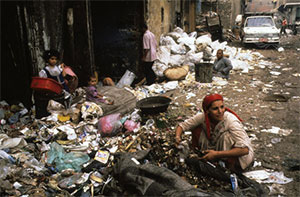 Romani people in Cairo, Egypt, forage through trash. Credit: UN Photo/Armineh Johannes
In 2015, the United Nations adopted the Sustainable Development Goals (SDGs) in an effort to promote “peace and prosperity for people and the planet.” To achieve that goal, it is essential to provide equal opportunities and access to basic services to all people. The 2025 UN SDG Report found that 35% of the 169 SDG targets are on track or making moderate progress, while 18% have reversed compared to the 2025 baseline. One in ten people still live in extreme poverty, one in eleven experience food insecurity, and over 1.1 billion people live in slums without access to clean water and sanitation. It is imperative to acknowledge the societal, technological, economic, and political issues that sustain poverty in countries around the world. Eradicating poverty will require significant frameworks in policy and governance on a national and international scale to ensure that all people will have equal access to basic services and economic opportunities by 2030. Furthermore, a dramatic reduction of United States foreign aid in 2025, including the termination of 83% of USAID programmes, threatens to erode years of fragile development gains.
Throughout the world, violent conflict and natural disasters also contribute to extreme poverty. The complete destruction of infrastructure and blockage of aid has significantly impoverished Palestine since October 7th. The destructive impact of Hurricane Maria in Puerto Rico left $91 billion in damage. An inadequate US government response also revealed significant and enduring questions within the issue of mitigating poverty: how do we rebuild infrastructure after its destruction? How do we restimulate economic development and bring in financial aid after disasters? Similar questions have been raised in the realm of regional cooperation, as devastating floods have wrecked hundreds of thousands of homes across multiple Southeast Asian nations in the past few years. Furthermore, the COVID-19 pandemic has greatly exacerbated the global poverty crisis, particularly in developing countries, setting back the United Nations goal of eradicating poverty by 2030.
IPS is committed to providing comprehensive features that focus on the persisting environmental, sociopolitical, and systemic issues that sustain poverty, and the steps taken worldwide towards poverty eradication.

The Week with IPS

NEXT STOP - SDGs
Tracking global progress towards a sustainable world
Tracking global progress towards a sustainable world

