Languages
Sunday, September 27, 2026



News and Views from the Global South
Financial Crisis

Developing Countries and the Perfect Storm
Part I: What Should Developed Countries Do?
Developing countries – in Africa, in Asia, in Latin America and in the Middle East - are facing a combination of crises that are unprecedented in recent times. Over the last three years they have had to face the COVID-19 crisis, the food crisis, the energy crisis, the climate change crisis, the debt crisis and, on top of all this, a global recession. The crises have overlapped, and each has added to the problems created by the previous ones.

Sanctions Now Weapons of Mass Starvation
US and allied economic sanctions against Russia for its illegal invasion of Ukraine have not achieved their declared objectives. Instead, they are worsening economic stagnation and inflation worldwide. Worse, they are exacerbating hunger, especially in Africa.
Davos Fails on Financial Transparency – And Everything Else
At this year’s World Economic Forum (WEF) at Davos which ended last week, the attention of the world’s financial and economic elite was captured by the war in Ukraine whose president Volodimir Zelensky used his address to call to “complete withdrawal of foreign businesses from the Russian market”, despite 380 of the largest multinational companies still operating in Russia.
Xenophobia-hit Zimbabweans Saving Country’s Dead Economy
Two decades ago, Trynos Mahamba left Zimbabwe for the United Kingdom, but back home, he has changed the lives of his relatives. Since the day after he left, Mahamba (53) has been sending money home while Zimbabwe’s economy faltered amidst violent land seizures from commercial white farmers during Zimbabwe’s land reform programme.
Fighting Inflation Excuse for Class Warfare
A class war is being waged in the name of fighting inflation. All too many central bankers are raising interest rates at the expense of working people’s families, supposedly to check price increases.
A Sliver of Hope for Lebanon?
In the midst of what has been an incredibly turbulent period for Lebanon, the conclusion of elections last week ought to be hailed as a chance to focus on the future. This, the first election since the mass uprisings in 2019 against what was seen as a corrupt ruling elite, has shown some signs of the drive for change.
When Saviours Are the Problem
Central bank policies have often worsened economic crises instead of resolving them. By raising interest rates in response to inflation, they often exacerbate, rather than mitigate business cycles and inflation.
Finance Drives World to Stagflation
The world is being pressed by financial interests to raise interest rates, ostensibly to check inflation. After the US Federal Reserve started raising interest rates, more central banks have been doing likewise. Considering inflation’s contemporary causes, such ‘follow the leader’ central bank mimicry cannot check it except by slowing economies. Worse, this has meant taking on huge new risks, seriously damaging world economic prospects in the medium and long-term.
Women in Argentina Cultivate Dignity in Cooperative Vegetable Garden
The space consists of just 300 square meters full of green where there is an agro-ecological vegetable garden and nursery, which are the work and dream of 14 women. Behind it can be seen the imposing silhouettes of the high rises that are a symbol of the most modern and sought-after part of Argentina's capital city.
Sri Lankan Economic Crisis Inflicted by Self-Serving Elite
Once deemed a basic human needs success story, Sri Lanka (SL) is now in its worst economic crisis since independence in 1948. Nonetheless, SL’s ‘moment of truth’ now offers lessons for other developing countries.
China Debt Traps in the New Cold War
As China increases lending to other developing countries, ‘debt trap’ charges are growing quickly. As it greatly augments financing for development while other sources continue to decline, condemnation of China’s loans is being weaponized in the new Cold War.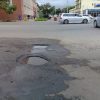
Zimbabwe Unsafe Roads Could Drive the Economy Around the Bend
When driving at night in Zimbabwe, watch out for a pair of eyes on the road and slow down. You may hit a giraffe inside a pothole. So goes an often-told joke.
Deepening Stagflation: Out of the Frying Pan into the Fire
The world is sailing into a perfect storm as key leaders seem intent on threatening more war, albeit while proclaiming the noblest of intentions. By doing so, they block international cooperation to create conditions for sustainable peace and shared prosperity for all.
War or Peace, Barbarism or Hope
The spectre of ‘stagflation’ threatens the world once again. This time, the risk is the direct consequence of political provocations and war, and not simply due to inexorable economic forces. Stagflation? Stagflation is a composite word implying inflation with stagnation. Stagnation refers to weak, ‘near zero’ growth, inevitably worsening unemployment. Inflation refers to price increases – not high prices, as often implied.
NGOs Seeking a Monterrey+20 Summit on Financing for Development
This week, exactly 20 years ago, world leaders adopted the United Nation’s Monterrey Consensus. They committed to “Confronting the challenges of financing for development” with a global response and to creating a fully inclusive and equitable global economic system.
Stagflation Threat: Be Pragmatic, Not Dogmatic
“If your only tool is a hammer, every problem looks like a nail”. Still haunted by the clever preaching of monetarist guru Milton Friedman’s ghost, all too many monetary authorities address every inflationary threat or sign they see by raising interest rates.
Inflation Targeting Constrains Development
All too many developing countries have been persuaded or required to prioritize inflation targeting (IT) in their monetary policy. By doing so, they have tied their own hands instead of adopting bolder economic policies for growth, jobs and sustainable development.
Young Argentine Women Forge a Future in Cooperative Factory
"We started making shampoos and soaps in the kitchen of a friend’s house in 2017. We were five or six girls without jobs, looking for a collective solution, and today we are here," says Letsy Villca, standing between the white walls of the spacious laboratory of Maleza Cosmética Natural, a cooperative that brings together 44 women in their early twenties in the Argentine capital.
Inflation Targeting Voodoo
All over the world, people expect policies by central bankers trained in economics to have a sound scientific base. But in fact, inflation targeting is an article of faith with neither theoretical nor empirical basis.
Resist Inflation Phobia Coup
Calls, even screams, to fight inflation above all else are getting shriller. Thankfully, even The Economist (5 Feb. 2022) reminds all, Fighting inflation could put the world in a slump. No inflation consensus International Monetary Fund (IMF) Managing Director Kristalina Georgieva doubts the world faces a runaway inflation threat. She urges policymakers to carefully calibrate fiscal and monetary policies, with more “specificity”, as not ‘one size fits all’.
Argentina Seeks a Way Out (Again) of its Economic and Social Labyrinth
Accustomed for decades to recurring economic crises, and hit hard in recent years by a steady loss of purchasing power, Argentines were informed on Friday Jan. 28 of a last-minute agreement with the IMF which, in the words of center-left President Alberto Fernández, takes "the noose off their necks".« Previous Page — Next Page »


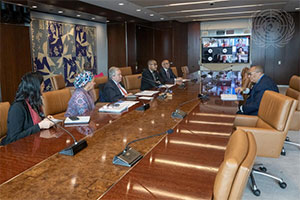 Secretary-General Meets with Members of Debt Expert Group. Credit: UN Photo/Eskinder Debeb
Financial crises are often defined by banking panics, recession, loss of market value, and deflation. Various financial crises at the turn of the 20th century, such as the Asian Crisis of 1997-1998 and the 2007-2008 Global Financial Crisis, have had immense impacts on the world economy. The COVID-19 pandemic also caused a financial crisis when mass lockdowns triggered staggering unemployment rates, a stagnation of economic growth, and led to the 2020 stock market crash. With the Russian invasion of Ukraine, the world has also witnessed a global energy crisis with shortages and increased prices in oil, gas, and electricity markets. According to UNCTAD’s World of Debt 2025, global public debt surpassed $100 trillion in 2024, with developing country debt growing twice as fast as developed economies since 2010. Burdens of debt servicing come with economic slowdowns and demands of austerity from lenders, with some economists arguing that this will lead to a new “lost decade” for the Global South. IPS brings you worldwide coverage of these financial developments and how we should manage these crises.

The Week with IPS

NEXT STOP - SDGs
Tracking global progress towards a sustainable world
Tracking global progress towards a sustainable world
