Languages
Sunday, September 13, 2026



News and Views from the Global South
Labour

Do Women Suffer Greater Loss of Employment than Men in Morbidity?
In a life peppered with tragedy, Mary Shelley wrote in 1818, “Have I not suffered enough, that you seek to increase my misery?” That this accurately sums up the fate of many women in South Asia who suffer a major health shock such as a serious illness or a disability or both, is hard to dispute.
Key Changes in International Agriculture and Rural Development Issues: Three Priority Areas in the Context of the 2030 Development Agenda
Transformations in international agricultural and rural development issues Some major changes in international agricultural and rural development over the last 30-40 years need to be taken into account in efforts to promote sustainable development and an inclusive rural transformation (IFAD 2016) as we approach the third decade of the millennium. This opinion piece, drawing on a longer article published in Agriculture for Development Journal (Summer 2019 Issue), seeks to stimulate reflection and debate on how work to support agricultural and rural development can evolve to address key challenges and opportunities related to migration, sustainable urbanization and youth in a changing global policy context.
Farm Workers Paying the Price for Cheap South African Wine
Systembolaget, the Swedish government-owned alcohol monopoly, promises fair conditions – but it also uses its purchasing power to put a downward pressure on prices. At the major South African wine producer Leeuwenkuil, workers suffer as the company tries to cut costs. So far, none of the South African suppliers have been stopped due to violations against Systembolaget’s code of conduct.
Disaster Risk Resilience: Key to Protecting Vulnerable Communities
The past five years have been the hottest on record in Asia and the Pacific. Unprecedented heatwaves have swept across our region, cascading into slow onset disasters such as drought. Yet heat is only part of the picture. Tropical cyclones have struck new, unprepared parts of our region and devastatingly frequent floods have ensued. In Iran, these affected 10 million people this year and displaced 500,000 of which half were children. Bangladesh is experiencing its fourth wave of flooding in 2019. Last year, the state of Kerala in India faced the worst floods in a century.
Kenya: The troubles of a science PhD from the West
Graduate students of the London School of Economics and Political Science gathered at Kenya’s coast in September 2018, where the Secretary-General of the United Nations Conference on Trade and Development (UNCTAD) Dr Mukhisa Kituyi told them: “With your international credibility, it is easier and tempting to leave and take out of the continent the little intellectual resource that could solve problems their countries face.”
Are Jair Messias Bolsonaro and Donald John Trump a Menace to the Planet?
We live in different worlds. The ones of friends, family and work colleagues. Worlds which are overshadowed by other, much bigger ones. Global spheres of international finance, politics, climate change, etc., contexts that might threaten our smaller circle of relationships; our family, our income, our general wellbeing, in short – our entire existence. However, even at those levels there exist small circles of acquaintances and associates able to make decisions that affect the entire humankind. Let me take one example – the regimes of U.S. President Donald J. Trump and Brazilian President Jair Messias Bolsonaro, which are menacing our global natural habitat.
To Uplift a Woman is to Uplift a Village
Khadija Zuberi, 23, from Ruaha Mbuyuni village in Tanzania’s central highlands, is a single mother to her four-year-old son, Hashim.
Boom or Bust -Education Will Determine Africa’s Transformation
August 12, marks International Youth Day, and the theme for this year is ‘making education more relevant, equitable and inclusive’, is particularly apt for Africa. Consider this. Every 24 hours around 35,000 African youth are looking for work.
Free Speech and the Hong Kong Protests
Sometime in the summer of 1974, I was leaning against the gunwale of the ferry between Calais and Dover, watching the moonlight streaming dark waters. When I turned to the left I found that a Chinese lady also looked out over the calm sea. What she told me changed my world view.
The Geneva Centre issues publication on enhancing access to justice for workers in the United Arab Emirates (UAE)
A new publication entitled “Improving access to justice for workers: The case of the UAE” has been published by the Geneva Centre for Human Rights Advancement and Global Dialogue. The publication is an outcome of a panel discussion held on 20 March 2018 at Palais des Nations in Geneva addressing the same subject. The debate was jointly organized by the Geneva Centre, the European Public Law Organization (EPLO) and the Permanent Mission of the United Arab Emirates to the United Nations Office in Geneva (UNOG).
Community Action Is a Critical Weapon in the War on Terror
During the egregious Dusit attack, Kenya demonstrated remarkable, resilience, solidarity and stood firm against the terrorists.
Kenya’s March Towards Demographic Dividend with Investments in Health Sector Partnering with The Netherlands
Demographic dividend is a term which is increasingly preoccupying discussions among development economists and the donor community in general in Kenya. The term refers to countries with the greatest demographic opportunity for development and those that are ushering in a period in which the working-age population has good health, quality education, decent employment and a lower proportion of young dependents. Smaller numbers of children per household generally lead to larger investments per child, more freedom for women to enter the formal workforce and more household savings for old age. When this happens, the national economic payoff can be substantial, and this is the demographic dividend.
How Effective is a Non-Binding Treaty Aimed at Ending Harassment at Work Places?
Against the back drop of widespread charges of sexual abuse and harassment at workplaces-- including the United Nations-- the International Labour Conference (ILC) last week adopted a “Convention” and a set of “Recommendations” to protect workers and employees worldwide.
From Tony Blair to Mette Frederiksen
Social Democrats, who had been steadily disappearing following the crisis of 2008, have been making a small comeback in the last year. Now they are in power in Spain, Portugal, Sweden, Finland and, most recently, in Denmark.
An Economic No-Brainer: Empower Women, Empower Economies
As the first woman to lead the International Monetary Fund (IMF), and a leader in advocating for increased investment and action toward gender equality, Christine Lagarde helps Deliver for Good explore the steps needed to build sustainable financing & economic opportunities for girls and women.
Colombia – Trade Unionism Under Threat of Death
Miguel Morantes was almost murdered. Ever since, three bodyguards are part of his everyday life in one of the most dangerous countries for trade union members.
Let’s Train Humans First … Before We Train Machines
We humans are at the absurd stage in our technological evolution when we seem to have abandoned our common sense. Billions are spent by governments, corporations and investors in training computer-based algorithms (i.e. computer programs) in today’s mindless rush to create so-called “artificial” intelligence, widely advertised as AI.
Global Hunger Is Threatening Families Because of Climate Change
There is barely a corner of human life that will not be affected by climate change, and some of its impacts are already being felt. Consider this, 821 million people are now hungry and over 150 million children stunted, putting the hunger eradication goal, SDG 2, at risk. Today 15 May, is the United Nations International Day of Families and the theme for this year is, ‘Families and Climate Action’.
Devastating Epidemic of Crime & Insecurity in Latin America & Caribbean
Development is a very uneven process, accompanied by heterogeneity in outcomes across sectors, across regions and across income groups. Such process, Albert Hirschman elegantly established about 60 years ago, constantly generates tensions and demands for redistribution of resources and power. In this sense, conflict is inherent to development.
Privatization Solution Worse than Problem
Privatization has not provided the miracle cure for the problems (especially inefficiencies) associated with the public sector. The public interest has rarely been well served by private interests taking over from the public sector. Growing concern over the mixed consequences of privatization has spawned research worldwide.
“We Move from Job to Job and Earn from Feast to Famine”
The fast-growing motion picture industry of South Africa is aiming for the stars. But the boom has a flipside. The South African Guild of Actors (SAGA) is fighting against precarious working conditions, being shut out of social security systems, and unfair copyright laws. This, and the legacy of apartheid.« Previous Page — Next Page »


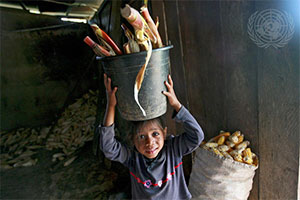 Timorese Girl with Fresh-Picked Corn. Credit: UN Photo/Martine Perret
A global common denominator is the need for a decent job. The economic realities of each country determine just how difficult it is to find one. Despite the labour movement's achievements, serious challenges persist: gender discrimination, child labour, worker migration, the digital divide and AI automation, evaporating pensions, unsafe workplaces, corporate pressure against union organising, negative impacts of trade agreements, and the precariousness of informal employment. The 2025 UN SDG Report identifies jobs and social protections as one of the six priority areas requiring urgent action, with progress either stalled or reversing in many developing nations.
In recent years, the fight to protect labour equality has taken on new dimensions with the rise of Environmental, Social and Governance standards. With the Social aspect aiming to promote equality and human rights, ESG principles have strengthened labour advocacy within corporate and governmental regulatory landscapes. In particular, ESG has become much more institutionalized in emerging economies such as Brazil and China. IPS follows the world’s workers as they confront these challenges - their setbacks and their successes.

The Week with IPS

NEXT STOP - SDGs
Tracking global progress towards a sustainable world
Tracking global progress towards a sustainable world
