Languages
Thursday, November 19, 2026



News and Views from the Global South
Natural Resources

AFRICA: Investment Growth Benefiting Only Some Poor States
While foreign direct investment in least developed countries (LDCs) in Africa has risen sharply over the past decade, most of it went to resource-rich economies and had little impact on employment creation.Arab Spring Stalls as U.S. Defers to Saudi “Counter-revolution”
As the so-called Arab Spring enters its sixth month, it appears to have run into seriously wintry headwinds.OP-ED: A Developing Health Crisis Across the Gulf Coast
Days after the BP oil disaster began, on Apr. 20, 2010, BP and the U.S. administration pledged that Gulf Coast communities would be made whole. One year later that promise remains unfulfilled: across the Gulf there is a developing health crisis as a result of the oil spill.A Fair Wind for Clean Energy in Central America
Soaring international prices for oil and gas are driving the expansion of renewable energies in Central America, a region that has plenty of untapped potential for producing hydroelectricity, wind power and geothermal energy.
Impacts of BP Oil Spill Remain Hidden in Mexican Waters
One year after the BP oil spill in the Gulf of Mexico, the worst accidental offshore oil spill in history, the search for damages in Mexican territory remains inconclusive, while scientists continue gathering and testing samples.MALAYSIA: Radiation Fears Fuel Protest
Fears of radioactive poisoning have fuelled a protest against an Australian mining company building the world’s largest rare earth processing plant outside China.
U.S.: BP Handling of Claims Slammed by Gulf Residents
Attorney Kenneth Feinberg, paid by BP to administer the firm's 20-billion-dollar compensation fund, has become the focal point of anger for Gulf residents who are angry, frustrated and desperate for help following last year's massive oil disaster.
Stress and Anger over BP Oil Disaster Could Linger for Decades
As the one-year anniversary of the record-breaking BP oil spill in the Gulf of Mexico approaches, mental health experts and social scientists warn of decades of impact on Gulf residents.LATIN AMERICA: Boosting Accountability for Mining and Oil Industries
Guatemala has been accepted as a candidate country by the Extractive Industries Transparency Initiative (EITI), which aims to strengthen governance by improving transparency and accountability in the sector, and to reduce tensions between mining and oil companies and local people affected by their activities.CUBA: Balancing Bane and Blessing of Oil
Cuba is sticking to its plans to begin oil exploration this year in its territorial waters in the Gulf of Mexico, and has assured neighbouring countries that "every reasonable" safety and environmental protection measure will be taken, in an area still haunted by the disastrous effects of the crude oil spill in 2010.
ARGENTINA-BOLIVIA: Gas Pipeline to Boost Development, Revenues – But Not for Everyone
"The pipeline will carry gas to Bolivia and seven provinces in Argentina, but we who live in Campo Durán, where the pipeline starts, will not have gas," Julio Palavecino told IPS.
Sky-High Oil Prices Here to Stay
As the Arab world continues to pitch and heave with flashes of popular uprisings here and sparks of brutal crackdowns there, analysts are painting a grim picture of the regional unrest's economic consequences, predicting the persistence of high oil prices in the coming years.Libya Uprising Hits West’s Dinner Tables
Linkages between the Libyan uprising and shelling out more money than usual at a local market in the West may not at first seem apparent but the common denominator is oil.
ECUADOR: Trees on Shaky Ground in Texaco’s Rainforest
When the trunks of the trees move with every step you take, you know you are in a swamp. This is what happens when you walk over the seemingly firm and vegetation-covered ground over what was once a pit used to dump oil sludge in the Ecuadorian Amazon rainforest.
CLIMATE CHANGE: “Act of Conscience” Could Earn 10-Year Prison Term
A college student who derailed a federal auction of oil and gas leases to protest drilling near national parks in the western U.S. state of Utah, as well as the larger issue of reliance on fossil fuels, has reignited debate over the legitimacy of civil disobedience in addressing profound global problems like climate change.
Investment in African Economies Shifting Away from Raw Materials
Local and foreign investment on the African continent is slowly moving away from agriculture and raw materials to manufacturing, services, communication and tourism, despite poor infrastructure and low skills levels.Spain Backpedals on Renewable Energy
Spain put the brakes on the use of clean energies to generate electricity, as the government approved an energy savings programme to cope with its large oil bill which affects its commitment to reduce non-renewable sources by 2020.
Will the Libya Syndrome Spread in OPEC?
The combination of a leader in power for 42 years, underground political forces bursting on the scene with violence, fractured armed forces and a fast-developing civil war would appear to be a specifically Libyan phenomenon that is unlikely to expand to the rest of OPEC.
Q&A: “The Trial Against Chevron Is Totally Corrupt”
Chevron, the second largest U.S. oil company, believes that to overturn the verdict ordering it to pay 9.5 billion dollars in reparations for environmental and public health damages in Ecuador's Amazon jungle, the best defence is a good offence.Soaring Commodity Prices a Mixed Bag for Mexico
While Mexico is earning more revenue from oil exports, the cost of food imports has risen to the point where food security is threatened.Chavez Gambles on Gaddafi Diplomacy
Hugo Chavez's offer to mediate in the Libyan crisis marks the Venezuelan president's latest attention-grabbing foray onto the world stage, yet analysts warn that he risks "ending up on the wrong side of history" if he stands by Muammar Gaddafi's internationally discredited regime.« Previous Page — Next Page »


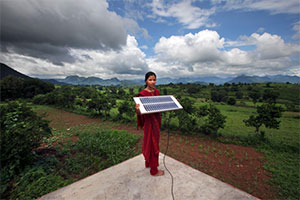 Bringing clean energy to rural India. Credit: Abbie Trayler-Smith / Panos Pictures / Department for International Development
Large reserves of oil, gas and minerals in developing countries generate opulent revenues. They could be used to stimulate economic growth and reduce poverty, but often result in environmental destruction and conflict, benefiting large companies and corrupt governments. Furthermore, competition over natural resources often manifests through geopolitical conflict. For example, before the US-Iraq war, Iraq’s domestic oil industry was nationalized. With US aggression came weakened Iraqi institutions and foreign intervention, thus eventually leading to the privatization of Iraqi oil, leaving the industry now largely dominated by Western companies. As another example, China’s rising investments within the lithium sector in South America are increasing the US-China rivalry across the Western Hemisphere. Notably, Bolivia has the largest reserves of lithium in the world, and the nation’s state-owned lithium extraction firm recently signed a contract with China’s CBC Consortium, while rejecting the entry of Western firms into the nation. In Bolivia’s case, rising Chinese investment in the nation’s lithium sector also raises concerns about environmental sustainability and the sociopolitical rights of Indigenous communities. More broadly, Sub-Saharan Africa holds nearly 30% of global reserves of critical minerals required for low-carbon technologies. Despite this, the region attracts less than 10% of global exploration investment, depicting a critical barrier to both the clean energy transitions and Sub-Saharan Africa’s economic development. Furthermore, resource wealth continues to fuel conflict like Sudan’s civil war, which has led to 9.1 million internally displaced people and is intensely connected to competition over gold, water, and agricultural land. IPS covers news about major oil, gas, and mining projects, their effects on the environment and local communities, and the ideas and actions of the interest groups involved.

The Week with IPS

NEXT STOP - SDGs
Tracking global progress towards a sustainable world
Tracking global progress towards a sustainable world
