Languages
Tuesday, November 17, 2026



News and Views from the Global South
Natural Resources
Saudis to Offset Libya Oil Shortfall
Saudi Arabia has increased oil production to compensate for the fall in output from Libya, as the popular uprising against the regime of Muammar Gaddafi continues to grow in that North African country.
Q&A: “The Verdict Against Chevron Is Enforceable, Because It Is Just”
On Feb. 14, a provincial Ecuadorean court issued the harshest environmental verdict in history against a major oil company, the U.S.-based Chevron. But is there any chance it will be carried out?
AFRICA: Billions Lost to State Coffers Due to Tax Leniency
Bad governance and the persistence of the tax avoidance industry allow billions of dollars of profit to be siphoned out of Africa, untaxed, every year.BAHRAIN: U.S. Faces New Test Over State Violence
U.S. Secretary of State Hillary Clinton Thursday expressed "deep concerns" about the deadly attack on hundreds of sleeping anti-government protestors carried out by Bahrain's security forces at a central square in the capital, Manama, Wednesday night.
ECUADOR: Still a Ways to Go, After Historic Ruling Against Chevron
The plaintiffs in the case against Chevron tried in Ecuador, who won a historic 9.5 billion dollar verdict after a nearly 18-year struggle over environmental and health damages caused in a quarter-century of oil operations in the Amazon jungle, are not disheartened by the road still ahead.
Niger Delta Demands for Justice Undaunted by Decades of Violence
Nigerian environmental rights groups have been making the case for the expulsion of oil companies from the Niger Delta in the southeastern part of the country at the World Social Forum in Dakar.COLOMBIA: Increasingly Broad Social Movements Fight Mining
Social mobilisation against gold-mining is growing in Colombia, which is now one of the world's biggest per capita polluters of mercury, used in artisanal mining, according to the United Nations Industrial Development Organisation (UNIDO).
ZIMBABWE: Activists Seek WSF Solidarity Against Privatisation
Zimbabwean activists will raise the issue of privatisation at the World Social Forum, taking place Feb 6-11 in Dakar, Senegal, and seek solidarity from other activists to resist a renewed government attempt at selling Zimbabwe’s state- owned enterprises.Report Confirms Gang Rapes at Canadian-Controlled PNG Mine
One of the world's largest mining organisations, Barrick Gold, is in damage control this week following the release of a Human Rights Watch (HRW) report outlining longstanding incidents of sexual and physical violence at the company's Porgera Joint Venture (PJV) mine in Papua New Guinea.
Questions About China’s “Win-Win” Relationship With Angola
Crouched on their haunches on the edge of a crumbling pavement, a group of Chinese construction workers are eating noodles from tin bowls, wearing floppy straw hats under their green safety helmets to protect them from the aggressive midday sun.AFRICA: France Plays Suspicious Role in Countries in Crisis
The three African states in which political crises have recently erupted – Côte d’Ivoire, Niger and Tunisia – all feature a strong French economic presence as well as close military and political ties to the former European colonial power, with France at times playing a protective role towards elites accused of abuses.ECUADOR: Seven Foreign Oil Companies to Pull Out
Seven of the 16 foreign oil companies operating in Ecuador have decided to pull out of the country in disagreement with a reformed oil law that turned the firms into providers of services to which the government will pay a fixed tariff for operating the fields.
Malnutrition Has an Indigenous Face in Peru
Indigenous children under five in Peru's highlands regions still bear the brunt of chronic malnutrition, even though local authorities in those areas received millions of dollars worth of taxes between 2006 and 2010 from the mining companies operating there.
PERU: Local Communities Protect Their Amazon
San Martín is one of the three most deforested Amazon regions in Peru. But now local residents and non-governmental organisations have joined with local and regional authorities to defend the flora, fauna and water resources and halt the destruction of the rainforests.MINING-PERU: Doe Run’s Latest Move
The U.S. mining and metallurgical company Doe Run has once again challenged the Peruvian government. The Renco Group, of which it is a subsidiary, notified the government of its plans to start an international arbitration process, invoking the free trade agreement between this South American country and the United States.
U.S.: Sick Gulf Residents Beg Officials for Help
In an emotionally charged meeting this week sponsored by the National Commission on the BP Deepwater Horizon Oil Spill, fishermen, Gulf residents and community leaders vented their increasingly grave concerns about the widespread health issues brought on by the three-month-long disaster.Sanctions Forced Iran to Slash Bloated Energy Subsidies
Touring Iran's Arab rivals this week, U.S. Secretary of State Hillary Rodham Clinton sounded almost triumphant as she asserted that economic sanctions have helped slow Tehran's nuclear progress.
South Sudan Voters Die in Ambush
At least 11 more people have been killed in violence over southern Sudan's historic referendum, officials have said.
SUDAN-U.S.: Referendum May Be Only the Beginning
Amid growing certainty that the much-anticipated weeklong referendum on independence for south Sudan will indeed begin Sunday as scheduled, U.S. officials and independent experts are warning that the situation in both the north and the south is likely to remain very fragile for some time to come.
PERU: Resistance to Increasing Mining Royalties
As metal prices continue to soar, the debate on a tax on windfall earnings of mining companies in Peru and an increase in the royalties they pay has been revived.
BOLIVIA: Madidi National Park and the Curse of Petroleum
Environmental organisations in Bolivia are waging a crusade to protect Madidi National Park against bids to tap into its petroleum reserves, build hydroelectric dams and promote human settlement in the country's largest nature preserve.« Previous Page — Next Page »


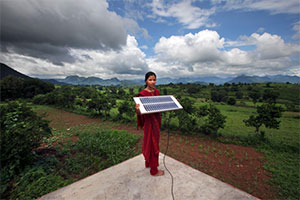 Bringing clean energy to rural India. Credit: Abbie Trayler-Smith / Panos Pictures / Department for International Development
Large reserves of oil, gas and minerals in developing countries generate opulent revenues. They could be used to stimulate economic growth and reduce poverty, but often result in environmental destruction and conflict, benefiting large companies and corrupt governments. Furthermore, competition over natural resources often manifests through geopolitical conflict. For example, before the US-Iraq war, Iraq’s domestic oil industry was nationalized. With US aggression came weakened Iraqi institutions and foreign intervention, thus eventually leading to the privatization of Iraqi oil, leaving the industry now largely dominated by Western companies. As another example, China’s rising investments within the lithium sector in South America are increasing the US-China rivalry across the Western Hemisphere. Notably, Bolivia has the largest reserves of lithium in the world, and the nation’s state-owned lithium extraction firm recently signed a contract with China’s CBC Consortium, while rejecting the entry of Western firms into the nation. In Bolivia’s case, rising Chinese investment in the nation’s lithium sector also raises concerns about environmental sustainability and the sociopolitical rights of Indigenous communities. More broadly, Sub-Saharan Africa holds nearly 30% of global reserves of critical minerals required for low-carbon technologies. Despite this, the region attracts less than 10% of global exploration investment, depicting a critical barrier to both the clean energy transitions and Sub-Saharan Africa’s economic development. Furthermore, resource wealth continues to fuel conflict like Sudan’s civil war, which has led to 9.1 million internally displaced people and is intensely connected to competition over gold, water, and agricultural land. IPS covers news about major oil, gas, and mining projects, their effects on the environment and local communities, and the ideas and actions of the interest groups involved.

The Week with IPS

NEXT STOP - SDGs
Tracking global progress towards a sustainable world
Tracking global progress towards a sustainable world
