Languages
Wednesday, November 18, 2026



News and Views from the Global South
Natural Resources
PERU: Gas Exports Will Cause Local Shortages, Governors Protest
The Peruvian government refuses to change the contract it signed with Consorcio Camisea to export natural gas to Mexico, as demanded by the governors of the southern provinces of Arequipa, Cuzco, Moquegua, Puno and Tacna, who are worried about shortages of local supplies.
Ecosystem in Peril after Gulf Oil Spill
With engineers giving a best-case scenario of "weeks" before the catastrophic oil leak in the Gulf of Mexico is sealed, some scientists are warning that the region's ecosystem could face major long-term damage.BIODIVERSITY: Oil Spill Will Devastate the North Sea Warn Experts
If an oil spill similar to that in the Gulf of Mexico were to happen in the North Sea, it would devastate the Wattenmeer, one of the most fragile and important biodiversity hotspots in northern Europe.UNESCO Catches Heat Over Prize Named for “Dictator”
Human rights groups are expressing outrage over a decision to proceed with the UNESCO-Obiang Nguema Mbasogo International Prize for Research in the Life Sciences, named after and funded by the controversial president of oil-rich Equatorial Guinea.MALAYSIA: Gov’t Urged to Explore Alternative Energy Sources
Instead of going nuclear, the Malaysian government should be harnessing alternative energy resources, which are adequate in supply, says the country’s anti-nuclear lobby.ECUADOR: New Deadline for Renegotiating Oil Contracts
The government of Ecuador hopes to sign new services contracts with foreign oil firms operating in the country, to replace the 34 contracts currently in effect, by the end of the year.ARGENTINA: Adding More Coal to the Fire
Bucking recommendations to build up renewable energy sources, Argentina is forging ahead with a plan that will increase its dependence on coal, regarded as the most polluting fossil fuel.MEXICO: Oil Spill Fuels Debate on Environmental Safety
The spreading oil spill in the Gulf of Mexico has highlighted the urgent need for stricter environmental rules and standards for deep sea oil rigs.ENVIRONMENT: Small Islands Urge Action at UN Oceans Meet
Faced with rising sea levels, dying coral reefs and decreasing fish stocks, small island developing states (SIDS) are feeling the effects of ocean decline, and they want wealthier countries to do more to ensure the survival of the world’s seas and other waterways.
ENVIRONMENT: Oil Spill Gives Urgency to UN Oceans Meet
The disastrous oil spill in the Gulf of Mexico has given increased urgency to the fifth Global Oceans Conference taking place here at the United Nations Educational, Scientific and Cultural Organisation (UNESCO).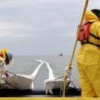
U.S.: Offshore Drilling Badly Tarnished by Gulf Oil Leak
As oil seeps into the environmentally and economically critical Gulf of Mexico following an explosion on a rig there two weeks ago, some groups are saying this catastrophe should mark the end of offshore drilling for oil - and be a "clarion call" for moving away from fossil fuels.BURMA: Pressure Mounts on Energy Giant Chevron to Disclose Revenue
When shareholders of the multinational company Chevron gather for their annual meeting in the U.S. city of Houston in late May, they will come face to face with Naing Htoo, whose community has suffered due to the exploits of the energy giant in military-ruled Burma.
Q&A: Coal, a Silent Killer
Fatal accidents at coalmines, like the recent tragedies in China and the United States, cause great public alarm. But U.S. physician Alan Lockwood warns that many more deaths are caused by the pollution that comes from the use of coal as an energy source.Mexico on the Alert Over Massive Oil Spill
Mexico is gearing up for the environmental effects of the oil spill caused by last week's sinking of a BP-owned deepwater drilling rig in the Gulf of Mexico, off the coast of the U.S. state of Louisiana.
NIGERIA: New Law to Promote Locals in Oil Industry
"This bill seeks to address the compelling need for us as a nation to have indigenous participation in the industry." With these words, Nigeria’s acting President, Goodluck Jonathan, signed the Nigerian Oil and Gas Industry Content Development Bill into law.Crunch Time for Ecuador’s Biological Treasure Trove
These are decisive days for the Yasuní National Park, one of the world's most biodiverse areas, because of the danger that its wealth of underground oil poses to this unique and fragile ecosystem in Ecuador's Amazon jungle region.US-NIGERIA: Acting President Gets Attention
Among the almost four dozen heads of state who have gathered here for this week's Nuclear Security Summit, Nigeria's acting president, Goodluck Jonathan, has been receiving a disproportionate share of high-level attention.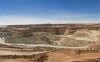
ENVIRONMENT-NIGER: French State-Owned Company “Poisoning” Poor
Recent research by Greenpeace suggests that French state-owned company Areva’s public claims of decontamination of populated areas near uranium mines in Niger are false. High radio-activity persists in towns and rural areas near the mines, affecting some 80,000 people.ECUADOR: Environmental Inspection in Yasuni Park
Representatives of Ecuador's ombudsman's office and environmental groups are visiting the Yasuni National Park on Saturday, home to some of the world's last indigenous people still living in voluntary isolation, in order to verify reports of illegal activity by oil companies.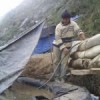
PERU: Miners Call Off Protests for Talks; Six Killed in Clashes
In response to a government promise to negotiate, small-scale gold miners in southern Peru temporarily called off protests Wednesday in which six people were killed and as many as 30 injured when the police attempted to clear a roadblock.GUATEMALA-EL SALVADOR: Cross Border Opposition to Mine
The Cerro Blanco gold and silver mine in the southeastern Guatemalan province of Jutiapa, on the border with El Salvador, is under fire from environmentalists in both countries concerned about the threat it poses to the shared Lake Güija and rivers on either side of the border.« Previous Page — Next Page »


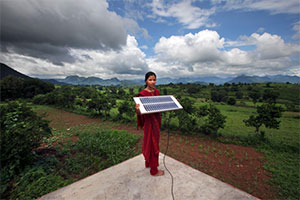 Bringing clean energy to rural India. Credit: Abbie Trayler-Smith / Panos Pictures / Department for International Development
Large reserves of oil, gas and minerals in developing countries generate opulent revenues. They could be used to stimulate economic growth and reduce poverty, but often result in environmental destruction and conflict, benefiting large companies and corrupt governments. Furthermore, competition over natural resources often manifests through geopolitical conflict. For example, before the US-Iraq war, Iraq’s domestic oil industry was nationalized. With US aggression came weakened Iraqi institutions and foreign intervention, thus eventually leading to the privatization of Iraqi oil, leaving the industry now largely dominated by Western companies. As another example, China’s rising investments within the lithium sector in South America are increasing the US-China rivalry across the Western Hemisphere. Notably, Bolivia has the largest reserves of lithium in the world, and the nation’s state-owned lithium extraction firm recently signed a contract with China’s CBC Consortium, while rejecting the entry of Western firms into the nation. In Bolivia’s case, rising Chinese investment in the nation’s lithium sector also raises concerns about environmental sustainability and the sociopolitical rights of Indigenous communities. More broadly, Sub-Saharan Africa holds nearly 30% of global reserves of critical minerals required for low-carbon technologies. Despite this, the region attracts less than 10% of global exploration investment, depicting a critical barrier to both the clean energy transitions and Sub-Saharan Africa’s economic development. Furthermore, resource wealth continues to fuel conflict like Sudan’s civil war, which has led to 9.1 million internally displaced people and is intensely connected to competition over gold, water, and agricultural land. IPS covers news about major oil, gas, and mining projects, their effects on the environment and local communities, and the ideas and actions of the interest groups involved.

The Week with IPS

NEXT STOP - SDGs
Tracking global progress towards a sustainable world
Tracking global progress towards a sustainable world
