Languages
Tuesday, October 27, 2026



News and Views from the Global South
Natural Resources

Small Glacial Lakes’ Mass Destruction in the Himalayan Community
Small glacial lakes can cause destruction, which may impact the livelihoods of entire communities. Now this is the harsh reality that the community of Thame village in the Mt. Everest region of Nepal now faces as they rebuild after the August 16 disaster.
A Cuban Town Improves Water Quality Through Desalination
Overnight, hundreds of people in the rural community of Las Mangas, located in Granma province in eastern Cuba, realised something they had already suspected: that the water they had been drinking for decades was not exactly crystal clear, but rather “salty”, as they say.
Rural Survival: Guardians of Mother Earth Saving Mau, Revitalizing Native Lands
The Great Rift Valley is part of an intra-continental ridge system that runs through Kenya from north to south. A breathtaking, diverse mix of natural beauty that includes dramatic escarpments, highland mountains, cliffs and gorges, lakes and savannas. It is also home to one of Africa’s greatest wildlife reserves—the Maasai Mara National Reserve.
Biodiversity: Roll Up the Sleeves and Do Something, says Astrid Schomaker, New UNCBD Head
“We are living in a time where nature is regularly raising its hand and saying, 'Look, I'm here and I'm in trouble,' and then bringing us all sorts of natural disasters to the table," says Astrid Schomaker, Executive Secretary of the United Nations Convention on Biological Diversity (UNCBD), in an exclusive interview with IPS.
Clean Energy Boosts Autonomy for Brazilian Women Farmers – VIDEO
 A community bakery, family production of fruit pulp, and the recovery of water springs are some of the initiatives of the Energy of Women of the Earth, organised since 2017 in the state of Goiás, in central-western Brazil.
Various Uncertainties Block Indigenous Land Rights in Brazil
A never-ending battle threatens the indigenous rights that seemed clear and secure in Brazil, until the extreme right emerged in 2018 with a force challenging the civilisational advances set out in the Constitution.
Micro-Dams, a Solution to Water Shortages in Rural Brazil
Water shortage is over, springs have emerged or become perennial, small ponds with fish have formed and pastures have become greener and more permanent, all thanks to the ‘barraginhas’, the Portuguese name given in Brazil to micro-dams that retain rainwater and infiltrate it into the soil.
Empowering Africa’s Informal Market Traders To Deliver Safe Food
Local informal food markets feed millions of urbanites in bustling African cities, but the consequences of tainted food could be illness and death for unsuspecting consumers.
Hydrogen from Renewables or Fossil Fuels? The Panamanian Question
In 2021, the Panama Canal welcomed a French experimental ship on a world tour, the Energy Observer, the first electric vessel powered by a combination of renewable energies and a hydrogen production system based on seawater.
Small Farmers Feeling Climate Change Heat Find Little Support From the State
The over 20 million residents of Pakistan’s port city of Karachi, in Sindh province in particular, have been experiencing brutal heat since May. But they are not the only ones bearing the brunt of high temperatures and humidity. Up to 15,000 cattle died due to scorching heat mixed with high humidity which Shakir Umar Gujjar, president of the Cattle and Dairy Farmers Association, Pakistan, said was “no joke”.
Pacific Community Photographic Winners Bring Impacts of Climate Change to Life
The Pacific Community’s photographic competition winners reflect the devastating climate impacts on beautiful and sensitive environments, documenting the most pressing issues the communities who live on the islands face today.
Water Stories: The Well Seven Families and 400 Buffaloes Rely On
In the rural village of Khardariya in the Dang district of Nepal, access to clean water is a major issue. Villagers depend on one poorly managed well for drinking water, cleaning, and feeding livestock. Anjana Yadav stood near the well while a neighbor walked toward it to fetch a bucket of water.
ECUADOR: ‘We demand that the violation of the rights of nature be recognised and reversed’
CIVICUS speaks with Darío Iza Pilaquinga, president of the Kitu Kara People of the Kichwa nationality of Ecuador, about a historic court ruling that applied a constitutional provision recognising the rights of nature.
Chilean Fisherwomen Seek Visibility and Escape from Vulnerability
The number of organisations that bring together fisherwomen who seek to be recognised as workers, make their harsh reality visible and escape the vulnerability in which they live is growing in Chile.
Cambodia’s Young Environmental Activists Pay a Heavy Price
It’s risky to try to protect the environment in authoritarian Cambodia. Ten young activists from the Mother Nature environmental group have recently been given long jail sentences. Two were sentenced to eight years on charges of plotting and insulting the king. Another seven were sentenced to six years for plotting, while one, a Spanish national banned from entering Cambodia, was sentenced in absentia.
The Price Women Pay for Climate Change
Global warming, widely believed to be a universal crisis, will actually impact girls and women far more than boys and men. It is already known that we live in a patriarchal world, one in which men are afforded far greater opportunities for success while women generally hold less societal power and have access to fewer resources. This especially pertains to developing countries in which agriculture related work, usually delegated to females, depends on a variety of environmental factors and subsequently, significantly hurts their livelihoods.
Life or Energy: The Hydroelectric Dilemma in Amazonian Brazil
The decade-and-a-half-long battle for life in the so-called Volta Grande (Big Bend) of the Xingu river, a stretch of the river dewatered by the Belo Monte hydroelectric power plant in the Brazilian Amazon, has a possible solution, albeit a partial one.
More Poverty for the Poor
Many low-income countries (LICs) continue to slip further behind the rest of the world. Meanwhile, people in extreme poverty have been increasing again after decades of decline.
Rural Communities in El Salvador Get Their Water Supply from the Sun
Setting up a community water project with a solar-powered pumping system was an unlikely idea for the peasant families of a Salvadoran village who, despite their doubts, turned it into reality and now have drinking water in their homes.
The International Seabed Authority Must Change Course Amid Series of Scandals
The International Seabed Authority (ISA) has enormous importance as responsible for the fate of the largest, and most untouched, biome on the Planet. Ahead of elections for its leadership, governments cannot ignore that its current Secretary-General has become the subject of both media investigations and criticism from other parts of the UN.
Are Sustainable Cities a Pipe Dream?
Cities, once thought to be modern utopias that foster innovation, inclusivity, and commerce, actually ended up being hubs for environmental degradation. Although the concept of urban living is inextricable from humanity, there are proposed ways to make them less environmentally taxing. One such solution is the idea of a sustainable city, otherwise known as a metropolis that effectively consumes fossil fuels and disposes of emissions with regards to the longevity of the planet as well as the economic wellbeing of its citizens. Cities can also be considered sustainable so long as they curb the consequences of consumption through means such as recycling or using healthier energy sources. Although this sounds like a simple path forward in Earth’s journey of decarbonizing, we must take a plethora of issues into consideration, such as transportation, housing, manufacturing, trade, and comfort.« Previous Page — Next Page »





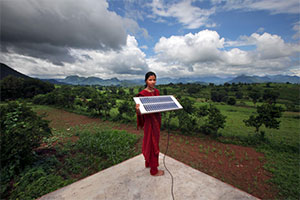 Bringing clean energy to rural India. Credit: Abbie Trayler-Smith / Panos Pictures / Department for International Development
Large reserves of oil, gas and minerals in developing countries generate opulent revenues. They could be used to stimulate economic growth and reduce poverty, but often result in environmental destruction and conflict, benefiting large companies and corrupt governments. Furthermore, competition over natural resources often manifests through geopolitical conflict. For example, before the US-Iraq war, Iraq’s domestic oil industry was nationalized. With US aggression came weakened Iraqi institutions and foreign intervention, thus eventually leading to the privatization of Iraqi oil, leaving the industry now largely dominated by Western companies. As another example, China’s rising investments within the lithium sector in South America are increasing the US-China rivalry across the Western Hemisphere. Notably, Bolivia has the largest reserves of lithium in the world, and the nation’s state-owned lithium extraction firm recently signed a contract with China’s CBC Consortium, while rejecting the entry of Western firms into the nation. In Bolivia’s case, rising Chinese investment in the nation’s lithium sector also raises concerns about environmental sustainability and the sociopolitical rights of Indigenous communities. More broadly, Sub-Saharan Africa holds nearly 30% of global reserves of critical minerals required for low-carbon technologies. Despite this, the region attracts less than 10% of global exploration investment, depicting a critical barrier to both the clean energy transitions and Sub-Saharan Africa’s economic development. Furthermore, resource wealth continues to fuel conflict like Sudan’s civil war, which has led to 9.1 million internally displaced people and is intensely connected to competition over gold, water, and agricultural land. IPS covers news about major oil, gas, and mining projects, their effects on the environment and local communities, and the ideas and actions of the interest groups involved.

The Week with IPS

NEXT STOP - SDGs
Tracking global progress towards a sustainable world
Tracking global progress towards a sustainable world
