Languages
Thursday, October 8, 2026



News and Views from the Global South
Natural Resources

Poor Sales at Slated Namibian Elephant Auction
A heavily criticised Namibian government sale of elephants has attracted only a third of its expected sales as government officials admit that an international outcry when the plans were announced may have put buyers off.
What Might Help Save Our Planet? Different Approaches to Desertification
I am in the Swedish countryside, lush and beautiful in its late summer attire, having a conversation with the son of a friend of mine. Oskar Olin runs a sheep farm, Stabbehyltan Lamm AB, where he practises holistic management. His three-hundred sheep graze within an area of 30 ha where Oskar every day moves his flock from one pasture to another. It takes between 45 to 90 days before the sheep are back on the same pasture where the rotation began. The animals are thus not overgrazing the area, while they at the same time trample down a protective layer of vegetation, which fertilizes the soil. Carbon is bound in the earth, soil organic matter increases, retaining humidity and accordingly deepen the root systems of wholesome plants.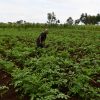
Digitisation Boosts Mechanised Farming Among Kenyan Farmers
When 33-year-old Kimani Mwaniki, an Irish potato farmer in Elburgon, Nakuru County in Kenya’s Rift Valley, heard about a farmer’s virtual school, he didn’t hesitate to enrol. He was keen to learn how the programme will enable him to get higher crop yields for his market in the capital city Nairobi and elsewhere.
Wildlife Trafficking to Come under Fire at IUCN Congress
A recent seizure at Johannesburg’s international airport of a large consignment of rhino horns confirmed worst fears – illegal trafficking of wildlife and the plundering of treasured species is back with a vengeance after a Covid-19 lockdown lull.
Suburban Living the Worst for Carbon Emissions – New Research
Work, education, entertainment, or simply better connectivity all draw people to cities. By the end of this century around 85% of the world population are predicted to live in cities.
Protecting Plants Will Protect People and the Planet
Back-to-back droughts followed by plagues of locusts have pushed over a million people in southern Madagascar to the brink of starvation in recent months. In the worst famine in half a century, villagers have sold their possessions and are eating the locusts, raw cactus fruits, and wild leaves to survive.
Why is the UK Government Turning off the Tap During a Global Pandemic?
The UK government’s decision to reduce its Official Development Assistance (ODA) budget from 0.7% of gross national income (GNI) to 0.5% -- a cut of around £4 billion this year -- was confirmed last week by a majority of 35 votes in a House of Commons vote.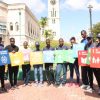
Cleantech Entrepreneurs Driving a Green Recovery in Barbados
Prior to the COVID-19 pandemic, the Eastern Caribbean island nation, famed for its beautiful landscapes, pristine white-sand beaches and temperate climate, attracted around a million tourists each year.
Caribbean aims to Turn Foul-smelling, Enviro Problem Sargassum Seaweed into High-Value Products
 A regular visitor to the islands of the Caribbean has become a dreaded nuisance over the past ten years. The sargassum seaweed that typically washes ashore now arrives each year in overwhelming, extraordinary amounts for reasons that are not entirely clear.
“The Critical Importance of Ecosystem Restoration”
June 2021 marked the launch of UN Decade on Ecosystem restoration. This effort aims at reversing the damage that us humans have caused and are still causing to Nature. It is clear that we have to reverse course and spare no effort into making this ‘Decade on Ecosystem Restoration’ a success. Preserving Nature and maintaining its services are critical for our survival on this planet and for our livelihoods.
Calls to Halt Construction of Massive Oilfield in One of Africa’s last Wildernesses
Wildlife and environmental campaigners have called for international action as concerns grow over a project to create a massive oilfield in one of Africa’s last wildernesses.
Bangladesh’s Indigenous Forest Dwellers Fear Losing Ancestral Land as Officials Grapple with Land Grabs
When the Bangladesh Forest Department felled Basanti Rema’s banana orchard, Rema, a Garo indigenous forest-dweller of Madhupur Forest, felt she was living a nightmare. Rema, from Pegmari village in Madhupur, Tangail district, had cultivated the banana plants on half an acre in the Madhupur Forest. But the Forest Department claimed that the land on which the bananas were cultivated belonged to the department.
Stopping Marine Plastic Pollution: A Key IUCN Congress Goal
Documented images of albatross chicks and marine turtles dying slow deaths from eating plastic bags and other waste are being seared into our consciences. And yet our mass pollution of Earth’s seas and oceans, fuelled by single-use plastics and throw-away consumerism, just gets worse.
Does a New ‘Gold Standard’ Really Protect Miners?
Many products these days come with the promise that workers and communities all along their supply line are protected from abuse under a particular standard or code of conduct. Since the United Nations adopted the Guiding Principles for Business and Human Rights a decade ago, a plethora of such certification systems have emerged, including for mining and connected industries ranging from cars to jewelry and electronics.
The Last Coral Reef Wilderness: the Chagos Archipelago
On the Global Reef Expedition—the largest coral reef survey and mapping expedition in history—scientists from the Khaled bin Sultan Living Oceans Foundation traveled to the Chagos Archipelago to study some of the most remote coral reefs on Earth.
Three Million in Three Years: Jamaica’s Tree-Planting to Tackle Climate Change
By the time he is finished, Dr. Satyanarayana Parvataneni expects he will be responsible for planting over 200,000 tree seedlings in Jamaica. It is an effort driven by a desire to preserve the planet for the next generation, as well as the one of the largest contributions to date to a national effort to plant three million trees in three years.
Soil for Survival: Countries Commit to Halt Land Degradation
India’s Prime Minister Narendra Modi has told the first United Nations General Assembly meeting on desertification and drought in a decade, that his country’s report card will show it is well on track to meet its land restoration commitments.

Charcoal Production Risks Future of Zimbabwe’s Native Forests
Once a week a tonnage of fresh charcoal is dropped off at Sibangani Tshobe's rugged, pit-stop stall by a hired, battered old Bedford lorry. Small, makeshift trolleys — nicknamed Scania's — quickly cart off small loads and disappear into Old Pumula, the oldest suburb in the country’s second-largest city of Bulawayo.
Preventing Hunger While Building Peace
Acute hunger is expected to soar in over 20 countries in the next few months, warns a recent report on global “hunger hotspots” from the UN’s Food and Agriculture Organization (FAO) and the World Food Programme (WFP). An estimated 34 million people are “one step away from starvation”, pushed to the brink by climate shocks, conflict, and the Covid-19 pandemic.
The Ocean’s Silent Killer: Breaking Down Overfishing
You don’t have to look too hard to find some news network or media outlet talking about water pollution, plastic waste, CO2 emissions, and climate change.
Fresh Air, Clean Water
You want to breathe fresh air and have access to clean water? I guess you do, just like all of us. As populations in the so-called developed countries, we love to go for holidays in places where on high mountains you get to breathe deeply and enjoy the fresh air, where the oceans or lakes are clean and refreshing. And how do we arrive there? Mostly by airplanes or cars, polluting the air whilst travelling to the desired destinations, causing harm to people and the planet. Interestingly, many people today, calculate their flight’s CO2 footprint and pay a certain amount of money to invest in renewable energy projects, in order to feel better about their travelling and to receive tax deductibility (depending on regulations of their country).« Previous Page — Next Page »





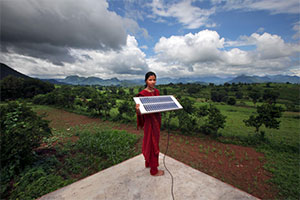 Bringing clean energy to rural India. Credit: Abbie Trayler-Smith / Panos Pictures / Department for International Development
Large reserves of oil, gas and minerals in developing countries generate opulent revenues. They could be used to stimulate economic growth and reduce poverty, but often result in environmental destruction and conflict, benefiting large companies and corrupt governments. Furthermore, competition over natural resources often manifests through geopolitical conflict. For example, before the US-Iraq war, Iraq’s domestic oil industry was nationalized. With US aggression came weakened Iraqi institutions and foreign intervention, thus eventually leading to the privatization of Iraqi oil, leaving the industry now largely dominated by Western companies. As another example, China’s rising investments within the lithium sector in South America are increasing the US-China rivalry across the Western Hemisphere. Notably, Bolivia has the largest reserves of lithium in the world, and the nation’s state-owned lithium extraction firm recently signed a contract with China’s CBC Consortium, while rejecting the entry of Western firms into the nation. In Bolivia’s case, rising Chinese investment in the nation’s lithium sector also raises concerns about environmental sustainability and the sociopolitical rights of Indigenous communities. More broadly, Sub-Saharan Africa holds nearly 30% of global reserves of critical minerals required for low-carbon technologies. Despite this, the region attracts less than 10% of global exploration investment, depicting a critical barrier to both the clean energy transitions and Sub-Saharan Africa’s economic development. Furthermore, resource wealth continues to fuel conflict like Sudan’s civil war, which has led to 9.1 million internally displaced people and is intensely connected to competition over gold, water, and agricultural land. IPS covers news about major oil, gas, and mining projects, their effects on the environment and local communities, and the ideas and actions of the interest groups involved.

The Week with IPS

NEXT STOP - SDGs
Tracking global progress towards a sustainable world
Tracking global progress towards a sustainable world
