Languages
Tuesday, October 6, 2026



News and Views from the Global South
Natural Resources

‘West of The Nile and Around The Sudd’
Tensions and hostilities persisted until early 2019, when the regime of Omar al-Bashir - to a large extent symbolized by oppressing minority groups in the Darfurs, Blue Nile state and South Kordofan - finally ended. Meanwhile, many inhabitants of the Nuba Mountains and other parts of South Kordofan, had escaped to South Sudan, which had become independent in 2011. There, they found, however, a country with even more interethnic strains and assaults, resulting, in addition to the innumerable internally displaced persons, the flight of 2.3 million citizens to six countries in the region. An area characterized by perpetual political and ethnic tensions which often resulted in border crossings in opposite ways. The present case of refugees from Ethiopia to the Republic of Sudan is an example of this phenomenon in the IGAD-region. (The Intergovernmental Authority on Development (IGAD) is an eight-country trade bloc in Africa that includes governments from the Horn of Africa, the Nile Valley and the African Great Lakes. Its headquaters is in Djibouti City)
Finance Nature-based Solutions to Quiet Nature’s Wrath – Experts
Climate change experts and leaders from the Commonwealth member states rallied behind calls to accelerate climate finance for nature-based solutions to arrest the pace of climate change, land degradation, and biodiversity loss.
COP26: Combined Exclusive Maritime Zone for Africa to Combat Illegal, Unreported & Unregulated Fishing
“Working together means we widen the number of like-minded actors towards a common good” –Dr. Azza Karam, Secretary-General of Religions for Peace International. As global leaders and civil society actors participate in COP26 in Glasgow, Scotland, illegal, unreported, and unregulated fishing is a significant problem that must be tackled.
Mobilising the ‘Tools’ for Renewable Energy Investment in the Seychelles
Breaking the world’s reliance on fossil fuels and accelerating the global uptake of renewable energy will play a decisive role in diminishing the threat of global warming to the survival of life on earth, according to experts. But turning the vision into reality will demand unwavering political will and, critically, massive investment, which can no longer be shouldered solely by aid and development partners.
Will Glasgow Fix Broken Climate Finance Promises?
Current climate mitigation plans will result in a catastrophic 2.7°C world temperature rise. US$1.6–3.8 trillion is needed annually to avoid global warming exceeding 1.5°C.
Is Asia and the Pacific Ready for the Global Climate Stage?
As the leaders of Asia and the Pacific prepare to head to Glasgow for the 26th United Nations Climate Change Conference of the Parties (COP26), they can be sure that our region will be in the spotlight: many of the most vulnerable countries to the impacts of climate change are located here; the seven G20 members from this region are responsible for over half of global GHG emissions; and five of the 10 top countries with the greatest historic responsibility for emissions since the beginning of the twentieth century are from Asia.
Green Gold: Billion Dollar Question for Congo Rainforest
On the brink of an unprecedented environmental emergency, EU ambassadors to the Democratic Republic of Congo (DRC) gathered earlier this month for a luxury river cruise hosted by the country’s Environment Minister, Eve Bazaiba.
An Ambitious, Stakeholder-Driven Climate Change Commitment Ahead of COP26: Eswatini’s Revised Nationally Determined Contribution (NDC) Process
There is no country today that has not experienced the effects of climate change, from changing weather patterns to extreme, devastating weather events.
Forests & Climate: We Need to do Much, Much More
Governments agree that saving the climate means saving forests – but ambition and action fall short of what’s required. First the good news: one of the forest goals agreed by governments, businesses and civil society organizations has been met.
How Land Management Can Restore Hope to Women in Rural Kenya
Jenifer Kamba, 33, has always loved farming – a love passed on to her by her late husband after they married 14 years ago. The young farmer duo grew maise, pepper and vegetables on their two-acre farm in Kivandini of Kenya’s Machakos county. Even after her husband died five years ago, Kamba didn’t stop farming. However, of late, the soil looks dry, and her production has declined considerably.
Mangrove Blue Carbon for Climate Change Mitigation
Smelly, boggy, and full of bugs, mangroves’ superpowers are well hidden. However, there is rising confidence that mangroves are the silver bullet to combat the effects of climate change.
UN Warned of Two Dangers Ahead: Health of the Human Race & Survival of the Planet
Addressing the UN General Assembly last month President Gotabaya Rajapaksa of Sri Lanka raised several concerns, two that had to do with health. One concerned the health of the human race; the other the health of Planet Earth on which man struggles increasingly to survive.
IUCN World Conservation Congress Warns Humanity at ‘Tipping Point’
The world’s most influential conservation congress, meeting for the first time since the onset of the COVID-19 pandemic, has issued its starkest warning to date over the planet’s escalating climate and biodiversity emergencies.
Zero Hunger Campaign in Vietnam Targets Remote Areas and Cities
Amidst the verdant hills and remote corners of Vietnam’s rural regions, the growth that has transformed the economy in this part of Southeast Asia in recent decades can be hard to see. Undernourishment among children still results in stunting – even in cities too where overweight/obesity is also on the rise.
Rwanda’s Rainforest Conservation Wins Praise from Indigenous Community
Laurent Hategekimana, a villager from Nyabihu, a district from Western Rwanda, recalls the terrible condition of the Gishwati natural forest a few years ago when it was overrun by illegal loggers and invading farmers.
If Women Farmers were Politicians, the World Would be Fed, says Danielle Nierenberg
Women, key contributors to agriculture production, are missing at the decision table, with alarming consequences, says Food Tank President Danielle Nierenberg in an exclusive interview with IPS.
Even as IUCN Congress Closes, Conservation Debate Hots Up
One of the most hotly debated issues at the recently concluded IUCN Congress in Marseilles was about designating 30 percent of the planet's land and water surface as protected areas by 2030.
Southeast Asian Farmers Adapt, Insure against Growing Climate Risks
As incidents of drought and extreme rainfall increase, farmers in Southeast Asia are partnering with experts to develop targeted weather forecasts to work around the threats and, when adaptation becomes too costly, buy specially designed insurance to protect their livelihoods.
The ARC Model: Proactive Disaster Risk Financing for a More Resilient Africa
The world faces multiple crises: climate change, extreme weather events, food security and biodiversity. For African nations, these issues are compounded by the COVID-19 pandemic and epidemic outbreaks that include Rift Valley Fever and Malaria. With 35 African Union Member States as signatories to its establishment Treaty, the African Risk Capacity (ARC) Group – comprising of ARC Agency and ARC Limited - works with Governments to help improve their capacities to better plan, prepare, and respond to extreme weather disasters and natural disasters.
NDC Partnership: Supporting a Global Network of Youth Climate Advocates
Just over six months after launching its Youth Engagement Plan, the NDC Partnership, the coalition assisting governments with their climate action plans, has brought together youth climate advocates for its inaugural NDC Global Youth Engagement Forum.
Poor Sales at Slated Namibian Elephant Auction
A heavily criticised Namibian government sale of elephants has attracted only a third of its expected sales as government officials admit that an international outcry when the plans were announced may have put buyers off.« Previous Page — Next Page »





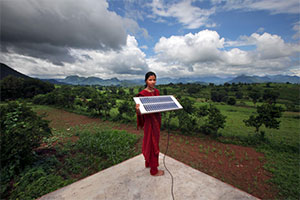 Bringing clean energy to rural India. Credit: Abbie Trayler-Smith / Panos Pictures / Department for International Development
Large reserves of oil, gas and minerals in developing countries generate opulent revenues. They could be used to stimulate economic growth and reduce poverty, but often result in environmental destruction and conflict, benefiting large companies and corrupt governments. Furthermore, competition over natural resources often manifests through geopolitical conflict. For example, before the US-Iraq war, Iraq’s domestic oil industry was nationalized. With US aggression came weakened Iraqi institutions and foreign intervention, thus eventually leading to the privatization of Iraqi oil, leaving the industry now largely dominated by Western companies. As another example, China’s rising investments within the lithium sector in South America are increasing the US-China rivalry across the Western Hemisphere. Notably, Bolivia has the largest reserves of lithium in the world, and the nation’s state-owned lithium extraction firm recently signed a contract with China’s CBC Consortium, while rejecting the entry of Western firms into the nation. In Bolivia’s case, rising Chinese investment in the nation’s lithium sector also raises concerns about environmental sustainability and the sociopolitical rights of Indigenous communities. More broadly, Sub-Saharan Africa holds nearly 30% of global reserves of critical minerals required for low-carbon technologies. Despite this, the region attracts less than 10% of global exploration investment, depicting a critical barrier to both the clean energy transitions and Sub-Saharan Africa’s economic development. Furthermore, resource wealth continues to fuel conflict like Sudan’s civil war, which has led to 9.1 million internally displaced people and is intensely connected to competition over gold, water, and agricultural land. IPS covers news about major oil, gas, and mining projects, their effects on the environment and local communities, and the ideas and actions of the interest groups involved.

The Week with IPS

NEXT STOP - SDGs
Tracking global progress towards a sustainable world
Tracking global progress towards a sustainable world
