Languages
Sunday, October 4, 2026



News and Views from the Global South
Natural Resources

Landmark UN Report Issues Stark call for Sustainable Land Management to Save Human Health
With 50% of humanity affected by land degradation, the world must move to a ‘crisis footing’ to conserve, restore and use land resources sustainably, a major UN report has said.
The World Can Stop Capital Flight Now
Curbing capital flight from developing countries is long overdue. New sanctions against Russian oligarchs show this can be done with the requisite political will. Recent research also shows how to more effectively stop capital flight.
Poor Water Distribution Infrastructure Gives Jamaica a ‘Water Scarce’ Label
It will take billions of dollars and many years to fix a growing problem that has placed Jamaica into the unlikely bracket of being among the world's most water-scarce countries due to the unavailability of potable water.
Kenyan Community Project Saving Forests, Saving Livelihoods
Despite an abundance of fisheries reserves along Kwale County’s lush coastline located on the south coast of Kenya, fishers can no longer cast a net just past the coral reef and expect an abundant crab or prawn harvest.
Oil Crisis Offers Opportunities to the South and for the Green Energy Transition
The oil and gas supply crisis unleashed by the Russian invasion of Ukraine represents new business opportunities for the oil-producing countries of the developing South, both traditional and emerging, and also for accelerating the global transition to green forms of energy.
Traditional, Time-Tested Methods and a Modern App Helps Beat Climate Change
Even as erratic weather and extremely high temperatures increase pest infestation and affect harvests, a combination of traditional methods, integrated pest management through intercropping and multilayering is helping farmers in Ahmednagar and Aurangabad districts of Maharashtra, India.
Indian Agriculture Towards 2030
India began its journey as an independent nation in 1947 with fresh memory of the Bengal Famine of 1943 which claimed 1.5 to 3 million lives. Against this backdrop, the First Five Year Plan (1951-56) prioritized agriculture which, however, shifted to heavily industrialization in the second Plan.
South Sudan: Oil Underground, Blood on the Surface
While several politicians -and media– have been viewing the ongoing armed conflict in South Sudan as a “civil war” between rival ethnic groups, so nothing to worry about, there are some key facts that should be considered for the sake of having a wider, more accurate panorama. One of them is that this country is rich in oil.
Desalination Plants, Solution and Environmental Challenge for Chile
The Pacific Ocean could quench the thirst caused by 10 years of drought in Chile, but the operation of desalination plants of various sizes has a long way to go to become sustainable and to serve society as a whole rather than just corporations.
Shall the Arctic Burn?
Climate change and land-use change are projected to make wildfires more frequent and intense, with a global increase of extreme fires of up to 14 percent by 2030, 30 percent by the end of 2050 and 50 percent by the end of the century, according to a new report by the UN Environment Programme (UNEP) and GRID-Arendal, a non-profit environmental communications centre based in Norway.
Mexico Needs a Mining Industry Model for the Energy Transition
The debate in Mexico and at an international level is focused on certain minerals that are fundamental to the energy transition, such as cobalt, lithium and nickel. But there are other indispensable minerals that remain in the background.
Struggle in Guatemala Offers Hope for Latin America’s Indigenous People
A struggle for the defense of their territories waged by indigenous Maya Q'eqchi' communities in eastern Guatemala could set a historic precedent for Latin America's native peoples because it would ensure not only their right to control their lands but also their natural resources, denied for centuries.
Speed Dating with the Future, a Romance with Science and Biodiversity
In a busy world where love is a complicated affair, speed dating is one way to connect, but can it work to ignite more sustainable relationships with nature? Are we open to a romance with science and evidence?
When the Fate of Half Our Planet is being Discussed, it’s too Important to Shut out Civil Society
Over the past two weeks, a petition signed by almost five million people globally was handed in to governments around the world. It called for a Global Ocean Treaty to help rescue our oceans.
Our Global Food Systems Are Rife with Injustice: Here’s How We Can Change This
The pandemic – alongside growing threats from climate change, widespread malnutrition, economic instability and geopolitical conflict – has heightened problems with the ways we produce, distribute and consume food. And it’s made clear the urgent need to make global food systems more just.
Green Gas: Energy as a By-Product of Sugarcane in Brazil
First came sugar. For four centuries, it was the main sugarcane product in Brazil. But since the 1970s sugarcane has grown and diversified as a source of energy: ethanol, electricity and biogas.
Cool Scheme to Reduce Food Waste in Nigeria
Food spoilage forced smallholder farmers out of pocket and out of business – until an entrepreneur came up with a cool idea.
Fighting Loss of the Greater Mekong’s Prized Rosewood Forests
The famed Rosewood forests of the Greater Mekong region in Southeast Asia produce dark, richly grained timbers zealously sought after worldwide by manufacturers of luxury furniture, flooring and musical instruments, among other products. But their high value has also made them a major commodity in transnational organized crime.
Experts call for Improved Protection of African Fisheries
With subsidies of global fisheries back on the World Trade Organisation’s agenda, experts are calling for African governments to upscale the protection of the sector long plagued by activities that continue to threaten the continent’s blue economy.
Biofuels, the World’s Energy Past and Future
The number of victims of serious burns, some fatal, has increased in Brazil. Without money to buy cooking gas, the price of which rose 30 percent this year, many poor families resort to ethanol and people are injured in household accidents.
‘West of The Nile and Around The Sudd’
Tensions and hostilities persisted until early 2019, when the regime of Omar al-Bashir - to a large extent symbolized by oppressing minority groups in the Darfurs, Blue Nile state and South Kordofan - finally ended. Meanwhile, many inhabitants of the Nuba Mountains and other parts of South Kordofan, had escaped to South Sudan, which had become independent in 2011. There, they found, however, a country with even more interethnic strains and assaults, resulting, in addition to the innumerable internally displaced persons, the flight of 2.3 million citizens to six countries in the region. An area characterized by perpetual political and ethnic tensions which often resulted in border crossings in opposite ways. The present case of refugees from Ethiopia to the Republic of Sudan is an example of this phenomenon in the IGAD-region. (The Intergovernmental Authority on Development (IGAD) is an eight-country trade bloc in Africa that includes governments from the Horn of Africa, the Nile Valley and the African Great Lakes. Its headquaters is in Djibouti City)« Previous Page — Next Page »


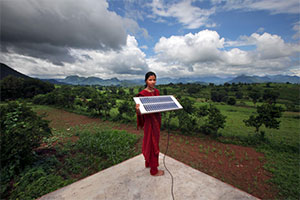 Bringing clean energy to rural India. Credit: Abbie Trayler-Smith / Panos Pictures / Department for International Development
Large reserves of oil, gas and minerals in developing countries generate opulent revenues. They could be used to stimulate economic growth and reduce poverty, but often result in environmental destruction and conflict, benefiting large companies and corrupt governments. Furthermore, competition over natural resources often manifests through geopolitical conflict. For example, before the US-Iraq war, Iraq’s domestic oil industry was nationalized. With US aggression came weakened Iraqi institutions and foreign intervention, thus eventually leading to the privatization of Iraqi oil, leaving the industry now largely dominated by Western companies. As another example, China’s rising investments within the lithium sector in South America are increasing the US-China rivalry across the Western Hemisphere. Notably, Bolivia has the largest reserves of lithium in the world, and the nation’s state-owned lithium extraction firm recently signed a contract with China’s CBC Consortium, while rejecting the entry of Western firms into the nation. In Bolivia’s case, rising Chinese investment in the nation’s lithium sector also raises concerns about environmental sustainability and the sociopolitical rights of Indigenous communities. More broadly, Sub-Saharan Africa holds nearly 30% of global reserves of critical minerals required for low-carbon technologies. Despite this, the region attracts less than 10% of global exploration investment, depicting a critical barrier to both the clean energy transitions and Sub-Saharan Africa’s economic development. Furthermore, resource wealth continues to fuel conflict like Sudan’s civil war, which has led to 9.1 million internally displaced people and is intensely connected to competition over gold, water, and agricultural land. IPS covers news about major oil, gas, and mining projects, their effects on the environment and local communities, and the ideas and actions of the interest groups involved.

The Week with IPS

NEXT STOP - SDGs
Tracking global progress towards a sustainable world
Tracking global progress towards a sustainable world
