Languages
Tuesday, November 17, 2026



News and Views from the Global South
Economy & Trade

COVID-19: Maintaining Food Security in Asia Pacific
COVID-19 has disrupted supply chains that are essential to assure food security in the Asia Pacific region, yet countries overall seem to have managed, so far, to keep supermarkets stocked with food and feed those who can afford it. The Asia Pacific region is home to over 60% of humanity and also contains sub-regions with among the highest frequencies of severe weather events and some of the most challenging environments for agriculture. As a region it is characterized by diverse food systems and a multiplex of supply chains. Under normal circumstances, food security is already threatened by a multitude of factors.
Time to Raise the Ambition for Climate Action
In recent days we have seen the understandable decision reached to postpone the UN climate change conference – COP26 – which was due to take place this November. As the world reels from the widespread impacts of the coronavirus crisis, it is the right call.
Bioenergy, the Ugly Duckling of Mexico’s Energy Transition
Rosa Manzano carefully arranges pieces of wood in a big mud igloo that, seven days after it is full, will produce charcoal of high caloric content.
COVID-19 and Hope for a Compassionate Future
The Coronavirus, COVID-19, makes its deadly round across the world. People fall sick and die, communities and entire nations end up in its deadly grip and try to cope with it. Everything is changing, and changing fast and we all have to deal with it together, even if many of us are being physically apart. Humans are social beings. Our mental and physical capacities are created around that fact and crave for support and compassion.
Kerala Covid-19 Response Model for Emulation
Within weeks, the Covid-19 epidemic was classified by the World Health Organization (WHO) as an epidemic of international significance, triggering a pre-agreed WHO response. By the end of the first week of April, more than 1.3 million people had been confirmed as infected, with over 65,000 deaths across the world.
Alive Amidst the Mayhem of COVID-19 – A Sex Worker’s Story
For a Bangladeshi woman, who has worked as a sex worker since childhood, her future post-COVID-19 looks hopeless. Shilpy, who works at Daulatdia, the largest brothel in the country, told IPS how she now also fears for the future of her two daughters.
Asia-Pacific Response to COVID-19 and Climate Emergency Must Build a Resilient and Sustainable Future
The unprecedented public health emergency triggered by the COVID -19 pandemic and its multi-faceted impact on people’s lives around the world is taking a heavy toll on Asia and the Pacific. Countries in our region are striving to mitigate the massive socioeconomic impact of the pandemic, which is also expected to affect the region’s economic health. In its annual Economic and Social Survey of Asia and the Pacific 2020 launched today, the United Nations Economic and Social Commission for Asia and the Pacific (ESCAP)expectsgrowth in Asia-Pacific developing economies to slow down significantly this year.
Green Counter-Revolution in Africa?
In 2006, the Bill and Melinda Gates Foundation and the Rockefeller Foundation jointly launched the Alliance for a Green Revolution in Africa (AGRA). The African Green Revolution Forum claims AGRA is the “world’s most important and impactful forum for African agriculture”.
The Economic Impact of COVID-19 on Developing Countries – Part 2
What is likely to be the impact of the COVID-19 pandemic on developing economies? In the first of this two part article we looked at possible short term disruptions and discussed actions by the private sector and Governments.
Reimagining Farming Post-Covid Pandemic
Together with medical services and transportation, farming and food production have been correctly identified as ‘essential services’ by all countries under lockdown. The Covid-19 pandemic has not yet made a dent in the food supply and so far, there are no reports of shortage of essential food and agricultural goods. All cities and towns are actively coordinating with government agencies, farms, businesses and transport companies to maintain the supply chain and ensure full availability of food for the population,
Human Rights and Compassion Must Guide Enforcement of COVID-19 Mitigation
Covid-19 infections continue to rise, bringing normal life to a virtualstandstill and causing countries to shut themselves off from the rest of the world.
Pandemic Crisis May Trigger Societal Restructuring
The Chinese word for crisis consists of two characters - “weiji”. Wei means danger and ji means opportunity. Every crisis is pregnant with danger and risks but also with opportunities – for some to make money, for others to learn valuable lessons, and for society to reorient or restructure its priorities, institutions and even the system.
Martin Khor, Third Worldist
Martin Khor Kok Peng passed away just after the end of the first quarter of 2020. He leaves behind an unusually rich legacy. Atypically for people mainly working in the worldideas, he was also a very practical and pragmatic activist who successfully built and sustained several important initiatives which will live on after him.
What More than COVID-19 to Jolt G20 into Collective Action?
My recent study on “The G20@10: Time to shift gears” 1 shows that, during the past decade, the main joint, collective action of the G20 has been to issue communiqués and other types of statements.
Can We Use Digital Technology to Cushion the Pandemic’s Blow?
As the world grapples with COVID-19, governments face a daunting challenge: limiting the adverse impact of a pandemic that has ground economic activity to a halt, affecting people at a scale rarely seen before.
Snapshot of Life under Lockdown in Bangladesh
 The Coronavirus pandemic is changing how we live our daily lives. The scale of the COVID-19 and its impact on our lives is unprecedented. When humanity gets past this, the world will be a very different place than the one we have known.

Surviving Domestic Violence in times of Covid19
“I come from Baglung District, a part of Dhawalagiri Zone in Nepal. My house overlooks the river. Do you know, our district is known for the suspension bridges?”, her eyes glimmer for a fraction of a second and then she breathes a heavy sigh! Her right hand is still wrapped in a scarf, while with the other she pats her 17-month-old. “If I ever get a chance I will take you to my village, we have a lot of medicinal plants.” She pauses while tears roll down as she continues our Facetime session. “I was 16 when I had my first child and I was 17 when my arm was broken by my mother-in-law.”
Dangers and Lessons of Present Multiple Crises
The Covid-19 pandemic, erupting in the background of lethargic global economy, could turn out to be the singular biggest crisis in a century. First reported in Wuhan, China, the corona virus has reached almost all countries. It has infected close to 1 million persons and caused over 40,000 deaths at time of writing; and the figures keep climbing. It is a health catastrophe which if not checked in its track would be the most serious since the Spanish Flu of 1918 that killed over 50 million people.
The Economic Impact of COVID-19 on Developing Countries
What is likely to be the impact of the COVID-19 pandemic on developing economies? It is difficult to make predictions, because much will depend on the spread of the disease, especially in Africa, Latin America, Asia and the Middle East, and the measures various Governments will take in the coming weeks and months.
West First Policies Expose Myths
As the epicentre of the COVID-19 pandemic shifts from China to the developed West, all too many rich countries are acting selfishly, invoking the ‘national interest’, by banning exports of vital medical supplies.
Harness Youth to Change World’s Future
Vanessa Nakate of Uganda may have been cropped out of a photograph taken at the World Economic Forum, but she along with Swedish activist Greta Thunberg have made the climate crisis centre stage.« Previous Page — Next Page »


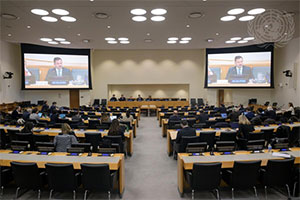 UN Commission on International Trade Law Holds Colloquium on Harmonizing Law in Age of Digital Trade and Finance. Credit: UN Photo/Manuel Elías
Trade has historically been a geopolitical tool that can both be used to propel development as well as entrench inequalities. In various nations in East Asia and Latin America, increased trade, as often seen in export booms, has allowed them to achieve influential standings within the global economy. On the other hand, many low-income countries in Sub-Saharan Africa, Asia, and Latin America struggle to maintain a robust trade performance, and oftentimes are subjugated to exploitative trade dynamics through intense extraction of their natural resources. In recent decades, international trade has reached a new era as emerging economies across the world are rising in economic preeminence. Stable international trade is crucial to world peace as global interconnectedness facilitates reliable diplomacy. Nevertheless, significant challenges are on the rise. Notably, a major wave of United States tariff escalations in January 2025 lifted US import taxes to their highest level since the 1930s, changing market dynamics and forcing renegotiations with global trading partners.These articles are aimed at informing readers about the complexities of trade and its varying effects on development, with a special focus on the consequences of the global economic crisis, the potential of fair trade and the gender implications of trade policies.
Updated by Yilan Batista and Shuli Wong August 2026

The Week with IPS

NEXT STOP - SDGs
Tracking global progress towards a sustainable world
Tracking global progress towards a sustainable world
