Languages
Tuesday, November 17, 2026



News and Views from the Global South
Economy & Trade

Supporting Informal Workers During the COVID-19 Crisis
Farmers, agricultural labourers, and informal sector workers are the worst hit by COVID-19 and the resulting lockdowns. Here are some steps that the government and banks can take to help them cope financially.
India’s Trinity of Challenges
The exigencies of combatting the coronavirus pandemic on a war-footing -- Prime Minister Narendra Modi has announced a nationwide stay-at-home lockdown for 21 days to break the chain of transmission -- has certainly deflected attention from equally pressing challenges confronting India. The nation’s capital witnessed horrific communal violence when the US President was visiting India, triggering international outrage, including from the South. The economy also deserves attention as growth has been decelerating since 2016-17. With the virus shock, the pace of expansion will contract as the economy shuts down and slides into recession.
East Asian Lessons for Controlling Covid-19
By the third week of March 2020, the number of Covid-19 deaths in Italy had overtaken the number of deaths in China. Authorities all over the world are restricting the movements of their populations as part of efforts to control the spread of Covid-19.
COVID-19 in the Time of Insecurity
Humankind has outlived multiple pandemics in the course of world history. The kingdoms and states of Central and Western Europe abolished the institution of serfdom once it had become clear that medieval rule in the aftermath of devastating pestilence would founder without ending the dependency and servitude that characterized the Dark Ages. The vulnerability of entire nations to the risk of total collapse in the absence of widespread access to the most basic healthcare in the Spanish Flu spurred governments to build the public health systems that have made the progress and development of the last hundred years possible. If the past is prologue, then continuity and survival command that we change.
Health Workers Are the Frontline Soldiers Against Covid-19. Let’s Protect Them
Many soldiers have seen first-hand the horrors of war and, terrifying though it often was, they knew who they were fighting, and could recognise their enemy.
Stronger UN Leadership Needed to Cope with Coronavirus Threat
The economic impact of the coronavirus pandemic is hard to predict as events are still unfolding, and estimates vary dramatically. UNCTAD estimates lost output in the order of US$1 trillion, just over a third of Bloomberg’s expectation of US$2.7 trillion in losses. The OECD expects global economic growth to halve from already anaemic levels.
Fisherfolk Fix Both Food and Climate by Closing Fishing Grounds
Samsul sounded very happy last Monday (Mar. 16) when recounting his experience of catching crabs worth more than $60 in a single day.
Fighting Coronavirus: It’s Time to Invest in Universal Public Health
Austerity policies pushed by international financial institutions have weakened public health systems, despite current financial support packages, condemning many people to die.
Women & Climate: Planting a Global Forest in a Connected World
In January of this year, Britain’s Prince Harry and his wife Meghan, the Duke and Duchess of Sussex, shocked much of the world when they announced they would be stepping down from their roles as senior royals.
3Returns Blog
On Thursday 20 and Friday 21 February, the Global Green Growth Institute (GGGI) in partnership with the Ministry of Natural Resources and Environmental Conservation (MONREC) and the University of Queensland (UQ) held a validation workshop on the 3Returns Model and Framework, presenting an Investment Case for Coastal Landscape Mangrove Restoration in Myanmar through the findings from an Economic Appraisal of Ayeyarwady Mangrove Forests, Bio-based Value Chains for Mangrove Restoration and Benefit Sharing Mechanisms. The event proved informative for both participants and presenters alike, providing critical insights and opening dialogue between multiple government departments.
State Intervention Necessary to Overcome Covid-19 Threats
It is now clear that most East Asian government responses to novel coronavirus or Covid-19 outbreaks have been effective. In Hong Kong, Japan, Singapore and Taiwan, the number infected have remained relatively low despite their proximity and vulnerability, while containment in China and South Korea has been impressive.
Use Stimulus Packages for Longer Term Progress
The coronavirus pandemic seems to have finally forced governments around the world to ditch their obsession (at least for the moment) with delivering budget surplus. As stock markets tumble, stimulus measures, worth billions of dollars, are announced to boost investor confidence and consumer spending to keep economies running.
Share Buybacks Enable Predatory Value Extraction
‘Getting government out of the way’, the neoliberal ‘free market’ mantra, was supposed to boost private investment. Instead, business investment has declined as a consequence. Many economies now seem incapable of making much needed investments to sustain growth, apparently due to ‘capital allocation’ problems.
I Am Generation Equality: Storytelling for Equality
When you flip through grade one Bangla school textbooks there is very little written about the progress women have made in Bangladesh since the Beijing Conference for Women in 1995.
New reforms needed to tackle Egypt’s economic challenges, claims TRENDS study
The IMF-supported economic reforms program launched in 2016 succeeded in improving almost macroeconomic indicators for the Egyptian economy yet a new phase of reforms is needed to tackle the remaining problems on the supply side, a new study has claimed.
Global Economic Consequences of COVID-19
The panic resulting from the events starting with the deaths in Wuhan keeps spreading globally faster than the spreading of the virus itself. Quite apart from the immediate health dangers, now a new economic danger looms large globally. We are facing the prospects of a deep and lasting global recession regardless of the health policy and economic policy measures taken by China, the US and other countries unless there is timely global cooperation and coordination. What will be the global economic impact of COVID-19 if swift and effective action is not taken globally? Is there a way to find out through some kind of rigorous model-based economic analysis?
Fight, Not Flight, Must Be the Strategy for Flattening the COVID-19 Curve
The number of coronavirus cases in Kenya has jumped to three after the government confirmed two more cases. President Uhuru Kenyatta has announced a raft of proactive measures to prevent the spread of the virus.
Rural Poverty and Disability in Ethiopia
With about 109 million people, Ethiopia is the second most populous nation in Africa after Nigeria, and the fastest growing economy in the region. However, it is also one of the poorest, with a per capita income of $790.
How will COVID-19 Affect Economies of Latin America & the Caribbean?
History shows that in Latin America and the Caribbean, volatility is the norm and not the exception and that the development trajectories of their countries are not linear.
Rural Poverty, Employment and Disability
About 15% of the world's population lives with some form of disability, of whom 2-4% experience significant difficulties in functioning. Disability is part of the human condition, and almost everyone will be temporarily or permanently impaired at some point in life, and those who survive into old age will experience increasing difficulties in functioning. Here the focus is on empirical validation of whether disabilities are associated with economic hardships through loss of employment and consequently impoverishment in rural India. The motivation stems from continuing neglect of health in the budgetary allocations –including the allocations for 2020-21.
CORRECTED VERSION: Stock Market Bubble Threat
The US is currently still in a stock market bubble which, if history is any guide, is likely to end, as argued by Thomas Palley. While President Trump would, of course, like to sustain it to strengthen his November re-election prospects, the Covid19 black swan is already showing signs of pricking the bubble« Previous Page — Next Page »


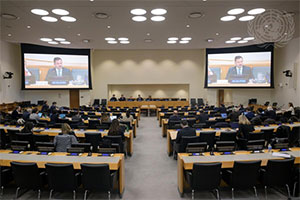 UN Commission on International Trade Law Holds Colloquium on Harmonizing Law in Age of Digital Trade and Finance. Credit: UN Photo/Manuel Elías
Trade has historically been a geopolitical tool that can both be used to propel development as well as entrench inequalities. In various nations in East Asia and Latin America, increased trade, as often seen in export booms, has allowed them to achieve influential standings within the global economy. On the other hand, many low-income countries in Sub-Saharan Africa, Asia, and Latin America struggle to maintain a robust trade performance, and oftentimes are subjugated to exploitative trade dynamics through intense extraction of their natural resources. In recent decades, international trade has reached a new era as emerging economies across the world are rising in economic preeminence. Stable international trade is crucial to world peace as global interconnectedness facilitates reliable diplomacy. Nevertheless, significant challenges are on the rise. Notably, a major wave of United States tariff escalations in January 2025 lifted US import taxes to their highest level since the 1930s, changing market dynamics and forcing renegotiations with global trading partners.These articles are aimed at informing readers about the complexities of trade and its varying effects on development, with a special focus on the consequences of the global economic crisis, the potential of fair trade and the gender implications of trade policies.
Updated by Yilan Batista and Shuli Wong August 2026

The Week with IPS

NEXT STOP - SDGs
Tracking global progress towards a sustainable world
Tracking global progress towards a sustainable world
