Languages
Wednesday, November 18, 2026



News and Views from the Global South
Economy & Trade

Global Climate Change Investment Heavily Tilted Towards Mitigation and Low on Adaptation
Good news: the graph depicting climate investments has been steadily increasing. Climbing from the 2012 figure of $360 billion in climate investments across the world to close to $600 billion currently.
‘Salty’ Concern: Tackling High Salt Consumption in China
China’s almost meteoric transition from a being a low income to a middle income country within a span of four decades is often perceived as a miracle analogous to the post Second World War Japanese economic development experience.
Africa’s Mineral Wealth May Just have to Stay in the Ground to Protect a Changing Climate
As a result of climate change, resource extraction industries in Africa will be impacted by asset stranding, researchers say.
The Rise of Phantom Investments
According to official statistics, Luxembourg, a country of 600,000 people, hosts as much foreign direct investment (FDI) as the United States and much more than China. Luxembourg’s $4 trillion in FDI comes out to $6.6 million a person.
Human Trafficking – It Came Disguised as the Opportunity of a Lifetime
Six years ago Mary Njambi* received news of a once-in-a-lifetime job opportunity far away from her poverty-stricken village situated in the heart of Kiambu County, Central Kenya. She was 20 years old, a single mother and out of work.
How Media Technocrats Manipulate Public Opinion
In a 1974 article, Woody Allen poked fun at biblical stories presenting ludicrous paraphrases of The Book of Job, Abraham´s intended sacrifice of his son Isaac, as well as The Book of Proverbs. One of Allen´s invented proverbs was: “The wicked at heart probably know something”, thus implementing that the “pure of heart”, i.e. credulous people, know nothing. 1
China Wants to Mainstream Environmental Protection
In the 2014 China-US joint announcement on climate change, China promised to peak its greenhouse gas (GHG) emissions around 2030. Later this commitment was cemented in the Paris Agreement signed in 2016.
Getting out of a Jam in Dhaka
 Bangladesh’s capital has some of the worst traffic in the world. But hope is on the way in the shape of a new mass rapid transit system.

Wall Street can Free the World’s 40 Million Modern-Day Slaves
Financiers in Wall Street, the City of London and other banking centres should play a bigger role in freeing the millions of people who endure slave-like working conditions globally, according to a new study.
Combining Biogas and Solar, the Best Energy Deal in Brazil
"Biogas is the best energy, it has no contraindications," and if you combine it with solar it becomes "the best energy business," at least in Brazil, says Anélio Thomazzoni.
No to Ageism, Yes to Intergenerational Equality
As we are celebrating the International Day of Older Persons today, we recognize that population ageing is a human success story, a story of longer and often healthier lives of the world’s people. The many faces of older persons that we see in Asia and in the Pacific, and, indeed, all over the world, attest to this fact. Still, however, ageing is considered a threat. There is talk about the “burden of ageing”, exploding healthcare costs, and concerns about plummeting economic growth due to the shrinking labour force. In many cities of Asia-Pacific, we see advertisement for “anti-ageing cosmetics” and surgeries. The current ideal is that we must be young, dynamic and without wrinkles or grey hair, especially older women.
Confronting New Climate Reality in Asia & the Pacific
Last week, world leaders gathered at the United Nations in New York for the Climate Action Summit. Their goal was simple: to increase ambition and accelerate action in the face of a mounting climate emergency.
Countercyclical Fiscal Policy Needed to Counter Global Economic Downturn
A conjuncture of developments, short- and medium-term, have conspired to further slow the world economy. In recent months, the International Monetary Fund (IMF), among others, has acknowledged that global economic prospects are worsening, forcing it to make not one, but at least five consecutive growth forecast revisions, all downward.
Q&A: How Vietnam went from Zero to Hero in Developing Solar Projects and What Other Countries Can Do for Climate Change
A week ago, downtown New York witnessed one of the most historic moments in the climate action moment — hundreds of thousands of people attended the Climate Strike, where teen activists delivered powerful speeches and blows to world leaders for not taking climate change seriously.
Investments to Cushion African Countries against Climate Shocks Not Enough
African Development Bank (AfDB) President Akinwumi Adesina unveiled millions of dollars of new pledges at the United Nations this week amid growing fears of climate change ravaging the continent and derailing anti-poverty targets.
Finance Global Green New Deal for Sustainable Development
The United Nations (UN) Sustainable Development Goals (SDGs) can only be achieved by 2030 with the political will to change international economic rules and mobilize resources needed for a massive public sector-led investment push to reinvigorate world economic progress sustainably, says UNCTAD’s Trade and Development Report 2019 (TDR 2019).
10,000 People a Day Must be Freed to End Slavery by 2030
"Six years after initiating my term as Special Rapporteur, it is sobering to say that the way to freedom from slavery remains long in spite of the legal abolition of slavery worldwide," said UN expert on contemporary forms of slavery, Urmila Bhoola.
How to ‘Fix the Business of Food’ and Save the Planet
With up to one billion undernourished people around the world, and agriculture and land use systems increasingly vulnerable to climate change and land degradation, more companies within the global food industry need to start aligning their operations with the United Nations Sustainable Development Goals or SDGs.
Nature’s Solution to Climate Change
When it comes to saving the planet, one whale is worth thousands of trees.
Africa’s Industrial Development: Turning Challenges into Opportunities
When world leaders gathered in New York for the 70th session of the General Assembly back in 2016, and proclaimed the period 2016-2025 as the Third Industrial Development Decade for Africa (IDDA III), it reaffirmed the importance of industrialization in supporting Africa’s own efforts towards sustained, inclusive and sustainable economic growth and accelerated development.
The Social Impact of Economic Inequality
Increasing economic inequality is a defining challenge of our time. In recent years, it has triggered analysis and reflection by many scholars, politicians and others on its causes and consequences on economic growth and efficiency, politics and democracy, human rights, individual behaviors, access to health, social cohesion and environmental degradation. The perception that the top 1% of income earners are gaining at the expense of the other 99% has resulted in widespread public debates in many countries on the social and political repercussions of inequality.« Previous Page — Next Page »


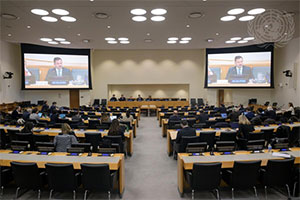 UN Commission on International Trade Law Holds Colloquium on Harmonizing Law in Age of Digital Trade and Finance. Credit: UN Photo/Manuel Elías
Trade has historically been a geopolitical tool that can both be used to propel development as well as entrench inequalities. In various nations in East Asia and Latin America, increased trade, as often seen in export booms, has allowed them to achieve influential standings within the global economy. On the other hand, many low-income countries in Sub-Saharan Africa, Asia, and Latin America struggle to maintain a robust trade performance, and oftentimes are subjugated to exploitative trade dynamics through intense extraction of their natural resources. In recent decades, international trade has reached a new era as emerging economies across the world are rising in economic preeminence. Stable international trade is crucial to world peace as global interconnectedness facilitates reliable diplomacy. Nevertheless, significant challenges are on the rise. Notably, a major wave of United States tariff escalations in January 2025 lifted US import taxes to their highest level since the 1930s, changing market dynamics and forcing renegotiations with global trading partners.These articles are aimed at informing readers about the complexities of trade and its varying effects on development, with a special focus on the consequences of the global economic crisis, the potential of fair trade and the gender implications of trade policies.
Updated by Yilan Batista and Shuli Wong August 2026

The Week with IPS

NEXT STOP - SDGs
Tracking global progress towards a sustainable world
Tracking global progress towards a sustainable world
