Languages
Saturday, November 28, 2026



News and Views from the Global South
Economy & Trade
United Nations, an Organisation on Life-Support?
While a mass uprising was toppling a dictatorship in Egypt and tens of thousands were marching for radical change at the World Social Forum in Dakar, a high-level group of ambassadors and experts came together at the United Nations late last week to discuss the future of global governance.TRADE: “Poor Countries Have Already Given Enough in Doha Round”
South Africa has expressed sharp concern over concerted attempts by leading industrialised countries, particularly the U.S. and the European Union (EU), to extract onerous commitments from developing countries as a condition to concluding the stalled Doha Round trade negotiations.CORRUPTION: Egyptians Can Claim Mubarak’s Stolen Billions
For decades, European bank accounts and trusts and the real estate market were havens for dictators seeking safe places to deposit billions of dollars they were stealing from their countries of origin.
Q&A: Political Support Needs Financial Backing
"The agenda for women's rights and empowerment in each country must be supported by the political leadership," says Norah Matovu-Winyi, Executive Director, African Women's Development and Communication Network (FEMNET).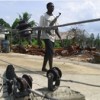
Niger Delta Demands for Justice Undaunted by Decades of Violence
Nigerian environmental rights groups have been making the case for the expulsion of oil companies from the Niger Delta in the southeastern part of the country at the World Social Forum in Dakar.
WORLD SOCIAL FORUM: Fisheries Need Transparent Regulation
Senegalese fishers participating in the 2011 World Social Forum (WSF) warned governments to "wake up to the ethical and transparent regulation of access to fisheries" to halt the overexploitation of this increasingly scarce resource.PERU: Government under Fire for Waiving Environmental Certificates for Dams
The Peruvian government has been forced to offer talks with governors, the ombudsperson's office and Catholic Church leaders, to stem the outcry over two emergency decrees that waive the requirement for environmental certificates for 33 investment projects, including hydroelectric dams in the Amazon rainforest.ECONOMY-LATIN AMERICA: The Downside of Strong Currencies
Latin America returned in 2010 to the strong economic growth it enjoyed over the past decade, after only a minimal slowdown during the global crisis that broke out in 2008. But the weakness of the dollar relative to local currencies is a cause for concern among governments and sectors that produce goods for export.
EGYPT: Labour Unrest Feeds Growing Protests
President Hosni Mubarak's speech Thursday night in which he refused to quit has provoked anger and could spark further unrest. Massive demonstrations, and pitched battles between pro-democracy protesters and the regime’s security forces, have already been intensifying in every corner of the country.
SRI LANKA: Garment Industry Woos Women Workers
Sri Lanka’s garment industry has launched a multi-million rupee campaign to bring in female workers shunning the country’s most profitable sector for better paying jobs.
WORLD SOCIAL FORUM: “We Don’t Want Everybody to Think the Same”
It is only the second time that the World Social Forum (WSF) takes place in Africa, the first one having been held in Nairobi, Kenya, in 2007. Since the start of the WSF in Porto Alegre, Brazil, 10 years ago, the organisers have been building African participation.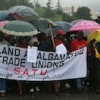
AFRICA: Swaziland in Crisis as Customs Union Revenue Is Slashed
Apart from the looming job losses in Swaziland’s public sector, small and medium enterprises (SMEs) have also warned of retrenchments following the government’s decision to suspend procurement from small businesses.COLOMBIA: Increasingly Broad Social Movements Fight Mining
Social mobilisation against gold-mining is growing in Colombia, which is now one of the world's biggest per capita polluters of mercury, used in artisanal mining, according to the United Nations Industrial Development Organisation (UNIDO).
ZIMBABWE: Activists Seek WSF Solidarity Against Privatisation
Zimbabwean activists will raise the issue of privatisation at the World Social Forum, taking place Feb 6-11 in Dakar, Senegal, and seek solidarity from other activists to resist a renewed government attempt at selling Zimbabwe’s state- owned enterprises.
WORLD SOCIAL FORUM: ‘Signs of Change’ Says Bolivia’s Morales as World Social Forum Opens
Tens of thousands of people marched through the streets of Dakar on Sunday to mark the start of the annual World Social Forum. Activists carried colorful banners denouncing land grabs, restrictive immigration laws, agricultural subsidies in Europe and the U.S. and many other issues.
Q&A: Looking to a World Without LDCs
Maximising time, energy and resources toward improving living conditions for millions of people in the poorest countries of the world - the so-called Least Developed Countries (LDCs) - means that the "business-as-usual" approach must yield to a holistic strategy, says Arjun Karki, a longtime expert on grassroots, democratic peace-building and development.Global Crisis Strengthens WSF’s Legitimacy
European non-governmental organisations combating neo-liberal globalisation find their position vindicated by the ongoing socio-economic and environmental crisis upsetting the world.SRI LANKA: Domestics Court Risks, Defying Age Bar
Sri Lanka has raised the age requirement for women wanting to leave the country to work as domestics abroad, but recruitment agents say this won’t prevent younger women from joining the exodus.
ECONOMY: Same Old System Can Only Produce New Crisis
The world is in financial crisis thanks to the reckless behaviour of bankers, say campaigners, yet ordinary people are picking up the tab. Debt activists fear the recession will provide cover for a fresh round of toxic debt to countries in the South.Rising Food Prices May Not Signal New Crisis
As food prices rose for the seventh month in a row in January, contributing to recent popular unrest in the Middle East and a spike in commodities purchases by developing countries last week, some analysts are quick to make comparisons to the dry years of 2007-2008.
WORLD SOCIAL FORUM: Dakar to Dhaka
Is it more important to build links with African civil society groups or concentrate on existing networks in the South Asian region? That is the dilemma before Indian delegates heading for the World Social Forum in Dakar, Senegal, and some who have opted out.« Previous Page — Next Page »


 UN Commission on International Trade Law Holds Colloquium on Harmonizing Law in Age of Digital Trade and Finance. Credit: UN Photo/Manuel Elías
Trade has historically been a geopolitical tool that can both be used to propel development as well as entrench inequalities. In various nations in East Asia and Latin America, increased trade, as often seen in export booms, has allowed them to achieve influential standings within the global economy. On the other hand, many low-income countries in Sub-Saharan Africa, Asia, and Latin America struggle to maintain a robust trade performance, and oftentimes are subjugated to exploitative trade dynamics through intense extraction of their natural resources. In recent decades, international trade has reached a new era as emerging economies across the world are rising in economic preeminence. Stable international trade is crucial to world peace as global interconnectedness facilitates reliable diplomacy. Nevertheless, significant challenges are on the rise. Notably, a major wave of United States tariff escalations in January 2025 lifted US import taxes to their highest level since the 1930s, changing market dynamics and forcing renegotiations with global trading partners.These articles are aimed at informing readers about the complexities of trade and its varying effects on development, with a special focus on the consequences of the global economic crisis, the potential of fair trade and the gender implications of trade policies.
Updated by Yilan Batista and Shuli Wong August 2026

The Week with IPS

NEXT STOP - SDGs
Tracking global progress towards a sustainable world
