Languages
Sunday, October 4, 2026



News and Views from the Global South
Trade & Investment

PPPs Likely to Undermine Public Health Commitments
The United Nations Agenda 2030 for the Sustainable Development Goals (SDGs) is being touted in financial circles as offering huge investment opportunities requiring trillions of dollars. In 67 low- and middle-income countries, achieving SDG 3 — healthy lives and well-being for all, at all ages — is estimated to require new investments increasing over time, from an initial $134 billion annually to $371 billion yearly by 2030, according to recent estimates by the World Health Organization (WHO) reported in The Lancet.
Expansion of Soy Resurrects Key Railway Line in Brazil
The railroad can contribute to the economy, making transportation cheaper, but it is unlikely to foment equitable development in and of itself, apart from facing complex construction obstacles in countries like Brazil.
Argentina Pursues the Lithium Dream
The government of Mauricio Macri dreams of Argentina becoming the world leader in lithium production. But it does not seem so clear that this aspiration, underpinned by the interest of multinational corporations, would also drive the development of local communities.
Digital Infrastructure
Millennials are the natives of the digital infrastructure. They have the privilege of having been born in a time when everything is within reach through the click of a button. Having worked in Dubai in the 1970s, I learned that there are three kinds of infrastructure: progressive, hard, and soft. Progressive infrastructure refers to the international airports and the seaports. The hard infrastructure are the roads, highways and the like. Lastly, the soft infrastructure refers to the ease of doing business. Back in the day, the Sheikh of Dubai would mention, what is good for business is good for Dubai. Later, I added two more; these are sustainable and institutional infrastructure. Even if you have the best plans in the world, without the right institutions to implement these, these plans would not come to fruition. Lastly, infrastructure should be sustainable in order to last for generations. With the advancement of technology, this is the Age of Digital Infrastructure.
The Data Revolution Should Not Leave Women and Girls Behind
If there is one political principle that has been constant throughout the history of human civilization it is the fact that land is power. This is something that is particularly true, and often painfully so, for women who farm in Africa.
Tourism Should Be Regulated, Before It Is Too Late…
This year, we will have 3 million tourists each day wandering the world. This massive phenomenon is without precedent in human history and is happening (as usual), with only one consideration in mind: money. We should pause and take a look at its social, cultural and environmental impact and take remedial measures, because they are becoming seriously negative if things are left as they are.
Uncertainty Surrounds Renegotiation of NAFTA and Its Consequences for Mexico
The first few months of 2018 will be key to defining the future of the North American Free Trade Agreement (NAFTA), whose renegotiation due to the insistence of U.S. President Donald Trump has Mexico on edge because of the potential economic and social consequences.
Trade Multilateralism Set Back yet Again
As feared, the Eleventh Ministerial Conference (MC11) of the World Trade Organization (WTO) in Buenos Aires, Argentina, on 10-13 December 2017, ended in failure. It failed to even produce the customary ministerial declaration reiterating the centrality of the global trading system and the importance of trade as a driver of development.
Billionaires, Fiscal Paradise, the World’s Debt, and the Victims
Among Bloomberg's many profitable activities is a convenient Bloomberg Billionaires Index that has just published its findings for 2017. It covers only the 500 richest people, and it proudly announces that they have increased their wealth by 1 trillion dollars in just one year. Their fortunes went up by 23% to top comfortable 5 trillion dollars (to put this in perspective, the US budget is now at 3.7 trillion). That obviously means an equivalent reduction for the rest of the population, which lost those trillion dollars. What is not widely known is that the amount of the circulation of money stays the same; no new money is printed to accommodate the 500 richest billionaires!
Goodbye to 2017, a Trump-dominated Year
In 2017, Donald Trump dominated the year by using US clout to change many aspects of global relations, and not for the better.
Money Talks at One Planet Summit in Paris
As funding to combat climate change has lagged behind lofty words, the One Planet Summit in France this week invited governments and business leaders to put money on the table.
Arming Poor Countries Enriches Rich Countries
Although the Cold War came to an end over a quarter century ago, international arms sales only declined temporarily at the end of the last century. Instead, the United States under President Trump is extending its arms superiority over the rest of the world.
Central America Builds Interconnected Clean Energy Corridor
Countries in Central America are working to strengthen their regional electricity infrastructure to boost their exchange of electricity generated from renewable sources, which are cheaper and more environmentally friendly.
WTO Ministerial Conference – Rejuvenating free trade
The Eleventh Ministerial Conference (MC11) of the World Trade Organization will be held on December 10-13 in Buenos Aires, Argentina. The meeting of this highest decision-making body of the WTO, which meets at least once every two years, is taking place at a critical moment of the free trade movement. WTO and free trade are threatened by the emergence of protectionist and anti-trade sentiments amongst many of the organisation's 164 members, and squabbling among the world's largest traders, including the USA, China, and even the generally free-trade oriented European Union. If countries lower the tariff rates against imports and refrain from imposing non-tariff barriers against trade, it benefits free trade and promotes growth.
Strengthening Governments to Cope with PPPs
Public-private partnerships (PPPs) have emerged in recent years as the development ‘flavour of the decade’ in place of aspects of the old Washington Consensus. Instead of replacing the role of government or consigning it to the garbage bin of history, corporations are increasingly using governments to advance their own interests through PPPs.
South-South Cooperation Key to a New Multilateralism
“There are new challenges to all states: among them, the real threat to multilateralism... South-South and triangular cooperation can contribute to a new multilateralism and drive the revitalisation of the global partnership for sustainable development.”
Beware Public Private Partnerships
Public-private partnerships (PPPs) are essentially long-term contracts, underwritten by government guarantees, with which the private sector builds (and sometimes runs) major infrastructure projects or services traditionally provided by the state, such as hospitals, schools, roads, railways, water, sanitation and energy.
Uncertain Future for “Diabolic” Free Trade Pacts Between EU and Africa
In the run-up to the fifth EU-Africa summit in Côte d'Ivoire, the future of the Economic Partnership Agreements (EPAs) between Europe and its former colonies looks bleaker than ever. While most of Europe’s trade partners around the world keep refusing to sign the deals, the African Union’s Commissioner for Trade will most likely announce a moratorium on all EPAs.
Foreign Investment Expands in Cuba…Despite Everything
“Maybe many of us thought that this project was a dream six years ago, but not anymore. The geography has completely changed, because of everything that has been built and the investments that have been approved," said Nathaly Suárez, director of Construction Management at the Mariel Special Development Zone (ZEDM).
Coping with Foreign Direct Investment
Foreign direct investment (FDI) is increasingly touted as the elixir for economic growth. While not against FDI, the mid-2015 Addis Ababa Action Agenda (AAAA) for financing development also cautioned that it “is concentrated in a few sectors in many developing countries and often bypasses countries most in need, and international capital flows are often short-term oriented”.
Beyond Piketty: on income inequality
Have demonetisation and the GST aggravated income inequality? With the Gujarat State elections barely a few weeks away, the debate on the Indian economy has become increasingly polarised. While the official view of demonetisation unleashed in November 2016 elevates it to a moral and ethical imperative, the chaos caused by the goods and services tax (GST) launched on July 1, 2017, is dismissed as a short-run transitional hiccup. Both policies, it is asserted, are guaranteed to yield long-term benefits, unmindful of large-scale hardships, loss of livelihoods, closure of small and medium enterprises and slowdown of agriculture. Critics of course reject these claims lock, stock and barrel. Lack of robust evidence is as much a problem for the official proponents of these policies as it is for the critics. Hence the debate continues unabated with frequent hostile overtones.« Previous Page — Next Page »


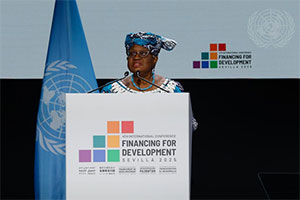 Opening of 4th International Conference on Financing for Development. Credit: UN Photo/Mariscal
International trade and investment are crucial elements of the world economy. While they can be powerful stimulators of development, they can also lead to global imbalances and dynamics of exploitation. In 2025, international trade entered a period of immense disruption, driven in part by a new wave of United States tariffs that reshaped global supply chains and investment flows. The increase in the US tariff rate, the highest since the 1930s, has forced bilateral renegotiations with global trading partners. Furthermore, the debt crisis in developing nations has accelerated while Official Development Assistance (ODA) has substantially dropped 7.3% in 2024.
In the 21st century, advancements in economic diversification in formerly colonized nations have propelled them into more central roles in the global economy. For example, both China and Mexico were able to develop their manufacturing sector and channel this development into booming export flows, thus advancing into the position of emerging economies. Foreign investment also plays an essential role in providing capital for developing countries, although they are oftentimes accompanied by social and environmental exploitation. For example, rising Chinese investments in natural resources in Latin America have often been met with tension as these investment projects fail to properly mitigate environmental risks and protect workers’ rights. In a more multifaceted vein, Sino-African relations have led to infrastructure development in Sub-Saharan Africa while also heightening the region’s economic dependency on China. IPS reports on global news in trade and investment, while shining a light on the nuanced nature of these endeavors.

The Week with IPS

NEXT STOP - SDGs
Tracking global progress towards a sustainable world
Tracking global progress towards a sustainable world
