Languages
Thursday, October 1, 2026



News and Views from the Global South
Trade & Investment

Fashion Paradigm That Does Not Pollute the Planet
Fashion is meant to be trendy. It’s fast-paced: in one season, out the next. If you want to keep up, you had better update your wardrobe - that top you bought last summer is already outdated. While things may have been built to last a life-time a generation ago, today they don’t even last a year.
Celebrations Herald a New Set of Hurdles for Bangladesh
Bangladesh’s great strides in human development were widely celebrated this month, although they come at the potential cost of Western trade benefits that have helped underpin the nation’s export success for decades.
A Breath of Fresh Air in India
With India’s citizens clamouring for breathable air and efficient energy options, the country’s planners are more receptive than ever to explore sustainable development options, says Frank Rijsberman, Director-General of the Global Green Growth Institute (GGGI).
Latin America & the Caribbean Edging Towards Eliminating Tuberculosis
Known as El Libertador throughout the Latin America and Caribbean (LAC) region, Simón Bolívar was central to the battle for independence from Spanish rule in Venezuela, Bolivia, Colombia, Ecuador, and Peru.
Has Trump Just Launched a Global Trade War?
Last week’s action by President Donald Trump has ended the United States’ leadership on liberal trade and may trigger a global trade war with major damaging consequences.
It’s the War, Stupid
It is revealing that a ruler who did not serve in the military, nor enjoys any experience in war affairs, has a special inclination to use a vocabulary more typical of bloody clashes between states than in diplomatic relations.
Trump’s Trade War in Perspective
US President Donald Trump’s recent announcement of steep tariffs on steel and aluminium imports seems to have shocked US allies, even though these were among his 2016 election promises. The European Union (EU), Australia and Canada reacted sharply, in contrast to the more restrained response from China, the main target of earlier actions.
The Government of Kenya and United Nations Partnership to Achieve Universal Health Care Inspires Many in Silicon Valley and the Stanford, U.C. Berkeley Communities
Recently, some of us from the Stanford University and U.C. Berkeley community had the privilege of hosting Siddharth Chatterjee, the United Nations Resident Coordinator for Kenya and his team at the Silicon Valley, where he spoke at the 2018 African Diaspora Investment Symposium. The Kenya team also met with academics, Directors of Centers and students as well as some of brilliant technology leaders in Silicon Valley at Facebook and Google.
Japan-led Pacific Rim Countries Desperate to Embrace Trump
The grandiose sounding Comprehensive and Progressive Agreement for Trans-Pacific Partnership (CPTPP) will be signed in Santiago de Chile today, 8 March. Instead of doing something to advance the condition of women on International Women’s Day, trade representatives from 11 Pacific rim countries will sign the CPTPP, which some critics argue will further set back the progress of humanity, including women who hold up ‘half the sky’.
The New CPTPP Trade Pact is Much Like the Old TPP
The new agreement that eleven countries are signing on 8 March in Chile in place of the Trans Pacific Partnership Agreement (TPP) is like old wine in a new bottle --- without the United States but retaining most of its controversial elements.
Inclusive Green Growth Must Shape Thailand’s Future, Says GGGI Chief
Energy efficiency in industries presents a unique opportunity for Thailand’s environmental and economic policies as regional trends push towards more inclusive and sustainable green cities for the country and its neighbors, says the Director-General of the Global Green Growth Institute (GGGI) Dr. Frank Rijsberman.
Model Trade Deal Con
In early 2016, the Trans-Pacific Partnership (TPP) Agreement -- involving twelve countries on the Pacific Ocean rim, including the USA -- was signed in New Zealand. Right after his inauguration in January 2017, newly elected US President Donald Trump withdrew from the TPP, effectively killing the agreement as its terms require the participation of both the US and Japan.What’s Limiting Our Potential?
Whenever there is a discussion about trade, investments, exports and economic growth, quite often much focus is placed upon infrastructure as the core challenge of our export growth. But is it the only hurdle?
Village Savings: Helping Small Farmers Weather Climate Shocks
In the past, Lameck Sibukale only knew savings in the form of rearing chickens, goats and more importantly, cattle—a long cherished cultural heritage of the Tonga-speaking people of southern Zambia.
Intellectual Property Regime Undermines Equity, Progress
Over the last few decades, people in the developing world have been rejecting the intellectual property (IP) regime as it has been increasingly imposed on them following the establishment of the World Trade Organization (WTO) including its trade-related intellectual property rights (TRIPs) regime. IP rights (IPRs) have been further enforced through ostensible free trade agreements (FTAs) and investment treaties among two (bilateral) or more (plurilateral) partners.
Stock Market Turmoil May Expose Flaws in Global Finance
Was last week’s global stock market sell-off only a “correction” or does it signify a new period of financial instability, caused by major flaws in the world financial system?
Bangladesh’s Garment Industry Boom Leaving Workers Behind
Although Bangladesh has made remarkable recent strides like building green factories and meeting stringent safety standards, garment workers here are still paid one of the lowest minimum wages in the world.
Look to India
It’s really time the Philippines pays serious attention to how India solves Third World problems in a practical and inexpensive but ingenious Third World way. And follow suit.
Renewed Partnership to End Hunger in Africa by 2025
After a period of prolonged decline, world hunger is on the rise. Africa has the highest rates of hunger in the world, and they are increasing. Agricultural and livestock productivity in Africa is under threat. This is largely due to conflict and climate change.
Wealth Concentration Continues to Increase
As the ‘masters of the universe’ gather for their annual retreat at Davos, the World Economic Forum (WEF) has just published its Inclusive Development Index (IDI) for the second time.
PPPs Likely to Undermine Public Health Commitments
The United Nations Agenda 2030 for the Sustainable Development Goals (SDGs) is being touted in financial circles as offering huge investment opportunities requiring trillions of dollars. In 67 low- and middle-income countries, achieving SDG 3 — healthy lives and well-being for all, at all ages — is estimated to require new investments increasing over time, from an initial $134 billion annually to $371 billion yearly by 2030, according to recent estimates by the World Health Organization (WHO) reported in The Lancet.« Previous Page — Next Page »


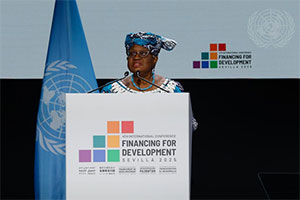 Opening of 4th International Conference on Financing for Development. Credit: UN Photo/Mariscal
International trade and investment are crucial elements of the world economy. While they can be powerful stimulators of development, they can also lead to global imbalances and dynamics of exploitation. In 2025, international trade entered a period of immense disruption, driven in part by a new wave of United States tariffs that reshaped global supply chains and investment flows. The increase in the US tariff rate, the highest since the 1930s, has forced bilateral renegotiations with global trading partners. Furthermore, the debt crisis in developing nations has accelerated while Official Development Assistance (ODA) has substantially dropped 7.3% in 2024.
In the 21st century, advancements in economic diversification in formerly colonized nations have propelled them into more central roles in the global economy. For example, both China and Mexico were able to develop their manufacturing sector and channel this development into booming export flows, thus advancing into the position of emerging economies. Foreign investment also plays an essential role in providing capital for developing countries, although they are oftentimes accompanied by social and environmental exploitation. For example, rising Chinese investments in natural resources in Latin America have often been met with tension as these investment projects fail to properly mitigate environmental risks and protect workers’ rights. In a more multifaceted vein, Sino-African relations have led to infrastructure development in Sub-Saharan Africa while also heightening the region’s economic dependency on China. IPS reports on global news in trade and investment, while shining a light on the nuanced nature of these endeavors.

The Week with IPS

NEXT STOP - SDGs
Tracking global progress towards a sustainable world
Tracking global progress towards a sustainable world
