Languages
Saturday, October 17, 2026



News and Views from the Global South
Trade & Investment

Food Security and Growth in Asia
A disquieting finding of The State of Food Security and Nutrition in the World 2017, Building resilience for peace and food security, or (SFSN2017), Rome, is that, in 2016, the number of chronically undernourished people in the world increased to 815 million, up from777 million in 2015 although still lower than about 900 million in 2000. Similarly, while the prevalence of undernourishment rose to 11 percent in 2016, this is still well below thelevel attaineda decade ago. Whether this recent rise inhunger and food-insecurity levels signals thebeginning of an upward trend, or whether itreflects an acute transient situation calls for a close scrutiny.
Unlocking Private Finance for Developing Countries’ Green Growth
Climate finance has never been more urgently needed, with massive investments in climate action required to meet the goals of the Paris Agreement and avoid the devastating effects of a warmer planet.
When Two Becomes One: Blending Public and Private Climate Finance
With the landmark Paris Agreement now almost two years old, funding for climate-related activities continues to be a challenge. However, efforts have been underway to bring two seemingly very different sectors together to address climate change.
$1.7 Trillion Global Spending on Military in 2017: Highest since End of Cold War
According to the latest report by the Stockholm International Peace Research Institute (SIPRI), in total, countries around the world spent $ 1.739 billion on arms in 2017. Although there was a marginal increase of 1.1 percent rise in real terms on 2016, the total global spending in 2017 is the highest since the end of the cold war.
Agricultural Trade Liberalization Undermined Food Security
Agriculture is critical for achieving the Sustainable Development Goals (SDGs). As the Food and Agriculture Organization (FAO) notes, ‘From ending poverty and hunger to responding to climate change and sustaining our natural resources, food and agriculture lies at the heart of the 2030 Agenda.’
Fighting Inequality in Asia and the Pacific
Inequality is increasing in Asia and the Pacific. Our region’s remarkable economic success story belies a widening gap between rich and poor. A gap that’s trapping people in poverty and, if not tackled urgently, could thwart our ambition to achieve sustainable development. This is the central challenge heads of state and government will be considering this week at the Economic and Social Commission for Asia and the Pacific (ESCAP). A strengthened regional approach to more sustainable, inclusive growth must be this Commission’s outcome.
United Arab Emirates: Entering into a Sustainable Future
The end of the oil age In the early 1970’s the United Arab Emirates (UAE) was an impoverished desert, with little access to food, water and well-paying jobs. Today, this country looks nothing like it was fifty years ago. Thanks to oil, the UAE has completely transformed and now is one of the most developed economies in the Middle East, if not the world: its per capita GDP is equal to those of highly developed European nations ($68,000 - 2017 est.).

Sustainable Food Systems; Why We do Not Need New Recipes
Many believe that the food and agricultural sector is different to all other economic sectors, that it is unique, and that it requires special economic models to thrive. After all, we expect the global food and agricultural system to respond to many different goals. It needs to deliver abundant, safe, and nutritious food. It needs to create employment in rural areas while protecting forests and wildlife, improving landscapes, and preventing climate change through lower food production emissions. Well-functioning food systems are also considered essential for social stability and conflict prevention. In fact many politicians today go as far as to argue that food systems need to thrive so as to stem rural-to-urban migration and the cross-border flow of desperate people fleeing food insecure nations.
“Green Development Has to Be Equal for All”
IPS caught up with Dr. Frank Rijsberman, director-general of the Global Green Growth Institute (GGGI), at the end of the flagship side event of the GGGI during the 51st Annual Meeting of the Asian Development Bank (ADB) in Manila on May 4, 2018, which featured the Belt and Road Initiative (BRI) and its potential to create sustainable infrastructure and promote green growth pathways.
Regional Cooperation Needs a Strategic Vehicle for Inclusive Growth
There is growing recognition that regional cooperation is a crucial driver of growth. We should now also recognize if regional trade networks are to yield the intended benefit of inclusive growth, then there needs to be a strategic vehicle for development that can be scaled.
Economic and Social Survey for Asia and the Pacific 2018 – Mobilizing finance for sustained, inclusive and sustainable economic growth.
Asia and the Pacific remains the engine of the global economy. It continues to power trade, investment and jobs the world over. Two thirds of the region’s economies grew faster in 2017 than the previous year and the trend is expected to continue in 2018. The region’s challenge is now to ensure this growth is robust, sustainable and mobilised to provide more financing for development. It is certainly an opportunity to accelerate progress towards achieving the 2030 Agenda for Sustainable Development.
Mounting Debt Threatens UN’s Sustainable Development Goals
In 2015, 193 countries adopted the 17 Sustainable Development Goals (SDGs) as an overarching policy roadmap through 2030. These goals are predicated on the idea that for a sustainable future, economic growth must go hand-in-hand with social inclusion and protection of the environment.
Blending Finance Not SDG Financing Silver Bullet
After largely failing to provide 0.7 per cent of their Gross National Income (GNI) in aid to developing countries for almost half a century since making the commitment, donor countries have recently promoted blended finance (BF) as a solution to the financing for development challenge. Blending refers to combining public development funds (in the form of grants, technical assistance or interest indemnification) with loans from private lenders.
Revving Up Green Growth
While sustainable development may still seem elusive to some, a new initiative wants to pave a path for nations working towards a greener future. Partnering for Green Growth and the Global Goals 2030, or P4G, is a new partnership initiative that aims to boost countries’ efforts in achieving the globally adopted Sustainable Development Goals (SDGs).
Development Prospects for Hundreds of Millions Remain in Jeopardy
The global economy is strengthening. A broad-based economic upturn has underpinned progress in many areas. But significant weaknesses and medium-term risks in the world economy continue to challenge our efforts. As a result, the development prospects of hundreds of millions of people remain in jeopardy.
Illicit Trade in Oil & Fuel: an Emerging Global Policy Challenge
Illicit trade in any of its forms—alcohol, tobacco, pharmaceuticals, diamonds, timber, ivory and oil—sits at the nexus of two social-economic disorders that challenge global stability.
India Pledges $50 Million More to UN Partnership Fund
At a time when funding for UN agencies is on the decline – and also threatened with cuts by the Trump administration—the Indian government has made an additional contribution of $50 million to development funding.
Brexit Reopens Old Wounds in Northern Ireland
In a bus sits a man wearing a chequered shirt and cap. His age is difficult to determine. He could be 45, 55 or 65 years old; life treats us so differently.
Tunneling Through the Andes to Connect Argentina and Chile
Visionaries imagined it more than 80 years ago, as a way to strengthen the integration between Argentina and Chile. Today it is considered a regional need to boost trade flows between the two oceans. Work on a binational tunnel, a giant engineering project in the Andes, is about to begin.
The UN tells private enterprise leaders that “Business as Usual Won’t Work”.
As global citizens face an array of issues from unemployment to discrimination, affecting their livelihoods and potential, a UN agency called upon businesses to employ a new, sustainable, and inclusive model that benefits all.
For Many Migrants, No Land Is Sweeter Than Home
Most migrants to Europe, Australia and the United States from Rangpur in northern Bangladesh leave home at a young age and return when they have just passed middle age.« Previous Page — Next Page »





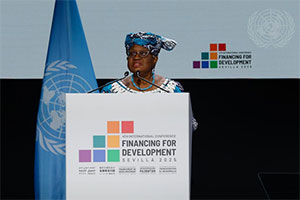 Opening of 4th International Conference on Financing for Development. Credit: UN Photo/Mariscal
International trade and investment are crucial elements of the world economy. While they can be powerful stimulators of development, they can also lead to global imbalances and dynamics of exploitation. In 2025, international trade entered a period of immense disruption, driven in part by a new wave of United States tariffs that reshaped global supply chains and investment flows. The increase in the US tariff rate, the highest since the 1930s, has forced bilateral renegotiations with global trading partners. Furthermore, the debt crisis in developing nations has accelerated while Official Development Assistance (ODA) has substantially dropped 7.3% in 2024.
In the 21st century, advancements in economic diversification in formerly colonized nations have propelled them into more central roles in the global economy. For example, both China and Mexico were able to develop their manufacturing sector and channel this development into booming export flows, thus advancing into the position of emerging economies. Foreign investment also plays an essential role in providing capital for developing countries, although they are oftentimes accompanied by social and environmental exploitation. For example, rising Chinese investments in natural resources in Latin America have often been met with tension as these investment projects fail to properly mitigate environmental risks and protect workers’ rights. In a more multifaceted vein, Sino-African relations have led to infrastructure development in Sub-Saharan Africa while also heightening the region’s economic dependency on China. IPS reports on global news in trade and investment, while shining a light on the nuanced nature of these endeavors.

The Week with IPS

NEXT STOP - SDGs
Tracking global progress towards a sustainable world
Tracking global progress towards a sustainable world
