Languages
Friday, October 16, 2026



News and Views from the Global South
Trade & Investment

Which Way Now for Zimbabwe as Constitutional Court Receives Petition Against Election Results?
Many in Zimbabwe are questioning whether the country can break with its horrid past or embrace a new future after a watershed election that saw Emmerson Mnangagwa win the presidential race by a narrow margin and the opposition lodge a formal petition challenging the results in the Constitutional Court.
Going Cashless, Led by Sweden
Sweden is rapidly moving away from cash. Demand for cash has dropped by more than 50 percent over the past decade as a growing number of people rely on debit cards or a mobile phone application, Swish, which enables real-time payments between individuals.
Global Economy Vulnerable a Decade After
Ten years ago, deteriorating confidence in the value of US sub-prime mortgages threatened a liquidity crisis. The US Federal Reserve injected considerable capital into the market, but could not prevent the 2008-2009 global financial crisis (GFC). The 2008 meltdown exposed the extent of finance-led international economic integration, with countries more vulnerable to financial contagion and related policy ‘spillovers’ exacerbating real economic volatility. It also revealed some vulnerabilities of the post-Second World War (WW2) US-centred international financial ‘architecture’ – the Bretton Woods system – modified after its breakdown in the early 1970s.
Globalization, Inequality, Convergence, Divergence
Economic divergence among countries and regions was never pre-ordained. According to the late cliometrician Angus Madison and other economic historians, the great divergence between the global North and South, between developed and developing countries, began around five centuries ago, from the beginning of the European, particularly Iberian colonial conquests.
Trade War – Developing Countries Should Respond
The escalating trade war initiated by United States President Donald Trump is a major threat to world trade and the global economy. The developing countries will be among those most affected. It is time for them to respond and speak out.
Balancing Trade Wars
A global trade war has broken out. The United States fired the first salvo and there has been retaliation by the European Union, Canada, China and even India. Tariffs on certain imported goods have been increased in a tit-for-tat reaction.
Greening the Way for Thailand’s First Green and Smart City
Thailand’s industrial sector must focus on sustainable and green development to remain competitive in the region.
Africa Could be Next Frontier for Cryptocurrency
Cryptocurrency is not bound by geography because it is internet based; its transactions are stored in a database called blockchain, which is a group of connected computers that record transactions in a ledger in real time.
Will Trump’s Trade War Make America Great Again?
The United States has had the world’s largest trade deficit for almost half a century. In 2017, the US trade deficit in goods and services was $566 billion; without services, the merchandise account deficit was $810 billion.
War, High Tariffs and Nationalisation – their Cost to Africa’s Climate
Africa’s political instability, its armed conflicts and regulatory issues are placing at risk investment needed to tackle climate change and reduce greenhouse gas (GHG) emissions on the continent.
Bamboo, A Sustainability Powerhouse
A landmark conference bringing more than 1,200 people from across the world together to promote and explain the importance of bamboo and rattan to global sustainable development and tackling climate change has ended with a raft of agreements and project launches.
Fight Against Drug Consumption Needs Gender Specific Treatments
The World Drug Report 2018, launched this week by the United Nations Office on Drugs and Crime (UNODC), highlighted the importance of gender in drug consumption and behaviour, suggesting it is essential to provide different types of health-care and legal solutions.
West Africa Moves Ahead with Renewable Energy Despite Unpredictable Challenges
The West African nation of Guinea may be a signatory of the Paris Agreement, a global undertaking by countries around the world to reduce climate change, but as it tries to provide electricity to some three quarters of its 12 million people who are without, the commitment is proving a struggle.
Food Sustainability, Migration, Nutrition and Women
We worry about how we can continue to put food on our tables; and yet one-third of food is never eaten, instead being lost or wasted. We worry about eating properly, and yet in many countries, poor nutrition, obesity and micronutrient deficiencies are increasingly common. This trend is taking place in the Americas, Oceania, Asia, Africa and in Europe.
Closing Africa’s Wealth Gap
From “Africa Reeling” to “Africa Rising,” there’s a new narrative for the African continent, now showing promising signs of sustainable growth under more stable governments. McKinsey & Company, a global management consulting firm, predicts that Africa’s combined GDP will be $2.6 trillion by 2020 and that “Africa’s consumer spending by 128 million households with discretionary income is expected to be around $1.4 trillion.”
Greece: SDGs a Way to End Economic Crisis?
Seven years after being on the verge of a financial collapse, Greece is now seeing better times. Its economic accounts have clearly improved but what is not under the spotlight is how the Greek people are still paying for the effects of the crisis.
China Generates Energy and Controversy in Argentina
As in other Latin American countries, in recent years China has been a strong investor in Argentina. The environmental impact and economic benefits of this phenomenon, however, are a subject of discussion among local stakeholders.
It Takes More Than Two to Tango: Platform to Achieve SDGs
Buenos Aires is a charming city; rich with history, magnificent architecture, and a soul and music that can pull you to tango in a heartbeat.
Valuing the Food System
Many factors contribute to the cost of a tomato. For example, what inputs were used (water, soil, fertilizer, pesticides, as well as machinery and/or labor) to grow it? What kind of energy and materials were used to process and package it? Or how much did transportation cost to get it to the shelf?
Harnessing the Blue Economy Must Consider Social Inclusion and Responsible Stewardship
In April 2018, Commonwealth leaders met in a retreat at a royal residence in the English county of Berkshire and agreed on strategies to deepen trade in their 53-member organisation, improve security, tackle climate change, and work together for the betterment of the lives of the people of the Commonwealth.
Hunger and Food Insecurity Plague the Lives of Millions in Africa
Africa is rising. But at the same time, Africa is the continent with the largest number of people, (390 million) living in extreme poverty.« Previous Page — Next Page »





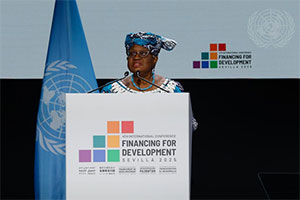 Opening of 4th International Conference on Financing for Development. Credit: UN Photo/Mariscal
International trade and investment are crucial elements of the world economy. While they can be powerful stimulators of development, they can also lead to global imbalances and dynamics of exploitation. In 2025, international trade entered a period of immense disruption, driven in part by a new wave of United States tariffs that reshaped global supply chains and investment flows. The increase in the US tariff rate, the highest since the 1930s, has forced bilateral renegotiations with global trading partners. Furthermore, the debt crisis in developing nations has accelerated while Official Development Assistance (ODA) has substantially dropped 7.3% in 2024.
In the 21st century, advancements in economic diversification in formerly colonized nations have propelled them into more central roles in the global economy. For example, both China and Mexico were able to develop their manufacturing sector and channel this development into booming export flows, thus advancing into the position of emerging economies. Foreign investment also plays an essential role in providing capital for developing countries, although they are oftentimes accompanied by social and environmental exploitation. For example, rising Chinese investments in natural resources in Latin America have often been met with tension as these investment projects fail to properly mitigate environmental risks and protect workers’ rights. In a more multifaceted vein, Sino-African relations have led to infrastructure development in Sub-Saharan Africa while also heightening the region’s economic dependency on China. IPS reports on global news in trade and investment, while shining a light on the nuanced nature of these endeavors.

The Week with IPS

NEXT STOP - SDGs
Tracking global progress towards a sustainable world
Tracking global progress towards a sustainable world
