Languages
Saturday, October 17, 2026



News and Views from the Global South
Trade & Investment

Seychelles Issues World’s First Blue Bond to Fund Fisheries Projects
The Republic of Seychelles announced on Monday that it has issued a 10-year blue bond to finance fisheries projects, making it the world’s first country to utilise capital markets for funding the sustainable use of marine resources.Big Brands Are Fuelling the Business of Nutrition
Food is an increasingly hot topic, no matter if you are rich or poor. Malnutrition – including undernutrition, overweight and obesity – affects 1 in 3 people around the world.
Africa’s Bumpy Road to Sustainable Energy
For years, Kenyans freely used and disposed of plastic bags. The bags were ubiquitous—in the markets, in the gutters and in the guts out of 3 out of every 10 animals taken to slaughter.
Perhaps Platform S?
When Accord and Alliance came to town, the brands and retailers had offered assurance of business continuity and were paying for the audits and assessments. Taking financial responsibility for factory remediation was, of course, the manufacturer's end of the bargain. In five years, out of Accord's initially inspected 1,620 factories, 420 had shut shop; for Alliance, out of the initial 829 factories, 173 closed business; National Action Plan, out of its first 1,549 factories, terminated 566. In total 1,159 factories have gone out of business. In response to growing demands of remediation, Bangladeshi manufacturers have either chosen to grow or quit. Those who have managed to stay afloat, in reality, have been able to afford expansion or consolidation.
Developing Countries Losing Out To Digital Giants
A new United Nations report warns that the potential benefits to developing countries of digital technologies are likely to be lost to a small number of successful first movers who have established digital monopolies.
What Accounts For Southeast Asia’s Phenomenal Success?
Southeast Asia has made extraordinary strides in recent decades. Growth in per capita incomes has been among the fastest in the world, and last year the region was the fourth largest contributor to global growth after China, India, and the United States. Living standards have improved dramatically. Poverty rates are down sharply.
Women & Youth Key to Achieving Agenda 2030 in South-South Cooperation
By 2050 Africa will have 830 million young people. Many countries in the global south, India included are seeing a youth(men and women) bulge. To reap a demographic dividend countries in the global south need to share and exchange knowledge to leapfrog socio-economic transformation.
Helping Ethiopia Achieve Green Growth and Avoid Industrialised Nations’ Environmental Mistakes
As Ethiopia undergoes a period of unprecedented change and reform, the Global Green Growth Institute(GGGI) is partnering with the Ethiopian government to try and ensure this vital period of transition includes the country embracing sustainable growth and avoiding the environmental mistakes made by Western nations.
New Agreement with Canada and U.S. Is Win-Lose for Mexico
Following the fanfare of the countries' leaders and the relief of the export and investment sectors, experts are analysing the renewed trilateral agreement with Canada and the United States, where Mexico made concessions in sectors such as e-commerce, biotechnology, automotive and agriculture.
Improving Infrastructure Planning In Developing Countries
Infrastructure investment is necessary, but hardly sufficient to enable developing countries to transform their economies to achieve sustainable prosperity, according to this year’s UNCTAD Trade and Development Report: Power, Platforms and the Free Trade Delusion (TDR 2018), released in late September.
Going Full Circle for Growth and the Planet
The business case for making our economy more sustainable is clear. Globally, transitioning to a circular economy - where materials are reused, re-manufactured or recycled-could significantly reduce carbon emissions and deliver over US$1 trillion in material cost savings by 2025.(1) The benefits for Asia and the Pacific would be huge. But to make this happen, the region needs to reconcile its need for economic growth with its ambition for sustainable business.
Investing in Arab and Asian Youth For a Sustainable Future
As the youth population has increased to unprecedented levels in Arab and Asian regions, governments need to do more to invest in them.
Trade War Due To Deeper Malaise
The world economy remains tepid and unstable a decade after the 2008 financial crisis, while growing trade conflicts are symptoms of deeper economic malaise, according to a new United Nations publication.
Europe Leads the Way in Development Index 2018
We just published the Commitment to Development Index (CDI) 2018, which ranks 27 of the world’s richest countries on how well their policies help the more than five billion people living in poorer countries.
New Trade Realities Cause Concern
Trade liberalization, a key dimension of recent globalization, has failed to promote broad structural transformation in developing countries and has instead contributed to increased worldwide inequality, a new United Nations report shows.
Seize the Opportunity Offered by Africa’s Continental Free Trade Area, says UNIDO Chief
Since the turn of the millennium, Africa has experienced a steady and unprecedented economic growth. However, poverty continues for people across the continent, especially in the sub-Saharan region. Unemployment and inequality have remained high. The rural population and the urban poor, women and youth, have not benefited from economic growth.
The Cambodian Port City on China’s 21st Century Silk Road That’s Becoming the New Macau
The new Macau. That's what the Cambodian coastal city Sihanoukville is called nowadays. Chinese investors are building casinos there on a massive scale. The southern port city lies on the new Silk Road (the so called 'One Belt, One Road') and is therefore interesting for China. The Cambodian government is happy to accept the money. And Beijing never asks difficult questions.
Another global financial crisis for developing countries?
George Soros, Bill Gates and other pundits have been predicting another financial crisis. In their recent book, Revolution Required: The Ticking Bombs of the G7 Model, Peter Dittus and Herve Hamoun, former senior officials of the Bank of International Settlements, warned of ‘ticking time bombs’ in the global financial system waiting to explode, mainly due to the policies of major developed countries.
South-South Cooperation in a Transformative Era
On 12 September, the international community commemorated the UN Day for South-South Cooperation. This is an important acknowledgement of the contributions of Southern partnerships in addressing the many development challenges that confront the international community, such as poverty, climate change, inequality, contagious diseases and humanitarian crises.
Great Recession, greater illusions
In 2009, the world economy contracted by -2.2%. Growth in all developing countries declined from around 8% in 2007 to 2.6% in 2009 as the developed world contracted by -3.8% in 2009. The collapse of the Lehmann Brothers investment bank in September 2008 symbolized the US financial crisis that triggered the Great Recession of 2008-2009.
Demonizing State-Owned Enterprises
Historically, the private sector has been unable or unwilling to affordably provide needed services. Hence, meeting such needs could not be left to the market or private interests. Thus, state-owned enterprises (SOEs) emerged, often under colonial rule, due to such ‘market failure’ as the private sector could not meet the needs of colonial capitalist expansion.« Previous Page — Next Page »





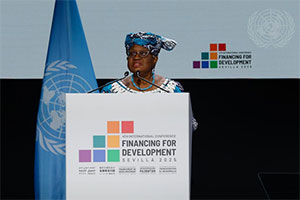 Opening of 4th International Conference on Financing for Development. Credit: UN Photo/Mariscal
International trade and investment are crucial elements of the world economy. While they can be powerful stimulators of development, they can also lead to global imbalances and dynamics of exploitation. In 2025, international trade entered a period of immense disruption, driven in part by a new wave of United States tariffs that reshaped global supply chains and investment flows. The increase in the US tariff rate, the highest since the 1930s, has forced bilateral renegotiations with global trading partners. Furthermore, the debt crisis in developing nations has accelerated while Official Development Assistance (ODA) has substantially dropped 7.3% in 2024.
In the 21st century, advancements in economic diversification in formerly colonized nations have propelled them into more central roles in the global economy. For example, both China and Mexico were able to develop their manufacturing sector and channel this development into booming export flows, thus advancing into the position of emerging economies. Foreign investment also plays an essential role in providing capital for developing countries, although they are oftentimes accompanied by social and environmental exploitation. For example, rising Chinese investments in natural resources in Latin America have often been met with tension as these investment projects fail to properly mitigate environmental risks and protect workers’ rights. In a more multifaceted vein, Sino-African relations have led to infrastructure development in Sub-Saharan Africa while also heightening the region’s economic dependency on China. IPS reports on global news in trade and investment, while shining a light on the nuanced nature of these endeavors.

The Week with IPS

NEXT STOP - SDGs
Tracking global progress towards a sustainable world
Tracking global progress towards a sustainable world
