Languages
Wednesday, October 14, 2026



News and Views from the Global South
Trade & Investment

Multilateralism Undermined by Globalization’s Discontents
On 24 October 1945, the world’s most inclusive multilateral institution, the United Nations, was born to “save succeeding generations from the scourge of war, ... reaffirm faith in fundamental human rights, … establish conditions under which justice and respect for the obligations arising from treaties and other sources of international law can be maintained, and to promote social progress and better standards of life in larger freedom” (UN Charter: Preamble).
Q&A: The Arrival of the African Blue Economy as a Real Prospect
The first every global conference to address the twin focuses on both conservation and economic growth of the oceans has fulfilled the broad range of expectations it set out to define.
‘What Fish Can Do for the WTO’
Fish will soon be off the menu, unless global leaders strike a deal ending multi-billion dollar harmful fisheries subsidies blamed for threatening world fish stocks and widening the inequitable use of marine resources.
‘A Turtle is Worth More Alive Than Dead’
On the north-eastern shores of Trinidad and Tobago, on the shoreline of Matura, more than 10,000 leatherback turtles climb the beaches to nest each year. But there the local community is keenly area of one thing: ‘a turtle alive is worth more than a turtle dead.”
Amidst Rising Hunger, BCFN Forum to Promote Food Sustainability
As 2018 nears its end, the world faces a new wave of food insecurity with the level of hunger being on the rise globally. A record 821 million people are facing chronic food deprivation – a sharp rise from 804 million figure in 2016 - said a report published by the UNFAO earlier this year. Along with rising hunger, food security has declined across Africa and South America while undernourishment is on the rise again in Asia, said the report which attributed the changing scenario to climate-related changes, adverse economic conditions and conflict. With this alarming picture as the backdrop, the 9th Barilla Center for Food and Nutrition (BCFN) International Forum on Food and Nutrition in Milan is all set to take off on November 27.
Global, Inclusive Partnerships Essential for the Future Sustainability of our Oceans and Seas
Throughout history, oceans, seas, lakes and rivers have provided life and livelihoods to people around the world. Today, they are a multi-trillion-dollar global economy supporting hundreds of millions of people and helping drive economic growth in all corners of the world.
How Australia Sustainably Manages the World’s Last Wild Commercial Fishery of Pearl Oysters
Australia’s remote north-western Kimberley coast, where the Great Sandy Desert meets the sapphire waters of the Indian Ocean, is home to the giant Pinctada maxima or silver-lipped pearl oyster shells that produce the finest and highly-prized Australian South Sea Pearls.
The Start of an Important Global Conversation on the Blue Economy
This November, Canada, along with Kenya and Japan, is proud to host the world’s first global conference focused on the world’s ocean economy: the Sustainable Blue Economy Conference in Nairobi, Kenya.
Women Must be at the Heart of Africa’s Blue Economy
The blue economy has quite rightly been described as the ‘New Frontier of the African Renaissance’. Its potential for a continent on which almost two thirds of its states have a coastline, whose trade is 90 percent sea-borne and whose lakes constitute the largest proportion of surface freshwater in the world, is enormous.
Inequality undermines democracy
Economic inequality – involving both income and wealth concentration – has risen in nearly all world regions since the 1980s. Gross economic inequalities moderated for much of the 20th century, especially after World War Two until the 1970s, but has now reached levels never before seen in human history.
Advocating for a Blue Economy Investment Facility
I recently connected with Felix Dodds and a colleague of his Chris Tomkins about the development around how the Blue Economy prior to the Kenya Government's international conference (26-28 November) on the subject. Felix is a global sustainable development leader who has worked on sustainable development for more than two decades observing and participating in international development meetings, including the negotiations on the Global Goals for Sustainable Development, which the Blue Economy is part of and asked for his take on why and how the business and finance community should get behind them.
The Blue Economy – A New Frontier for Small Island Developing States
The blue economy—a concept and economic model that balances economic development with equity and environmental protection, and one that uses marine resources to meet current needs without compromising the ability of future generations to meet their own—is not a new idea.
‘Hate Is a Status Symbol. If You’re Not Being Hated You’re Not in the Game’ Says Celebrity Branding Guru Jeetendr Sehdev
New York Times bestselling author Jeetendr Sehdev believes that chief marketing officers need to start thinking differently about the younger generations they’re struggling to engage with. Ahead of his keynote, ‘Human 2.0: Sacrifice Everything If You Believe In Something’, at The Future of Marketing on November 22, Sehdev chats to The Drum about his book ‘The Kim Kardashian Principle’, how the Nike Colin Kaepernick campaign implemented his rules to create their success and why brands should embrace the hate from social media.
Venture Capital Can Turbo Charge Growth in Emerging Markets
Global poverty is undoubtedly the most critical economic and moral challenge of the 21st century. While economists debate how to raise up the world’s poorest – the more than 800 million people living on less than US$1.25 a day.-- entrepreneurs are spurring innovation and growth in emerging markets.
Creating Beauty and Worth from Bamboo Enhances the Livelihoods of Ghana’s Artisans
Yaw Owiredu Mintah from Ghana has been working as an all-round processor of bamboo and rattan since the 1980s. And while he says that he can do most things with bamboo like weaving, framing and finishing, he admits, “I need to improve my skills and designs because all of us are, most of the time, doing the same things.”
Lack of Funds Prevent Ugandan Communities from Investing in Cage Aquaculture
Colvince Mubiru had heard about cage fish farming on Uganda’s lakes. The small business owner decided to try his hand at it and spent USD8,000 to set up farming cages for Nile Tilapia on Lake Victoria, expecting to reap a huge profit. But just six months into his enterprise, he made huge losses.
Africa’s Giant Blue Economy Potential
With good reason, Africa is excited over the prospects of sharing in the multi-trillion maritime industry, with the continent’s Agenda 2063 envisioning the blue economy as a foremost contributor to transformation and growth.
Lessons for the ‘Rest’ from ersatz miracles
Of the ten fastest growing economies since 1960, eight are in East Asia. Two main competing explanations claimed to explain this regional concentration of catch up growth since the late 20th century, often referred to as the East Asian miracle.
Caribbean Looks to Protect its Seafood From Mercury
Four Caribbean countries have done an inventory of the major sources of mercury contamination in their islands, but a great deal of work still needs to be done to determine where and what impact this mercury is having on the region's seafood chain.
Is the United Nations in Kenya Fit For Purpose?
The United Nations globally is witnessing some of the most ambitious reforms led by the UN Secretary General Mr. Antonio Guterres. Most relevant to us in Kenya is the entire reform of the development system and how the UN will adapt to a fast-changing development environment.
North African Countries Need to Protect Their Economies From Illicit Trade
Since the 2011 revolution, Tunisia has been heralded as a model of democratic transition. However, nine governments in the past seven years have been struggling to revive the economy and the North African state faces the difficult task of maintaining faith in democracy amid a lagging economy, rising security challenges, and widespread corruption.« Previous Page — Next Page »





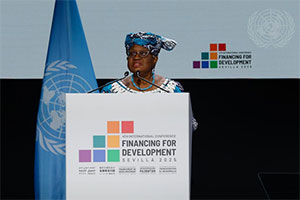 Opening of 4th International Conference on Financing for Development. Credit: UN Photo/Mariscal
International trade and investment are crucial elements of the world economy. While they can be powerful stimulators of development, they can also lead to global imbalances and dynamics of exploitation. In 2025, international trade entered a period of immense disruption, driven in part by a new wave of United States tariffs that reshaped global supply chains and investment flows. The increase in the US tariff rate, the highest since the 1930s, has forced bilateral renegotiations with global trading partners. Furthermore, the debt crisis in developing nations has accelerated while Official Development Assistance (ODA) has substantially dropped 7.3% in 2024.
In the 21st century, advancements in economic diversification in formerly colonized nations have propelled them into more central roles in the global economy. For example, both China and Mexico were able to develop their manufacturing sector and channel this development into booming export flows, thus advancing into the position of emerging economies. Foreign investment also plays an essential role in providing capital for developing countries, although they are oftentimes accompanied by social and environmental exploitation. For example, rising Chinese investments in natural resources in Latin America have often been met with tension as these investment projects fail to properly mitigate environmental risks and protect workers’ rights. In a more multifaceted vein, Sino-African relations have led to infrastructure development in Sub-Saharan Africa while also heightening the region’s economic dependency on China. IPS reports on global news in trade and investment, while shining a light on the nuanced nature of these endeavors.

The Week with IPS

NEXT STOP - SDGs
Tracking global progress towards a sustainable world
Tracking global progress towards a sustainable world
