Languages
Thursday, October 15, 2026



News and Views from the Global South
Trade & Investment

Making Tourism More Responsible
Long before Joy Daniels became the manager of a travel company she was cleaning rooms at a guesthouse. But after joining a Fair Trade-certified business, a place that valued its staff, in a few years she was soon promoted to manager.
Hospital PPPs Undermine Healthcare
Despite all the evidence to the contrary, and substantial opposition from community groups, public-private partnerships (PPPs) are still being promoted to deliver sustainable development. Public-private hospital partnerships are supposed to ensure that the private sector will offer much needed efficiency in healthcare provision.
Asia’s Landlocked
Structural economic transformation and the expansion of international trade are among the most pressing issues to be addressed, if Asia’s landlocked developing countries (LLDCs) are to overcome the development challenges related to their geographical locations.
A New Spectre is Haunting Europe
After Theresa May’s defeat in the British parliament it is clear that a new spectre is haunting Europe. It is no longer the spectre of communism, which opens Marx’s Manifesto of 1848; it is the spectre of the failure of neoliberal globalisation, which reigned uncontested following the fall of the Berlin Wall, until the financial crisis of 2009.
Why We Should Care about Vulnerable Coastal Communities
According to UN statistics, approximately 40 per cent of the world’s population lives within 100 kilometers of the coast, and overall the world’s coastal population is increasing faster than the total global population. At the same time, global warming is causing sea levels to rise and increasing extreme weather incidents on coastlines.
Gloom Ahead of World Economic Storm
In light of the uncertainty caused by the US-China trade war, the IMF expects the US economic growth to slow from a three-year high of 2.9 per cent in 2018 to 2.5 per cent in 2019, while China’s expansion has already slowed in recent years, albeit from much higher levels.
Blue Economy Can be a Lifeline for Africa
By efficient management, the sustainable exploitation of resources in oceans, seas, lakes and rivers—also known as the blue economy—could contribute up to $1.5 trillion to the global economy, according to the Organisation for Economic Cooperation and Development, an intergovernmental organization comprising of 36 countries.
A Closer Look at the World Bank’s Sizable China Portfolio
China continues to borrow an average of $2 billion a year from the World Bank, making it one of the Bank’s top borrowers—despite being the world’s second-largest economy and itself a major global lender, according to our study released today.
Rethinking Free Trade Agreements in Uncertain Times
After US President Donald Trump withdrew from Obama’s Trans-Pacific Partnership (TPP), involving twelve countries on the Pacific rim, on his first day in office, Japan, Australia and their closest allies proposed and promoted the Comprehensive and Progressive Trans-Pacific Partnership (CPTPP) to draw the US back into the region to counter China’s fast-growing power and influence.
Veterans of the Global Financial Crisis Pass their Wisdom on to the Next Generation
It happened again and again in a career punctuated by upheavals: the peso crisis of 1994, the Asian crisis of 1997, and finally, the big one—the global financial crisis of 2008.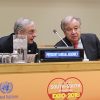
BAPA+40: An Opportunity to Reenergize South-South Cooperation
The upcoming conference on the Buenos Aires Plan of Action (BAPA+40), scheduled to take place in the Argentine capital on 20-22 March 2019, ought to be more than just another UN conference where the developing countries assemble to present their demands and seek support from the North.
What the COP24 Needs: A New Emerging Mindset
An alternative framework of international development and new forms of consumption of good/services are implicit in achieving the goals of UN climate conference recently held in Poland.
Taking Away the Ladder
The notion of the BRICS (Brazil, Russia, India, China, and later, South Africa) was concocted by Goldman Sachs’ Jim O’Neill. His 2001 acronym was initially seen as a timely, if not belated acknowledgement of the rise of the South. But if one takes China out of the BRICS, one is left with little more than RIBS. While the RIBS have undoubtedly grown in recent decades, their expansion has been quite uneven and much more modest than China’s, while the post-Soviet Russian economy contracted by half during Boris Yeltsin’s first three years of ‘shock therapy’ during 1992-1994.
New Science Shows Climate-Smart Farming is Within Reach
Until the United Nations climate talks in Bonn last year, no clear plan to include agriculture in climate negotiations existed. This was troubling, considering agriculture contributes 19-29% of global greenhouse gases, and changing temperatures are making it harder to farm. This is having an increasingly prominent effect on food security -- hunger levels have now risen for the third year in a row.
AI to map Chinese strikes
29 years ago, Han Dongfang survived the hail of bullets at Tiananmen Square. Now, he lives in Hong Kong and maps Chinese labour market strikes. Arbetet Global caught up with him at the ITUC World Congress in Copenhagen.
Big Business Capturing UN SDG Agenda?
Over the last two decades since the Global Compact, the United Nations has increasingly embraced the corporate sector, most recently to raise finance needed to achieve the Sustainable Development Goals (SDGs), i.e., for Agenda 2030. But growing big business influence has also compromised analyses, recommendations, policies and programme implementation, undermining the SDGs.
Indonesia Commits to Low Carbon Development and a Green Economy at COP24
Although Indonesia has attained decent economic growth of over five percent in the last decade, in order to ensure sustainable growth in the future the switch to renewable energy (RE) will be critical, says the country’s government.
The Revolution of Renewable Energy Needs Political Leadership
The cost of renewable energy is low, and at times, less than fossil fuels. What are the barriers to switching to renewables? Where current energy systems exist, they will need to be upgraded to be able to draw power from modern renewables and to exploit storage solutions that they require.
Q&A: Creating an African Bamboo Industry as Large as China’s
The bamboo industry in China currently comprises up to 10 million people who make a living out of production of the grass. But while the Asian nation has significant resources of bamboo — three million hectares of plantation and three million hectares of natural forests — the continent of Africa is recorded to have an estimated three and a half million hectares of plantations, excluding conservation areas.
Havana Charter’s Progressive Trade Vision Subverted
In criticizing the ‘free trade delusion’, UNCTAD’s 2018 Trade and Development Report proposes an alternative to both reactionary nationalism, recently revived by President Trump, and the corporate cosmopolitanism of neoliberal multilateral discourse in recent decades by revisiting the Havana Charter on its 70th anniversary.
Mobile Phones Exposed to Growing Cyber Threats
Mobile phones are helping millions of low-income customers to access financial services for the first time, but they are also exposing them to new cyber threats they could never have imagined.« Previous Page — Next Page »





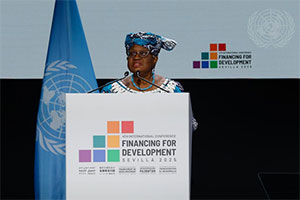 Opening of 4th International Conference on Financing for Development. Credit: UN Photo/Mariscal
International trade and investment are crucial elements of the world economy. While they can be powerful stimulators of development, they can also lead to global imbalances and dynamics of exploitation. In 2025, international trade entered a period of immense disruption, driven in part by a new wave of United States tariffs that reshaped global supply chains and investment flows. The increase in the US tariff rate, the highest since the 1930s, has forced bilateral renegotiations with global trading partners. Furthermore, the debt crisis in developing nations has accelerated while Official Development Assistance (ODA) has substantially dropped 7.3% in 2024.
In the 21st century, advancements in economic diversification in formerly colonized nations have propelled them into more central roles in the global economy. For example, both China and Mexico were able to develop their manufacturing sector and channel this development into booming export flows, thus advancing into the position of emerging economies. Foreign investment also plays an essential role in providing capital for developing countries, although they are oftentimes accompanied by social and environmental exploitation. For example, rising Chinese investments in natural resources in Latin America have often been met with tension as these investment projects fail to properly mitigate environmental risks and protect workers’ rights. In a more multifaceted vein, Sino-African relations have led to infrastructure development in Sub-Saharan Africa while also heightening the region’s economic dependency on China. IPS reports on global news in trade and investment, while shining a light on the nuanced nature of these endeavors.

The Week with IPS

NEXT STOP - SDGs
Tracking global progress towards a sustainable world
Tracking global progress towards a sustainable world
