Languages
Monday, October 19, 2026



News and Views from the Global South
Trade & Investment

OPINION: Greece, the Punching Ball of Germany
Greece is again in the media, because a new negotiation is due between the embattled country and its creditors. The North-South divide of Europe is coming back with force (while the East-West relationship is increasingly looking as beyond repair). The German minister of Finance, Wolfgang Schäuble , has come back with his peculiar view of the economy as a branch of moral and ethical discipline, and not as a reading of reality. He has asked the Greeks “to not get distracted” by the refugees crisis, and not forget their primary task, which is to pay their debt. The request is to cut 2% of the Gross National Product; in case there will not be a 3.5% budget surplus within 2018.
Widening the STI Net for Implementation of the Sustainable Development Agenda
Investment in science, technology and innovation (STI) needs to be the backbone of productivity-led economic recovery and sustainable development. Despite significant increases in productivity over the past few decades, economic growth in developing economies of Asia and the Pacific has been primarily driven by factor accumulation. However, the average rate of productivity growth slowed between 2000-2007 and 2008-2014 by 65%, which has contributed to the economic slowdown and can undermine efforts to effectively pursue the 2030 Agenda for Sustainable Development. We must revive growth in productivity, one of the keys to which is a highly-skilled labor force.
Hunger, a Matter of Global Security
Desperate, frustrated, and with little hope for the future, on 17h December 2010, the Tunisian Mohamed Bouazizi doused himself in petrol and set himself alight. Thus began the popular revolution that toppled the dictatorship of Zine El AbidineBen Ali, in power since 1987, and with it a domino effect that spread across North Africa and the Middle East.
Climate Change Leaves Kashmir’s Economy High and Dry
Trudging barefoot on his two-acre piece of land, 57-year-old Mukhtar Ahmad has little hope of growing any crops this year due to the sudden dry spell that has struck Kashmir’s winter.
WFO Calls for Farmer-Centred Sustainable Development
Over 600 delegates representing at least 570 million farms scattered around the world gathered in Zambia from May 4-7 under the umbrella of the World Farmers' Organisation (WFO) to discuss climate change, land tenure, innovations and capacity building as four pillars on which to build agricultural development.
Farmers Can Weather Climate Change – With Financing
Merian Kalala, a farmer in Solwezi, capital of the North-Western Province of Zambia, knows firsthand that climate change is posing massive problems for agricultural productivity.
No Farmers, No Food — True But Not Enough
Agriculture is the primary sector of all economies. It is the sector responsible for granting food and nutrition security to all human beings. Consequently it is responsible for social stability and health. And it provides work opportunities to families, men, women and youth, and largely contributes to the country Gross Domestic Product (GDP).
An Inclusive and Sustainable Approach to Rural Electrification in India: Case of Decentralized Renewable Systems
The Declaration of 2014- 2024 as the ‘Decade of Sustainable Energy for All’ by the United Nations (UN) is a clear manifestation of the importance attached to energy in the process of development. Setting ‘Universal Access to Energy’ as one of the goals of UN’s ‘SE4All’ initiative is reiteration of the fact that access to energy constitutes an essential ingredient in the process of economic development of any country. This underscores the complex and inextricable link that exists between energy and sustainable development.
Farmers Hold Keys to Ending Poverty, Hunger, FAO Says
With recent data showing that 793 million people still go to bed hungry, ending hunger and poverty in 15 years is the next development challenge that world leaders have set for themselves.
Seeking a New Farming Revolution
As the World Farmers' Organization meets for its annual conference in Zambia to promote policies that strengthen this critical sector, IPS looks at how farmers across the globe are tackling the interconnected challenges of climate change, market fluctuations, water and land management, and energy access.
The Waves of the Pacific Are on Chile’s Energy Horizon
Chile, a country with 6,435 km of Pacific Ocean coast line, could find in wave and tidal power a solution to its need to diversify its energy mix.
World Farmers’ Organisation Meeting Eyes New Markets, Fresh Investment
‘No Farmer, No Food’ is an old slogan that the Zambia National Farmers’ Union still uses. Some people consider it a cliché, but it could be regaining its place in history as agriculture is increasingly seen as the answer to a wide range of the world’s critical needs such as nutrition, sustainable jobs and income for the rural poor.
Opinion: Increasing Productivity Key to Revive Growth and Support Sustainable Development in Asia and the Pacific
The Asia-Pacific region’s successful achievement of the 2030 Agenda for Sustainable Development needs to be driven by broad-based productivity gains and rebalancing of economies towards domestic and regional demand. This is the main message of the Economic and Social Survey of Asia and the Pacific 2016, published today by the Economic and Social Commission for Asia and the Pacific. Such a strategy will not only underpin the revival of robust and resilient economic growth, but also improve the quality of growth by making it more inclusive and sustainable.
The Hypocrisy of the West and Fiscal Paradise
The publication of the Panama Papers has now been digested, like any scandal, after just a few days. We are now getting so accustomed to scandals, that it is confusing, and the general public reaction often is: all are corrupt and politics is all about corruption.
G-77 Should Adopt South-South Climate Change Program of Action: Ambassador Djoghlaf
The 134 members of the Group of 77 and China (G-77) made their mark on the Paris Climate Change Agreement and should now adopt a program of action to implement it, Ambassador Ahmed Djoghlaf told IPS in a recent interview.
Boosting the Future of the Food Movement
Investing in new entrepreneurs who bring a holistic approach to food sustainability is one way that the food movement can overcome mounting global challenges from environmental degradation to food waste.
Panorama of Perfidy in the Panama Papers
Ever since the Panama Papers hit the fan, the leak has been working like a series of introductions at a high-profile gathering. It's putting a bunch of names to a bunch of faces, men and women leading a double life because of their money. It also shows that these folks have something in common with the squirrels. The rodents hide their nuts, and they hide their assets.
Opinion: Panama, Secrecy and Tax Havens
Unlike Wikileaks’ exposes, the recent Panama revelations were quite selective, targeted, edited and carefully managed. Most observers attribute this to the political agendas of its mainly American funders. Nevertheless, the revelations have highlighted some problems associated with illicit financial flows, as well as tax evasion and avoidance, including the role of enabling governments, legislation, legal and accounting firms as well as shell companies.
OPINION: Breaking the Grip of Rimbunan Hijau over Papua New Guinea
James Sze Yuan Lau and Ivan Su Chiu Lu must be extremely busy men. Together, they are listed as directors of some 30 companies involved in various activities and services related to logging or agribusiness in Papua New Guinea (PNG). The former is the managing director of Rimbunan Hijau (RH) PNG and son-in-law of RH’s founder Tiong Hiew King; the latter is executive director of RH PNG Ltd.. All but two of these 30 companies have the same registered address at 479 Kennedy Road, in the national capital, Port Moresby–the headquarter of the RH group in the country.
Opinion: The Empire’s New Clothes? Conjuring Growth from the TPP
While the main US motivation for the Trans Pacific Partnership (TPP) has been to counter China’s influence in the region, it has also been used to undermine the Doha ‘Development’ Round of trade negotiations to better advance politically influential US corporate interests. Hence, it has become all the more necessary to legitimize the TPP in terms of its ostensible benefits. Touted as a ‘gold standard’ 21st century trade deal, it is nonetheless necessary to ascertain what gains can really be expected and whether these exceed its costs.
Developing countries left out of global tax decisions
Over one hundred developing countries continue to be left out of global tax cooperation negotiations despite leaks such as the Panama papers showing the high cost of tax avoidance.« Previous Page — Next Page »





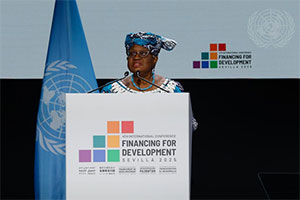 Opening of 4th International Conference on Financing for Development. Credit: UN Photo/Mariscal
International trade and investment are crucial elements of the world economy. While they can be powerful stimulators of development, they can also lead to global imbalances and dynamics of exploitation. In 2025, international trade entered a period of immense disruption, driven in part by a new wave of United States tariffs that reshaped global supply chains and investment flows. The increase in the US tariff rate, the highest since the 1930s, has forced bilateral renegotiations with global trading partners. Furthermore, the debt crisis in developing nations has accelerated while Official Development Assistance (ODA) has substantially dropped 7.3% in 2024.
In the 21st century, advancements in economic diversification in formerly colonized nations have propelled them into more central roles in the global economy. For example, both China and Mexico were able to develop their manufacturing sector and channel this development into booming export flows, thus advancing into the position of emerging economies. Foreign investment also plays an essential role in providing capital for developing countries, although they are oftentimes accompanied by social and environmental exploitation. For example, rising Chinese investments in natural resources in Latin America have often been met with tension as these investment projects fail to properly mitigate environmental risks and protect workers’ rights. In a more multifaceted vein, Sino-African relations have led to infrastructure development in Sub-Saharan Africa while also heightening the region’s economic dependency on China. IPS reports on global news in trade and investment, while shining a light on the nuanced nature of these endeavors.

The Week with IPS

NEXT STOP - SDGs
Tracking global progress towards a sustainable world
Tracking global progress towards a sustainable world
