Languages
Sunday, October 18, 2026



News and Views from the Global South
Trade & Investment

The Idiocy of Things Requires an “Information Habeas Corpus”!
Today we are saturated with media hype about the joys of information and communication technology (ICT). We will all be connected, all the time, by the Idiocy of Things (IoT )devices and our social media, all converging in the cloud. Our lives will be monitored by smart sensors in homes with smart refrigerators, toasters, TVs, doorbells, alarm systems, garages, cars and electricity meters. We are bombarded with ads showing us how all these smart devices will improve our lives and health, bringing ever greater convenience. Driverless cars will be safer, allowing us to read, monitor our kids or enjoy the scenery. All this ICT and automation is already a multi-billion dollar industry and its producers are salivating over its growth and profits. Individual privacy rights and security concerns seem to be an afterthought.
African Leaders Make an Economic Case for Increased Nutrition Investments
Africa’s contribution to global malnutrition statistics is miserably high, with 58 million children under the age of five said to be too short for their age, while 13.9 million weigh too little for their height.
Achieving Universal Access to Energy; Africa Caught Between a Rock and a Hard Place
“It is unacceptable that 138 years after Thomas Edison developed the light bulb, hundreds of millions of people cannot have access to electricity to simply light up the bulb in Africa,” says Africa Development Bank (AfDB) Group President, Akinwumi Adesina, mourning the gloomy statistics showing that over 645 million people in Africa lack access to electricity, while over 700 million are without clean energy for cooking.
New International Accord to Tackle Illegal Fishing
A new international accord to tackle illegal and under-reported fishing will come into force on June 5.
Conjuring Growth from the Trans-Pacific Partnership TPP
It is now generally agreed that the Trans-Pacific Partnership (TPP) has served US foreign policy objectives well. For this purpose, the Peterson Institute of International Economics (PIIE) has provided the fig-leaf for the empire’s new clothes with exaggerated projections of supposed growth gains from the TPP.
Least Developed Countries Still Face Significant Challenges
Since the establishment of the Least Developed Countries (LDCs) category in 1971, the international community has worked hand in hand to support its most vulnerable members.The Caracas Crunch
After Uruguay`s former president José Mujica last week declared that Nicolás Maduro was `mad as a goat`, the latter chose to wear the insult as a badge of honour, announcing at a rally: `Yes, I`m as mad as a goat, it`s true. I`m mad with love for Venezuela, for the Bolivarian revolution, for Chavez and his example.
Water Woes Put a Damper on Myanmar’s Surging Economy
The central plains of Myanmar, bordered by mountains on the west and east, include the only semi-arid region in South East Asia – the Dry Zone, home to some 10 million people. This 13 percent of Myanmar’s territory sums up the challenges that the country faces with respect to water security: an uneven geographical and seasonal distribution of this natural resource, the increasing unpredictability of rain patterns due to climate change, and a lack of water management strategies to cope with extreme weather conditions.
Bangladeshi Shrimp Farmers See Big Money in Small Fry
Frozen tiger shrimp exports from Bangladesh, mainly to the United States and the European Union, have grown substantially over the years and the demand keeps increasing.Middle-Class Ethos
The middle class is viewed as a positive force for progress given its higher education, mobility and wealth. But this view is based on its role in developed states in fostering egalitarian progress, democracy and the rule of law by initiating social movements.
Natural Capital Investment Key to Africa’s Development
Plugging Africa’s funding gaps to accelerate social and economic development requires a fresh approach to using its natural capital, environment experts said on Monday.
Is it in Europe’s Interest to Push Russia into China’s Arms?
No mention in the media of the dangerous increase in the tension between Europe and Russia and yet Nato has just made operational in Romania a missile system, the ABM, which the United States has declared will protect it from “rogue” states, like Iran.
Will Canada Recognise Rights of Indigenous Peoples in Developing Countries Too?
While Canada’s long-awaited support for the UN Declaration on the Rights of Indigenous Peoples brought hope and celebration last week, it's not yet clear whether the rights of Indigenous people in developing countries harmed by Canadian mining companies will also be included.Dollars and Sense
There is only one way of dealing with corruption. Make it legal. Better still, make it mandatory. Why should the poor be denied opportunities the corrupt enjoy with such insouciant impunity? Corruption is the pestilence that leaves pockmarks of a Clive, a Capone, a Noriega, a Suharto, a Marcos, a Duvalier, an Abramovich.What`s Next for Nawaz Sharif?
Nawaz Sharif`s much-awaited speech in the National Assembly was as unconvincing as his two previous addresses to the nation. It was the same detail of family business and tale of persecution.
Is Demise of Small Farmers Imminent?
Imminent demise of small farmers is predicted as they are not competitive in a context of transforming agrifood markets. Most important is the transformation of the "post–farm gate" segments of the supply chains.
Bees and Silkworms Spin Gold for Ethiopia’s Rural Youth
Beekeeping and silkworm farming have long been critical cogs of Ethiopian life, providing food, jobs and much needed income.
The Crippling Burden of Mounting Foreign Debt Servicing Costs
The massive increase in the country’s foreign debt and its huge debt servicing costs are a severe burden on the economy. They are a severe strain on the public finances and external reserves of the country.
Justice for Berta Caceres Incomplete Without Land Rights: UN Rapporteur
The murder of Honduran Indigenous woman Berta Caceres is only too familiar to Victoria Tauli-Corpuz, the UN’s Special Rapporteur on the Rights of Indigenous Peoples.Increasing Economic Inequality Not Inevitable
Since the 1980s, the world has been moving once again to the greatest level of national level income inequalities observed in recorded human history. A study by the Credit Suisse Research Institute suggested that the income share of the rich has increased at the expense of the ‘middle class’ in most of the world.
Breastfeeding Saves Lives But Can’t Compete With Aggressive Marketing
Despite its many lifesaving benefits breastfeeding still struggles to compete with the marketing used by the multi-billion dollar baby formula industry, according to a new report published this week.« Previous Page — Next Page »





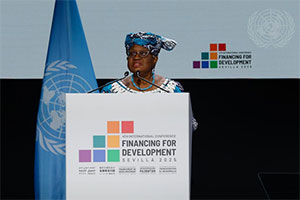 Opening of 4th International Conference on Financing for Development. Credit: UN Photo/Mariscal
International trade and investment are crucial elements of the world economy. While they can be powerful stimulators of development, they can also lead to global imbalances and dynamics of exploitation. In 2025, international trade entered a period of immense disruption, driven in part by a new wave of United States tariffs that reshaped global supply chains and investment flows. The increase in the US tariff rate, the highest since the 1930s, has forced bilateral renegotiations with global trading partners. Furthermore, the debt crisis in developing nations has accelerated while Official Development Assistance (ODA) has substantially dropped 7.3% in 2024.
In the 21st century, advancements in economic diversification in formerly colonized nations have propelled them into more central roles in the global economy. For example, both China and Mexico were able to develop their manufacturing sector and channel this development into booming export flows, thus advancing into the position of emerging economies. Foreign investment also plays an essential role in providing capital for developing countries, although they are oftentimes accompanied by social and environmental exploitation. For example, rising Chinese investments in natural resources in Latin America have often been met with tension as these investment projects fail to properly mitigate environmental risks and protect workers’ rights. In a more multifaceted vein, Sino-African relations have led to infrastructure development in Sub-Saharan Africa while also heightening the region’s economic dependency on China. IPS reports on global news in trade and investment, while shining a light on the nuanced nature of these endeavors.

The Week with IPS

NEXT STOP - SDGs
Tracking global progress towards a sustainable world
Tracking global progress towards a sustainable world
